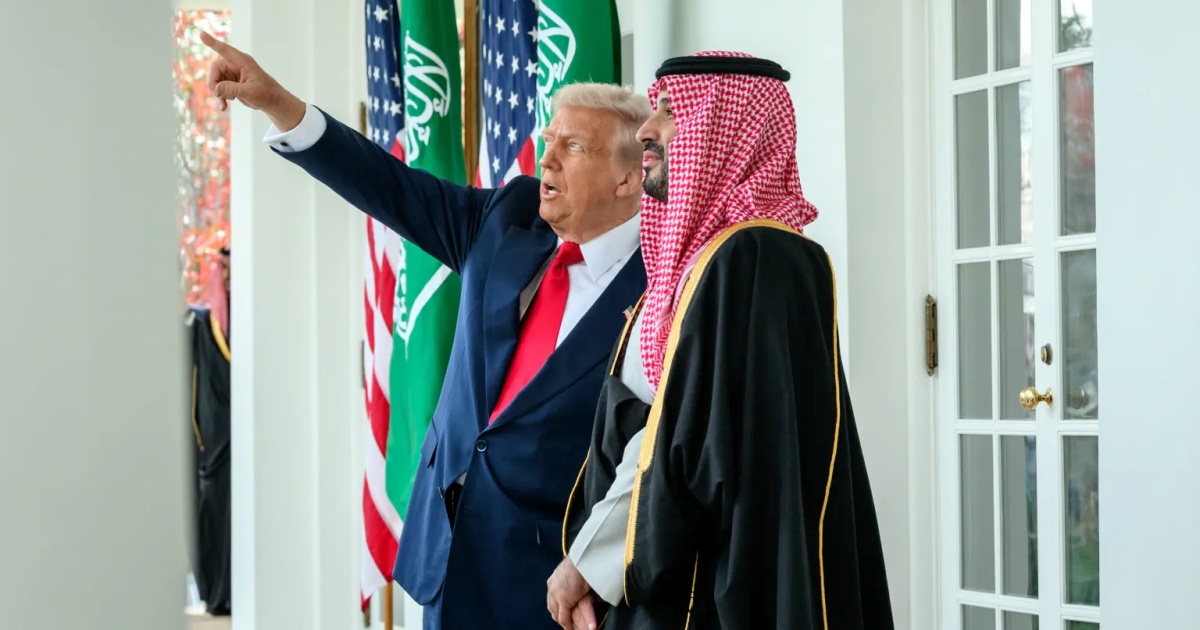
On Thursday, Donald Trump introduced an unexpected twist to the civil nuclear cooperation agreement signed just a day earlier between Washington and Riyadh. He stated that its final approval hinges on Saudi Arabia normalizing relations with Israel and joining the Abraham Accords.
Trump announced this condition via a message on his Truth Social platform, where he also clarified that the agreement does not entail uranium enrichment on Saudi soil.
"The civil nuclear energy agreement—which will not include material enrichment—currently under negotiation between the U.S. Department of Energy and Saudi Arabia is strictly for non-military purposes, akin to those in Iran and the UAE. It will be approved, but only if Saudi Arabia adheres to the highly regarded Abraham Accords," Trump wrote.
Understanding the "123 Agreement"
The "123 Agreement," a technical term derived from Section 123 of the United States Atomic Energy Act, was signed on Wednesday by Energy Secretary Chris Wright and Saudi Minister Abdulaziz bin Salman. The pact, valued at billions and set to last 30 years, allows U.S. companies—such as Westinghouse Electric—to develop Saudi Arabia's civilian nuclear infrastructure.
Previously, officials within the Trump administration hinted that the agreement left open the possibility for Saudi Arabia to enrich uranium domestically, following a joint feasibility study over two years. This concession raised alarms among non-proliferation experts, a notion Trump refuted with his Thursday statement.
The Abraham Accords: A Path to Diplomacy
The Abraham Accords represent a diplomatic normalization framework between Israel and several Arab nations initiated by Trump during his first term. The founding declaration was signed on September 15, 2020, by Israel, the UAE, Bahrain, and the United States, with Morocco joining later that December, followed by Sudan's non-full ratification.
Saudi Arabia has not joined this framework, maintaining that recognition of Israel will only occur with a credible path to an independent Palestinian state based on the 1967 borders, with East Jerusalem as its capital.
Reactions Across the Globe
Israeli Prime Minister Benjamin Netanyahu lauded Trump's condition, stating that Saudi Arabia joining the Abraham Accords would be a historic advance for Middle East peace. He emphasized the opportunity to expand the "circle of peace" following recent conflicts with Iran.
Secretary of State Marco Rubio supported the presidential stance, asserting that any nuclear agreement will include safeguards to prevent a weapons program.
Conversely, Senator Bernie Sanders criticized Trump's coherence, highlighting the contradiction in opposing Iran's nuclear enrichment while permitting it with Saudi Arabia, a nation known for its authoritarian regime.
Concerns Over Regional Nuclear Proliferation
The agreement comes amidst ongoing U.S. military actions against Iran, a strategic rival to Saudi Arabia, involving strikes on Iranian nuclear facilities. Experts warn that a Saudi nuclear program could trigger a regional proliferation chain. Henry Sokolski, the executive director of the Nonproliferation Policy Education Center, stressed the danger of such developments, suggesting that UAE, Turkey, and Egypt might follow suit.
On the contrary, Jennifer T. Gordon of the Atlantic Council viewed the pact as a strategic win for the U.S. over Russia and China, arguing it secures Saudi collaboration with Western allies.
Congress is set to review the agreement, but overturning it would require a two-thirds majority to bypass a potential presidential veto, rendering its rejection unlikely while Republicans control the chamber.
Key Questions on the Saudi Nuclear Agreement
What is the significance of the Abraham Accords for Saudi Arabia?
The Abraham Accords are pivotal as they could lead to Saudi Arabia normalizing relations with Israel, a critical step for regional peace and cooperation.
Why is uranium enrichment a contentious issue in the Saudi nuclear deal?
Uranium enrichment is controversial because it can lead to the development of nuclear weapons, raising proliferation concerns in an already volatile region.
How does the "123 Agreement" affect U.S.-Saudi relations?
The "123 Agreement" strengthens U.S.-Saudi ties by enabling American companies to participate in Saudi Arabia's nuclear infrastructure development, fostering economic and strategic partnerships.