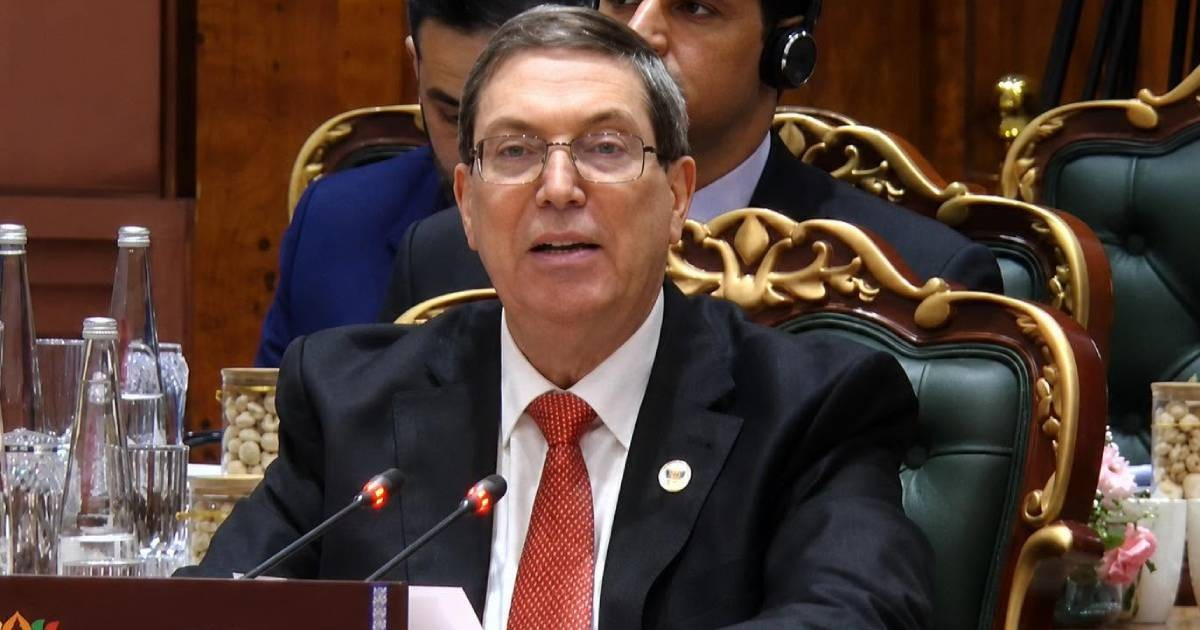
Bruno Rodríguez Parrilla, Cuba's Foreign Minister, reacted on Thursday to the latest series of sanctions imposed by the United States on the Cuban government. He accused Washington of using these actions to enforce a "collective punishment" on the island's people, aiming to initiate a "humanitarian crisis."
The sanctions, introduced by the State Department under Executive Order 14404—signed by President Donald Trump on May 1, 2026—target nine entities and two senior officials associated with the energy sector, the military conglomerate GAESA, and the international medical missions program.
"Every act of aggression by the U.S. government, like the measures announced on July 23 by the Secretary of State, shows that the aim is to impose collective punishment on the entire Cuban population," Rodríguez expressed on his X account.
The foreign minister went further, alleging that Washington seeks to hide "its genocidal intentions and the goal of sparking a humanitarian crisis," which stands in stark contrast to the State Department's official stance. The department maintains that "the ultimate objective of the sanctions is not to punish, but to encourage positive change in the Cuban regime's behavior."
International Medical Missions Under Fire
One of the main targets of the new sanctions is Cuba's international medical missions program, which the United States describes as a form of forced labor and human trafficking.
Washington sanctioned Comercializadora de Servicios Médicos Cubanos S.A. (CSMC), the Central Unit for Medical Cooperation (UCCM), as well as the Minister of Public Health, José Ángel Portal Miranda, and UCCM's director, Gretza Sánchez Padrón.
The State Department claims the Cuban government retains between 50% and 95% of the salaries paid by host countries for the services of Cuban health professionals.
Rodríguez dismissed these allegations, defending the program as a gesture of international cooperation. "The attack on Cuban medical cooperation equates to an assault on the human right to access health services for hundreds of thousands of people worldwide," he stated.
Wider Impact on Energy and GAESA
The new U.S. measures also tighten the hold on Cuba's energy sector by including CEINPET, ENERSA S.A., and EINARBO S.A. Additionally, they increase pressure on the military conglomerate GAESA.
In this context, CEIBA Investments Limited and ORBIT S.A., a remittance processing company considered by Washington to be under GAESA's control, were sanctioned.
The State Department also highlighted the transfer of the Port of Mariel's management to Coral Marítima S.A. in mid-June as a sanction-evasion example. This move, according to the U.S., aimed to shield the military conglomerate's assets from existing restrictions.
Cuba's Consistent Response
This announcement marks the fifth set of sanctions imposed by the Trump administration on the Cuban regime since Executive Order 14404 came into effect.
Bruno Rodríguez has publicly responded to each of these sanctions packages. On July 13, he labeled a previous round of sanctions as "criminal and genocidal" and, weeks earlier, announced that Cuba would request a special session of the United Nations General Assembly to denounce the tightening of U.S. sanctions.
With his latest statement, the foreign minister continues the Cuban government's usual rhetoric, blaming the embargo and U.S. sanctions for the island's ongoing crisis. Meanwhile, Washington contends that the measures aim to restrict the financial resources of the regime's political, military, and repressive apparatus.
Understanding the Impact of U.S. Sanctions on Cuba
What are the new U.S. sanctions against Cuba?
The latest U.S. sanctions target nine entities and two senior officials linked to the energy sector, military conglomerate GAESA, and international medical missions program, as part of efforts to pressure the Cuban regime.
Why does the U.S. sanction Cuba's international medical missions?
The U.S. considers Cuba's international medical missions as forced labor and human trafficking, claiming the Cuban government retains a large portion of the salaries earned by health professionals abroad.
How has Cuba responded to the ongoing sanctions?
Cuba, through Foreign Minister Bruno Rodríguez, has consistently criticized the U.S. sanctions, labeling them as acts of collective punishment and attributing the island's crisis to these measures.