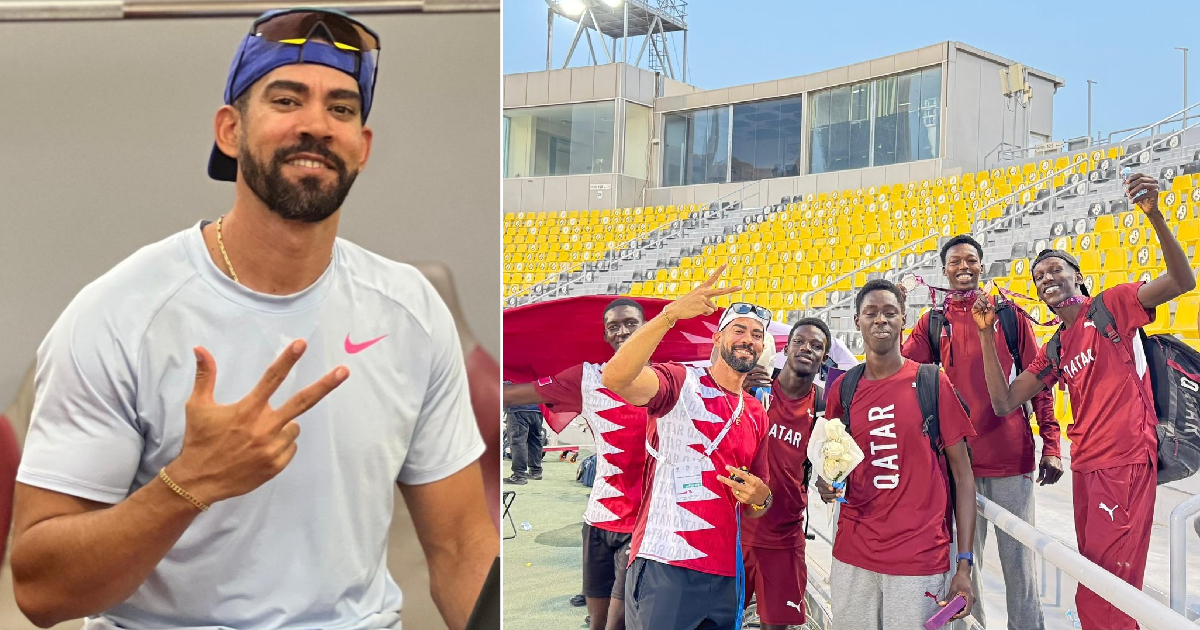
There was a time when Yasmani Copello's lean and flexible figure seemed to defy the stopwatch. Each stride was a blend of power, grace, and precision; each hurdle, a mere challenge for this runner who made the 400-meter hurdles the stage for his greatest triumphs. Although he no longer chases medals on the track, the passion that propelled him to the top remains undiminished.
From the Khalifa Stadium in Qatar, Copello now channels his experience into coaching, convinced that real victory lies not in crossing the finish line first, but in preparing those who will. Balancing fatherhood and his newfound role as a coach, the champion embarks on a different journey, where legacy matters more than any podium finish.
New Beginnings: Embracing Fatherhood and Coaching
It's a pleasure to catch up with Yasmani Copello, who recently became a father—congratulations, champion! "The pleasure is mine," he responds, "Yes, I'm a father to a boy named Ares. He's the greatest blessing in my life. His mother, Elif, is very happy. She has been my driving force in achieving everything we have today, and as a mother, she is wonderful."
Personally, I feel great. I wouldn't change a thing. I'm still involved in what I love most, which is athletics, but now from a different perspective: as a coach.
Transitioning from Athlete to Mentor
When did you decide to retire from active sports? "I retired after the 2024 Paris Olympics. I was utterly exhausted both physically and mentally. It was a tough and heartbreaking decision because it meant leaving behind something I loved the most: competing."
How did your journey as a coach in Qatar begin? "I started coaching in mid-2024, even while I was still active as an athlete. I would finish my training sessions and immediately move on to coach my athletes because that's how this profession works—right there on the field."
Currently, I coach eight athletes. Six of them qualified for the Junior World Championships in Oregon, USA, this August, although only three can attend. I primarily focus on the 400 meters and 400-meter hurdles events.
Among the standout athletes is "Zeze"—as I call him, since Arabic names are a bit challenging for me. Last year, he became the Asian under-16 champion with a time of 51.26 seconds. Faisal, another promising athlete, was the Asian under-18 runner-up with a time of 50.54 seconds.
What's remarkable is that many of these young talents never went through a school sports system like in Cuba; most were recruited from soccer.
Qatar's Commitment to Athletic Excellence
How do you assess the training conditions in Qatar? "Qatar has made significant strides in offering opportunities to young coaches and experienced athletes like myself to boost the development of sports—specifically athletics in my case—and elevate its level."
We train at the Khalifa Stadium, the same venue that hosted the 2019 World Athletics Championships. It's a spectacular facility, impeccably maintained over time, providing everything needed to perform at the highest level.
Reflections on Cuban Track and Field and Future Aspirations
You trained under the Cuban sports system before representing Turkey internationally. How do you see Cuban track and field performing at Los Angeles 2028? "I was trained in the Cuban sports system, which laid the foundation for my development as an elite athlete. Although I later represented Turkey, Cuba remains competitive, winning medals in world championships and achieving good results in the Diamond League, especially in jumping events."
In races, the outlook is more modest, not quite reaching the heights Cuba historically enjoyed. Nonetheless, I believe that at the Los Angeles Olympics, if everything goes smoothly and Cuba competes without issues in the United States, there will be real medal chances, particularly in triple jump and long jump, given the strong tradition in these specialties."
Achieving Excellence in the 400-Meter Hurdles
The 400-meter hurdles demand a unique combination of speed, endurance, and technique. What does it take to excel? "The 400-meter hurdles is a highly complex event. It requires blending speed, endurance, strength, and precise technique. Striking that balance is challenging and demands extensive study, planning, and experience. This is something I continue to learn more about in my new role as a coach."
After being an Olympic and world medalist, what legacy do you wish to leave as a coach? "Rather than just developing top athletes, I aspire to nurture good people. My greatest legacy would be to educate my athletes not only for sports but also for life. With a solid human foundation, they'll be better prepared to reach the international elite and achieve great results."
Finally, do you have any messages you'd like to share? "Yes, I'd like to send a special greeting to my family, especially my parents, who are the source of the strength I possess. I also want to thank everyone who contributed to my sports growth... Thank you all so much!"
We don't bid farewell to the athlete or the coach, as the echo of a life built on effort, humility, and love lingers. Behind every medal was a family, parents, a dream, and many helping hands. Now, that legacy continues by shaping good human beings before champions. Thank you for sharing your story, your heart, and reminding us that true greatness always leaves a mark.
Understanding Yasmani Copello's Path and Legacy
What inspired Yasmani Copello to transition from athlete to coach?
Yasmani Copello was inspired to become a coach after retiring from active competition, as he wanted to share his experience and knowledge with a new generation of athletes.
How has Qatar supported the development of athletics?
Qatar has invested in providing opportunities for young and experienced coaches to enhance the country's sports development, offering excellent facilities like the Khalifa Stadium for training.
What is Yasmani Copello's coaching philosophy?
Yasmani Copello focuses on developing his athletes as both outstanding sportspeople and good individuals, emphasizing a well-rounded education that prepares them for life beyond sports.