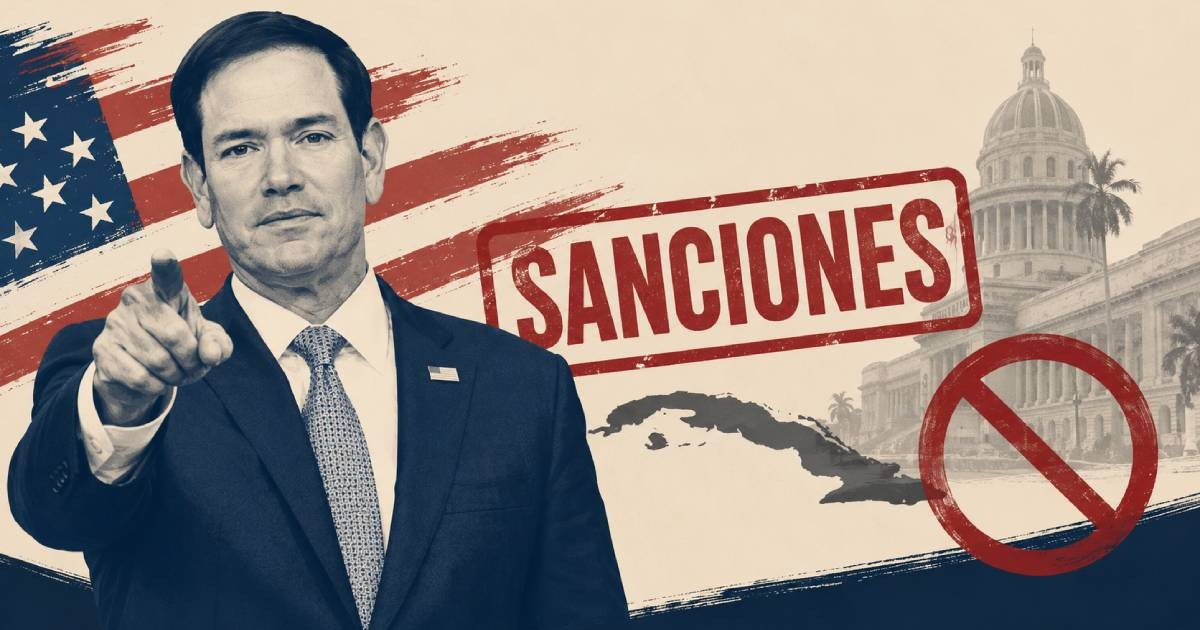
On Thursday, U.S. Secretary of State Marco Rubio followed through on a commitment he has reiterated since May: to sustain and escalate pressure on the Cuban regime until political and economic changes are realized. His latest move involved announcing a fresh series of sanctions targeting nine entities and two senior officials, aimed at undermining three strategic pillars of power on the island: GAESA, the energy sector, and the overseas medical missions program.
These new sanctions were enacted under Executive Order 14404, signed by former President Donald Trump on May 1, 2026, which authorizes penalties against individuals and entities linked to repression in Cuba and activities deemed a threat to U.S. national security.
“The Cuban communist regime continues to exploit its people and acts as the primary sponsor of radical leftism and political violence in our hemisphere,” stated Rubio as he announced the measures.
Targeting GAESA's Economic Influence
A significant portion of these sanctions once again focus on GAESA, the military conglomerate that controls much of Cuba’s economy and which Washington accuses of attempting to circumvent U.S. restrictions by reorganizing its businesses.
The State Department highlighted, for instance, the transfer of management of the Port of Mariel to Coral Marítima S.A., a move made in June that, according to Washington, aimed to shield the conglomerate's assets from sanctions.
As a result, entities such as Terminal de Contenedores de Mariel S.A., Coral Marítima S.A., CEIBA Investments Limited, and ORBIT S.A., a remittance processing company, have been designated by the U.S. government, which suspects them of being controlled by GAESA.
Energy Sector Under Scrutiny
The sanctions also extend to the Centro de Investigaciones del Petróleo S.A. (CEINPET), the research arm of the already-sanctioned CUPET, as well as ENERSA S.A. and EINARBO S.A., companies involved in importing gas and lubricants. Washington asserts that these entities are integral to the infrastructure supporting the regime's energy system.
Medical Missions Program Faces Renewed Pressure
The new round of sanctions further impacts the export program of medical services, which the United States labels as a form of forced labor and human trafficking.
Sanctioned entities include the Comercializadora de Servicios Médicos Cubanos S.A. (CSMC) and the Unidad Central de Cooperación Médica (UCCM), along with the Minister of Public Health, José Ángel Portal Miranda, and UCCM Director Gretza Sánchez Padrón.
According to the State Department, the Cuban regime withholds between 50% and 95% of the wages that host countries pay for the services of Cuban doctors.
These sanctions represent a continuation of a strategy that Rubio outlined from the beginning of Executive Order 14404's implementation.
On May 7, after initially sanctioning GAESA and Moa Nickel S.A., the Secretary of State warned that the Trump administration “will continue taking measures until the regime adopts all necessary political and economic reforms.”
Eleven days later, on May 18, sanctions were expanded to 11 senior regime officials, the Directorate of Intelligence (DGI), and other state agencies, with a new warning: “Additional sanctions actions should be expected in the coming days and weeks.”
Rubio fulfilled that promise again on June 11, when he sanctioned CUPET, labeling the state oil company as one of the primary tools used by the regime to sustain its repressive apparatus.
At that time, he stated, “We will continue to attack the communist regime's ability to use its energy trade to promote its corrupt agenda and violently suppress the Cuban people.”
The latest designations come just days after the State Department released the report “Cuba: The Capital of 21st Century Communism,” a 100-page document detailing seven decades of Cuban subversion, which Rubio explicitly cited as the context for the new measures.
With these sanctions announced on Thursday, the Trump administration adheres to the roadmap Rubio has championed in recent months: progressively increasing economic pressure on the main income sources of the Cuban regime and on the bodies that, according to Washington, uphold its political, military, and repressive apparatus.
FAQs on U.S. Sanctions Against Cuba
What is the purpose of the U.S. sanctions against Cuba?
The U.S. sanctions aim to pressure the Cuban regime into making political and economic reforms by targeting key sectors that support its power structure.
Who are the main targets of the latest sanctions?
The latest sanctions target GAESA, the energy sector, and the medical missions program, along with nine entities and two senior officials associated with these areas.
How does the U.S. describe Cuba's medical missions program?
The U.S. describes Cuba's medical missions program as a form of forced labor and human trafficking, claiming that the regime retains a significant portion of the doctors' wages.