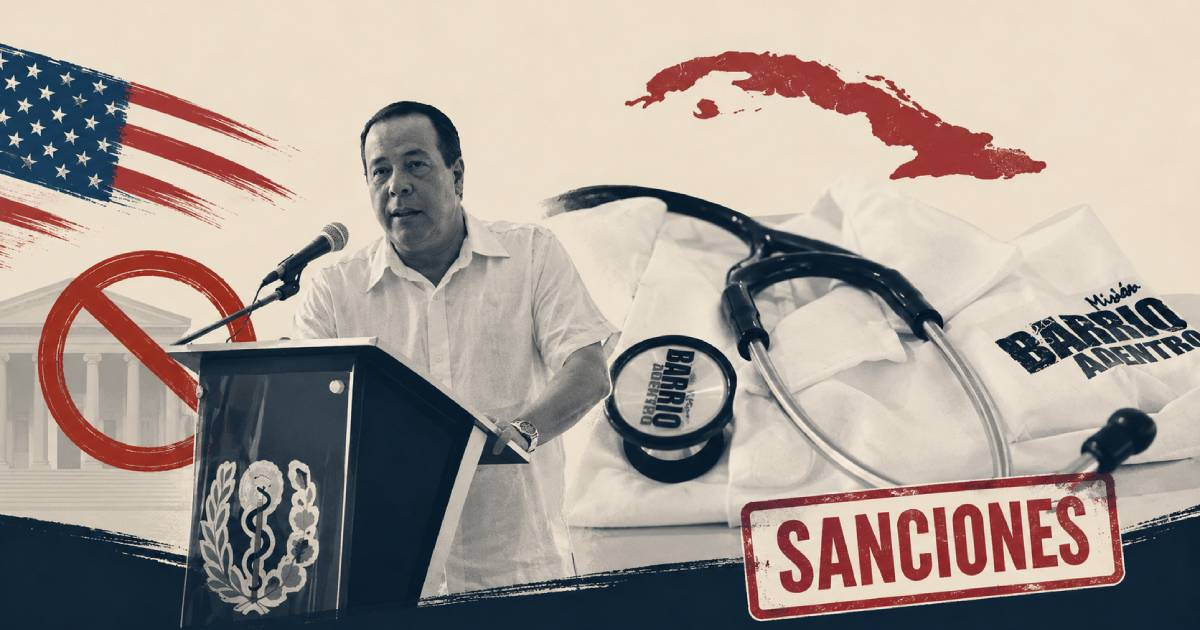
The United States government has unveiled a fresh wave of sanctions against Cuba's socialist regime, focusing on the heart of its overseas medical missions program. Among those targeted are José Ángel Portal Miranda, the Minister of Public Health, the official in charge of recruiting doctors for these missions, and two primary entities managing the system.
These actions were taken by the State Department under Executive Order 14404, signed by President Donald Trump on May 1, 2026. This order permits sanctions against individuals and entities linked to repression in Cuba or activities deemed a threat to U.S. national security.
Key Figures and Entities Sanctioned
José Ángel Portal Miranda, who has served as Minister of Public Health since July 2018, was added to the sanctions list due to his role as a senior official in the regime and his oversight of the entities responsible for the exportation of medical services.
Alongside him, Gretza Sánchez Padrón, director of the Central Unit for Medical Cooperation (UCCM), was designated. The UCCM, part of the Ministry of Public Health, is tasked with selecting, recruiting, and managing professionals sent to work abroad.
The State Department also sanctioned the UCCM itself and the Comercializadora de Servicios Médicos Cubanos S.A. (CSMC), a state-run company that markets Cuban medical services internationally. Washington described the CSMC as "Cuba's main source of foreign currency," generating more revenue than any other sector in the island's economy, with estimates exceeding $4.9 billion annually.
Forced Labor Allegations
In its official statement, the State Department reiterated that the medical missions program represents a systematic policy of forced labor, labeling it a form of human trafficking. According to Washington, the Cuban regime retains between 50% and 95% of the wages paid by host countries for the services of health professionals, affecting tens of thousands of doctors and other healthcare workers deployed in over 50 countries.
The Trump administration has made challenging the medical missions a central focus of its policy towards Havana throughout 2026. In April, the Inter-American Commission on Human Rights (IACHR) released a 199-page report indicating severe signs of forced labor, human trafficking, and contemporary forms of slavery within the program, recommending that countries in the hemisphere review or halt their participation.
Sanctions Extend Beyond Healthcare
The sanctions announced this Thursday are not confined to the healthcare sector. In the energy arena, the Petroleum Research Center S.A. (CEINPET), the research arm of the already sanctioned CUPET; Empresa de Energía S.A. (ENERSA); and EINARBO S.A., which imports gas and lubricants from Mexico and India, were also penalized.
Furthermore, the State Department accused the military conglomerate GAESA of attempting to circumvent U.S. sanctions through corporate reorganizations and intermediary companies. An example cited was the transfer of the Port of Mariel's administration to Coral Marítima S.A., a move executed in June 2026 that, according to Washington, aimed to shield GAESA's assets from U.S. restrictions.
Also added to the list were CEIBA Investments Limited, a Guernsey-based firm focused on real estate in Cuba, and ORBIT S.A., a remittance processing company considered "almost certainly controlled by GAESA" by the State Department.
Ongoing Economic Pressure Campaign
These new measures broaden the Trump administration's economic pressure campaign against the Cuban regime. On July 13, Washington had already sanctioned ten additional entities, including GEMAR, the Ministry of Tourism, the Rapid Response Brigades, and the Territorial Troops Militias. With the latest designations, the U.S. continues to tighten the noose around sectors deemed strategic for the regime's financing.
The State Department reminded that the sanctions entail the blocking of all assets and interests of those designated under U.S. jurisdiction and warned that foreign companies or financial institutions maintaining relations with them could face restrictive measures.
"The ultimate goal of the sanctions is not to punish, but to foster a positive change in behavior," concluded the agency in its statement.
U.S. Sanctions on Cuba: Key Questions Answered
What are the main reasons behind the U.S. sanctions on Cuba's medical missions?
The U.S. sanctions target Cuba's medical missions program due to allegations of forced labor and human trafficking, as the Cuban regime reportedly retains a significant portion of the wages paid for health professionals' services, impacting thousands of workers.
How does the U.S. justify its sanctions against Cuban entities?
The U.S. justifies its sanctions under Executive Order 14404, which allows actions against individuals and entities associated with repression in Cuba or activities that threaten U.S. national security. The aim is to encourage behavioral change rather than punishment.