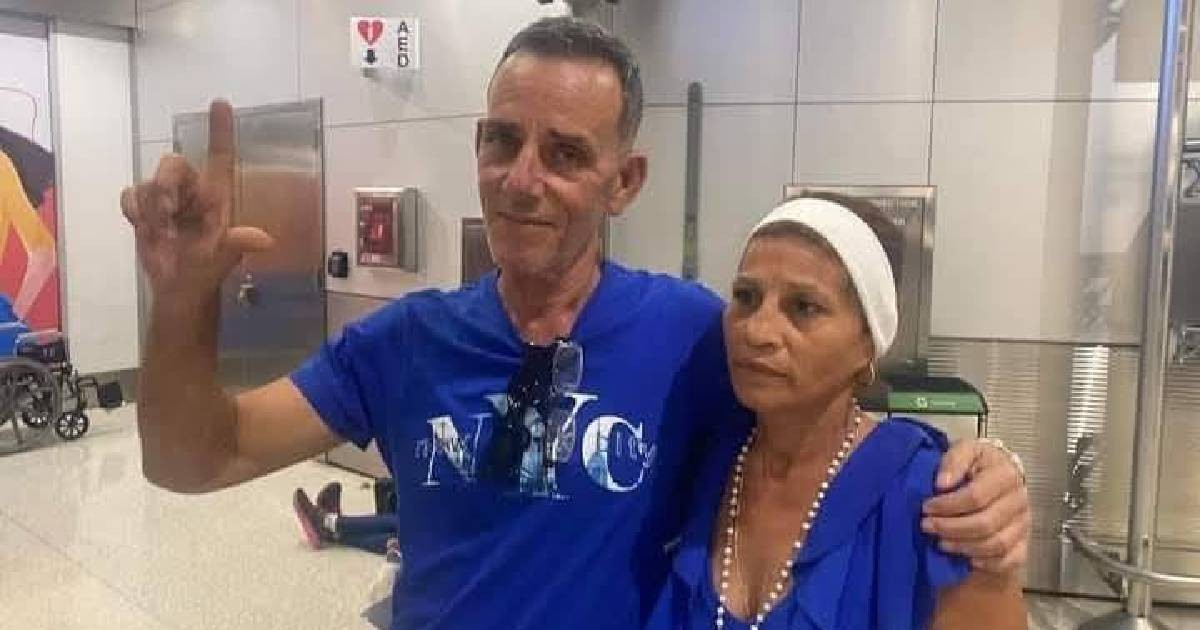
As July marks the second anniversary of Cuban independent journalist and former political prisoner Lázaro Yuri Valle Roca's forced exile to Miami, he and his wife, Eralidis Frómeta, remain trapped in a bureaucratic limbo in the United States, lacking both documentation and work permits.
Frómeta starkly expressed their predicament in a recent Facebook post: "We are living as if we were still in Cuba, fearful because of our undocumented status. We can't take it anymore, not even a work permit. What was the point of fighting so hard and risking our lives? My husband and I are completely unprotected."
Valle Roca arrived at Miami's airport on June 5, 2024, in a severely deteriorated physical condition after nearly three years in Cuba's maximum-security Combinado del Este prison. He had been sentenced to five years for "enemy propaganda," enduring beatings, partial loss of hearing and sight, and dropping from 80 to 53 kilograms in weight.
His release was secured through a humanitarian parole facilitated by Frómeta with the U.S. embassy in Havana, a condition set by the Cuban regime for his early release.
Revocation of Humanitarian Parole
Their legal situation took a drastic turn in March 2025 when the Department of Homeland Security informed the couple of the revocation of their parole. This was a result of the Trump administration's Executive Order 14165, which eliminated humanitarian parole programs for Cubans, Haitians, Nicaraguans, and Venezuelans, and ordered them to leave the U.S. by April 24, 2025.
Faced with this threat, the couple began the process of seeking political asylum and reached out to congress members, senators, Secretary of State Marco Rubio, and activist Rosa María Payá for support.
Appeals for Help from Rights Organizations
The Committee to Protect Journalists formally requested U.S. authorities to rescind the notification, and in May 2025, Human Rights Watch called for protection for 13 Cuban dissidents in similar situations, including Valle Roca and Frómeta.
However, nearly a year later, their situation remains unresolved.
Frómeta publicly criticized the silence of human rights organizations, questioning, "Where are the human rights organizations that do not provide us secure protection in the USA?" She highlighted that their images of repression "continue to circulate worldwide" while they remain without legal support, a situation she described as "cast into oblivion. It's clear we've stopped being money-making machines at the expense of our pain and suffering."
This case is part of a larger pattern affecting dozens of exiled Cuban dissidents who arrived in the U.S. under parole, only to find themselves in an immigration limbo following policy changes.
Valle Roca, in an April 2025 interview with El País, stated that if deported, he would face his return without fear: "If I ever get deported, I'll go back shouting 'Down with Miguel Díaz-Canel and Long Live Free Cuba.'"
Frequently Asked Questions About Valle Roca's Situation
What challenges do Valle Roca and his wife face in the U.S.?
They are living without legal documentation or work permits, creating a fear of deportation and hindering their ability to support themselves.
Why was their humanitarian parole revoked?
Their parole was revoked due to Executive Order 14165 from the Trump administration, which ended humanitarian parole programs for several nationalities, including Cubans.
How have rights organizations responded to their case?
Organizations like the Committee to Protect Journalists and Human Rights Watch have appealed for their protection, but the couple's situation remains unresolved.