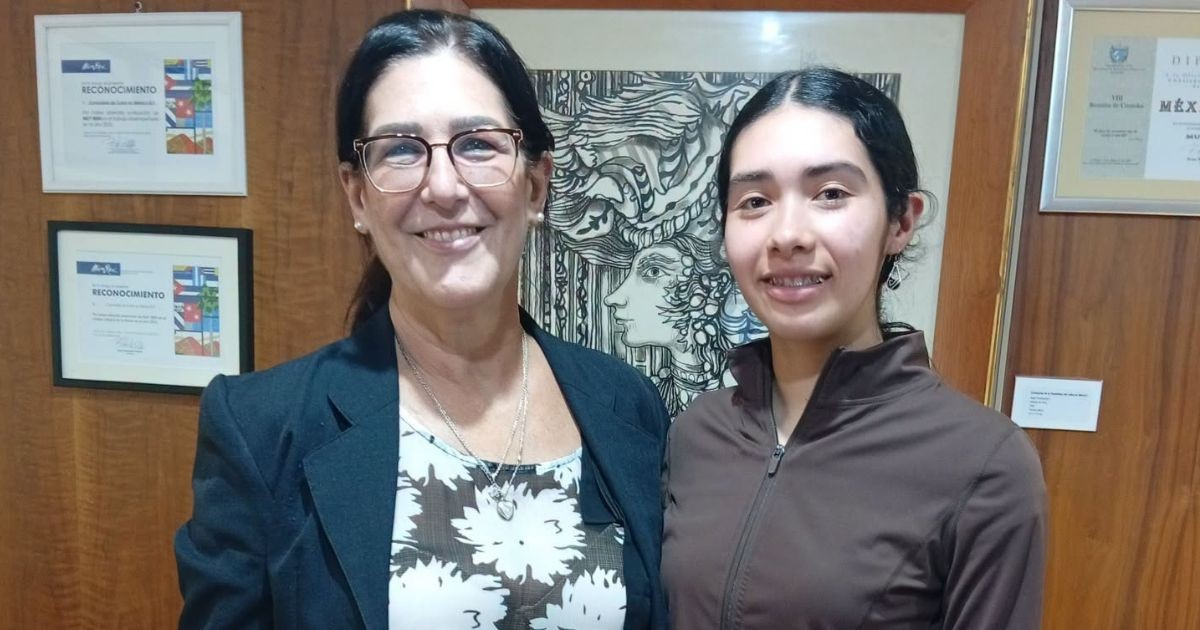
This past Wednesday, the Consular Section of Cuba in Mexico City granted the DACCRE Scholarship to Lis Vinajel López, a young Cuban-Mexican woman set to pursue a medical degree entirely cost-free on the island.
Describing the ceremony as a "source of great pride," the consulate clarified that the DACCRE Scholarships are "exceptionally awarded to descendants of Cubans living abroad to undertake their studies in our country."
Established in 2005 following the III Conference "The Nation and Emigration," spearheaded by Fidel Castro in 2004, the program aims to strengthen ties between the Cuban regime and its diaspora.
What Does the Scholarship Cover?
However, the announcement did not detail whether the scholarship includes housing, meals, transportation, academic materials, travel, or other costs associated with living on the island.
Since its inception, the program has awarded over 140 scholarships by 2025 to children of Cuban residents across 54 countries, with Medicine and Dentistry being the most common fields of study.
The Economic Appeal of the Scholarship
The scholarship's financial allure is clear when compared to the expenses of studying Medicine at a private university in Mexico. For instance, Tecnológico de Monterrey offers a program consisting of eight semesters and eight trimesters.
Based on official rates, an 18-credit term costs 201,150 Mexican pesos, while a 12-credit term is 134,100 pesos, figures that are beyond the reach of most Mexicans.
Other private institutions also have high tuition fees. At Universidad Anáhuac México, a semester of 40 credits involves four payments of 40,311 pesos, totaling 161,244 pesos, excluding enrollment, health insurance, and other fees.
In contrast, a DACCRE scholarship covering medical studies in Cuba represents significant savings for the recipient and their family.
Professional Practice Challenges
Regarding professional practice, a medical degree from Cuba does not automatically authorize one to work as a doctor in Mexico.
While there is a bilateral agreement between the two countries for the recognition and revalidation of university degrees, the treaty requires recipients to meet the legal requirements of the host country.
In 2023, authorities in Morelos rejected a group of Cuban doctors for lacking professional licenses and failing to complete the apostille of documents issued in Cuba.
Nevertheless, many Cuban-trained doctors eventually manage to practice in Mexico, where there is high demand for healthcare professionals, making Cuban education a perceived long-term investment.
The Program's Political Influence
From a critical standpoint, the program serves as a political tool for the regime: it attracts descendants of emigrants—many of whom have never lived in Cuba—and educates them in a controlled ideological setting, strengthening identity and political ties with Cuban communities abroad.
In November 2025, during the XII DACCRE Scholarship Holders Meeting, the program's director, Ana Teresita González Fraga, described education as "a solid bridge connecting the nation with its residents abroad."
Frequently Asked Questions About DACCRE Scholarships
What is the DACCRE Scholarship?
The DACCRE Scholarship is an educational grant awarded to descendants of Cuban expatriates, allowing them to study in Cuba, typically in fields like Medicine and Dentistry.
Does the scholarship cover all living expenses in Cuba?
The scholarship details do not specify coverage for living expenses such as housing, meals, or transportation, leaving these costs potentially uncovered.
Can Cuban-trained doctors practice in Mexico?
While there is an agreement for recognizing Cuban degrees, doctors must meet Mexico's legal requirements to practice, which may include obtaining a professional license.