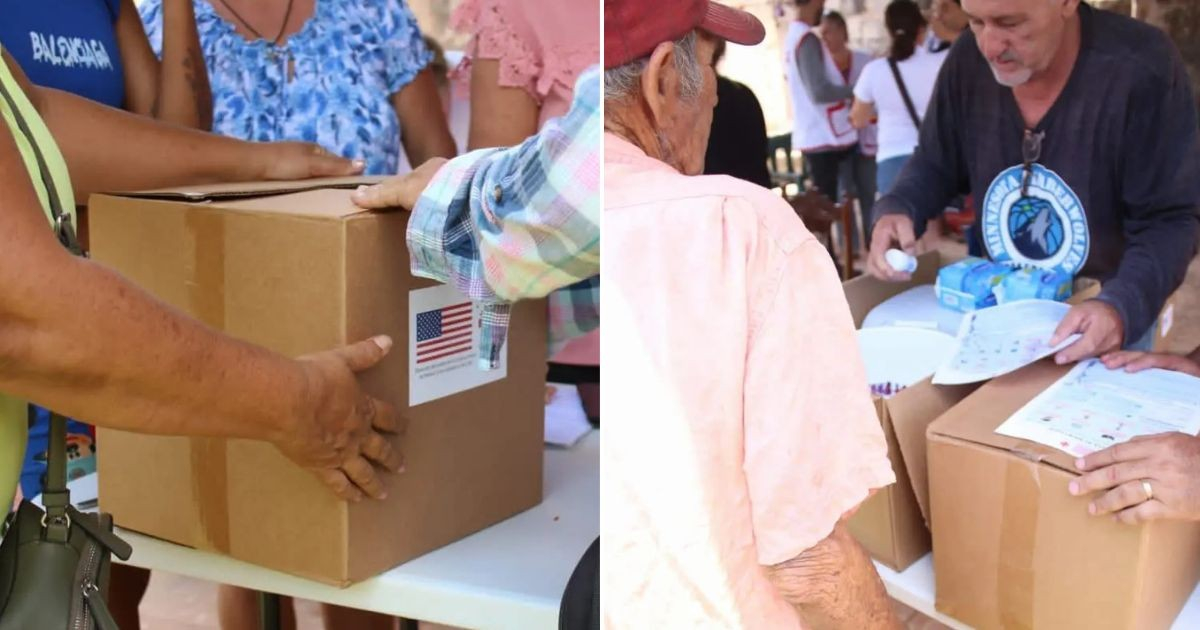
On Wednesday, the distribution of humanitarian aid from the United States began in the towns of Bejucal, Mayabeque, and Alquízar, Artemisa, targeting Cuba's most vulnerable families. This initiative was announced by Cáritas Cuba on their official website.
Cáritas Habana is overseeing the distribution within the Archdiocese of Havana, ensuring that aid reaches both the main towns and various local communities.
The food kits, intended to provide family lunches for around ten days, contain 10 pounds of rice, 10 pounds of black beans, six cans of sardines in tomato sauce, five cans of tuna, a gallon of vegetable oil, three pounds of spaghetti, a pound of iodized salt, and a pound of brown sugar.
Completing the package, the personal hygiene kit includes a solar lamp, water purification tablets, a 20-liter container with a lid, a 10-liter plastic bucket, six bars of soap, powdered detergent, four toothbrushes, two tubes of toothpaste, and sanitary towels.
The parish volunteers involved in this operation have stressed their dedication to acting with "respect, close support for beneficiaries, transparency, and humane treatment within each community," as reported by Cáritas Cuba.
This aid is delivered directly to families, bypassing the Cuban regime's authorities, to ensure that resources are neither intercepted nor redirected by the island's government.
This distribution marks the first formal humanitarian flight from the U.S. to Cuba, which took off from Miami on Tuesday carrying approximately 18 tons of food and hygiene supplies, sufficient to assist up to 700 families within the Archdiocese of Havana during this initial phase.
The flight was organized in collaboration with Catholic Relief Services (CRS) as part of the $100 million commitment announced by Secretary of State Marco Rubio.
Of this total, $60 million will be managed by the Catholic Church through CRS and Cáritas Cuba, while $40 million will be handled by independent non-governmental organizations.
The complete plan aims to benefit between 100,000 and 120,000 families across the island.
The logistical coordination was arranged in prior meetings between U.S. representative Mike Hammer, the director of Cáritas Cuba, Carmen María Nodal Martínez, CRS President Sean Callahan, and the Archbishop of Santiago de Cuba, Dionisio García Ibáñez.
This is not the first instance of U.S. assistance of this nature. In January and February 2026, Cáritas Cuba had already distributed aid from the U.S. in eastern Cuban dioceses, in two phases amounting to nine million dollars, benefiting around 8,000 families.
Frequently Asked Questions About U.S. Humanitarian Aid to Cuba
What areas are receiving U.S. humanitarian aid in Cuba?
The aid is currently being distributed in Bejucal, Mayabeque, and Alquízar, Artemisa, with plans to reach various communities within the Archdiocese of Havana.
Who is responsible for distributing the aid?
Cáritas Habana, in conjunction with parish volunteers, is responsible for the distribution of the aid within the Archdiocese of Havana.
What items are included in the food and hygiene kits?
The food kits include rice, black beans, sardines, tuna, vegetable oil, spaghetti, iodized salt, and brown sugar. The hygiene kits contain a solar lamp, water purification tablets, soap, detergent, toothbrushes, toothpaste, and sanitary towels.