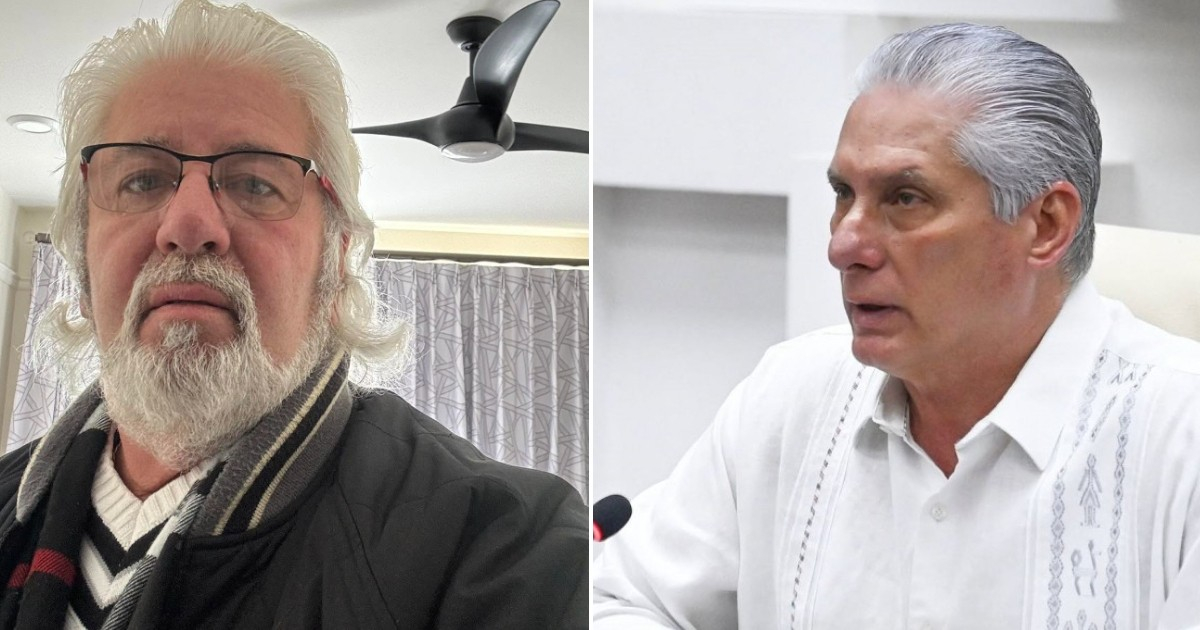
Luis Alberto Ramírez Katungo took to Facebook to share a post titled "The Utopia That Never Was," where he employs irony and philosophical analysis to deconstruct the metaphor used by Miguel Díaz-Canel on Monday when discussing the possibility of Cuba emerging from its crisis.
The spark for this reflection was an interview Díaz-Canel gave to the Russian channel RT en Español. When asked about the country's future, instead of offering a tangible plan, he resorted to a poetic image: "Utopia is on the horizon. When we walk two steps, utopia steps back two. And the horizon advances by ten steps. What is the purpose of utopia? To keep walking. I would say hope is the same." This phrase echoes a quote by Argentine filmmaker Fernando Birri, popularized by Uruguayan writer Eduardo Galeano in his book "The Book of Embraces" (1989).
Katungo was quick to point out the underlying contradiction: "In my opinion, this is one of the most absurd statements I've heard in quite some time because it seems the speaker does not grasp the meaning of the word utopia."
Philosophical Irony Meets Political Reality
In his reflection, Katungo reminds readers that the term originates from Greek, meaning "no place" or "the place that doesn't exist," and that both utopia and the horizon share an essential characteristic: neither can be reached. This is the essence of the metaphor, not a philosophical revelation.
"Paradoxically, with that phrase, it seems to admit that the so-called Cuban Revolution is chasing an impossible goal. If the revolution is a utopia, then it's like plowing the sea, trying to reach the sky without wings, or jumping into an abyss hoping gravity ceases to exist," Katungo wrote.
Public Outrage and Criticism
The post joins a wave of critical reactions the phrase sparked on social media, where thousands of Cubans responded with indignation and sarcasm.
Historian and activist Alina Bárbara López Hernández, who has been under house arrest since June 2024, also reacted harshly to the leader's words: "A political leader who wants to be respected must earn it. Respect is not demanded; it is earned. No one like the Cuban president to utter nonsense in a grandiose tone."
The context in which Díaz-Canel used that metaphor further highlights the gap between rhetoric and reality. In the same RT interview, he acknowledged that no fuel ships have arrived in Cuba for six months—except one from Russia—that the country produces only 40,000 barrels of oil a day, far short of the 90,000 to 110,000 needed, and that Venezuelan supply collapsed following Nicolás Maduro's capture in January 2026.
Adding to this, 96.91% of the population lacked adequate access to food in May 2026, according to the Food Monitor Program, and the minimum wage in Cuba is equivalent to less than five dollars a month on the informal market exchange, while the economy has contracted by more than 15% since 2020.
Katungo concluded his post with a blunt assertion: "The Cuban regime is in search of a golden chimera, but all it has found—and continues to find—is poverty, desolation, and sadness."
Understanding Cuba's Current Crisis
What metaphor did Miguel Díaz-Canel use to describe Cuba's situation?
Díaz-Canel used a metaphor about utopia being on the horizon, implying that while it may seem close, it remains perpetually out of reach, suggesting that the journey is what matters.
How did Luis Alberto Ramírez Katungo respond to Díaz-Canel's statement?
Katungo criticized the statement as absurd and highlighted the contradiction of chasing an unreachable utopia, equating it to futile efforts.
What is the current state of Cuba's economy according to the article?
The article states that Cuba's economy has shrunk by over 15% since 2020, and the minimum wage is less than five dollars a month on the informal market, with severe shortages in fuel and food.