The first humanitarian flight from Miami to Cuba took off on Tuesday, marking the beginning of a $100 million aid package announced by Secretary of State Marco Rubio. This shipment includes boxes filled with non-perishable foods and essential items aimed at supporting Cuban families in need.
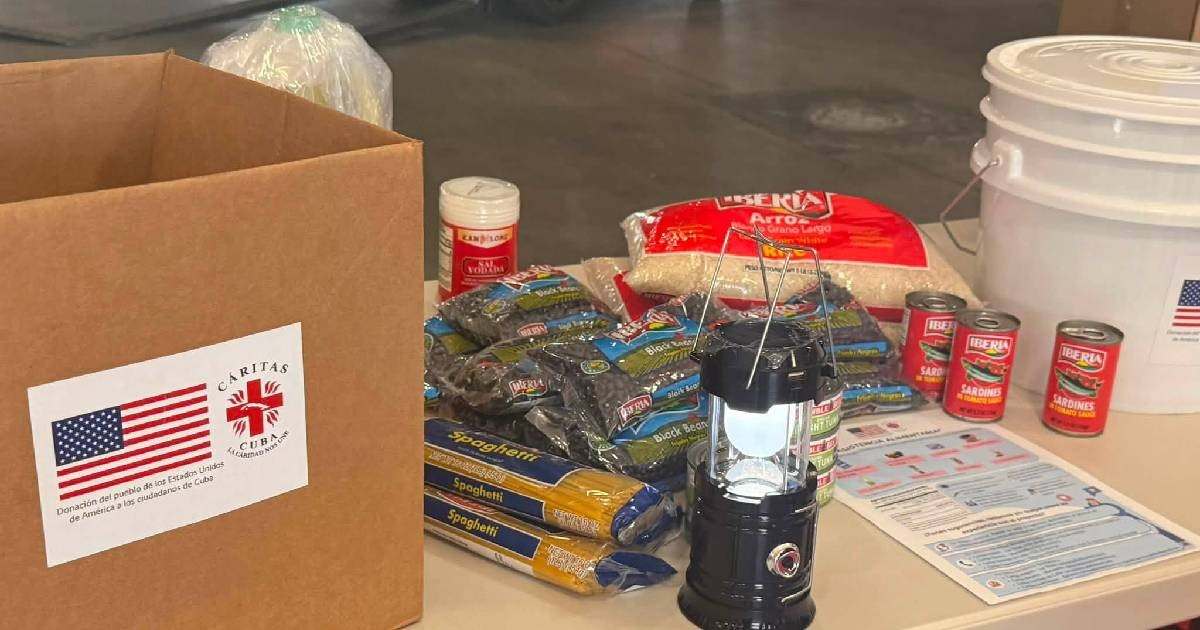
Telemundo 51 journalist, Alexis Boentes, offered a detailed look at the contents of the packages arriving on the island via Cáritas Cuba, each containing 37 food rations.
Each box prominently features the U.S. flag alongside the logo of Cáritas Cuba, with the slogan "Charity Unites Us" and the message "A gift from the people of the United States of America to the citizens of Cuba."
Different Packages for Different Needs
There are two variations of the food modules. The 10-day supply includes 10 pounds of long-grain white rice, 10 pounds of black beans, three cans of sardines in tomato sauce, five cans of tuna in water, 3.78 liters of vegetable oil, three pounds of spaghetti, one pound of iodized salt, and two pounds of brown sugar.
The other version offers smaller quantities: five pounds of rice, three cans of sardines, one can of tuna, black beans, one liter of vegetable oil, 500 grams of spaghetti, iodized salt, and two pounds of brown sugar.
Nutritional Value and Practical Challenges
According to the leaflet included with the packages, the 10-day basket "provides 48% of the weekly caloric needs for a family of four," delivering approximately 2,182 kilocalories per person.
The document also notes, "It is recommended that families consume the module to meet necessary nutrients, though this may be challenging in practice."
The products come from well-known American brands familiar to Hispanic communities: Iberia (rice, beans, sardines, and spaghetti), Bumble Bee (tuna), and Sysco (oil and sugar). Some modules also contain non-food items such as collapsible flashlights, five-gallon buckets, Colgate toothpaste, toothbrushes, and water jugs.
Distribution and Logistics
This initial shipment, managed by the company 7Air and destined for Havana, includes 700 food kits and 700 hygiene kits, aiming to assist an equal number of families.
The overarching plan is to reach over 196,000 families across the island. Distribution is carried out solely through the Catholic Church and Cáritas Cuba, with no involvement from the Cuban regime or GAESA, the military-run business conglomerate.
The strategy deliberately avoids cash transfers: the U.S. government purchases the products directly and delivers them to Catholic Relief Services (CRS), which then channels them to local parishes for direct distribution.
The $100 million package—split into $60 million for the Catholic Church and $40 million for other trusted organizations like Samaritan's Purse—was formally announced by Rubio on May 13, 2026, in Rome. Initially dismissed as a "fable" and a "joke" by the regime, it was accepted in mid-June 2026, despite practical barriers imposed on distribution outside state control.
Previous Aid Efforts and Contact Information
This initiative builds on the experience of a previous $9 million package delivered after Hurricane Melissa in October 2025, from which Cáritas Cuba distributed 82%, aiding 8,800 families in eastern provinces. The current module leaflets include contact numbers for Cáritas in Holguín-Las Tunas, Bayamo-Manzanillo, Santiago de Cuba, and Guantánamo-Baracoa for feedback and suggestions on the program.
Understanding U.S. Aid to Cuba
What items are included in the U.S. aid packages sent to Cuba?
The aid packages include non-perishable foods like rice, beans, sardines, tuna, and spaghetti, as well as essential items such as vegetable oil, salt, sugar, and non-food items like flashlights and hygiene products.
Who is responsible for distributing the aid in Cuba?
Distribution is managed by the Catholic Church and Cáritas Cuba, without any involvement from the Cuban government or military-controlled GAESA.
What is the goal of the $100 million aid package to Cuba?
The aid package aims to assist over 196,000 families across Cuba by providing essential food and hygiene supplies.