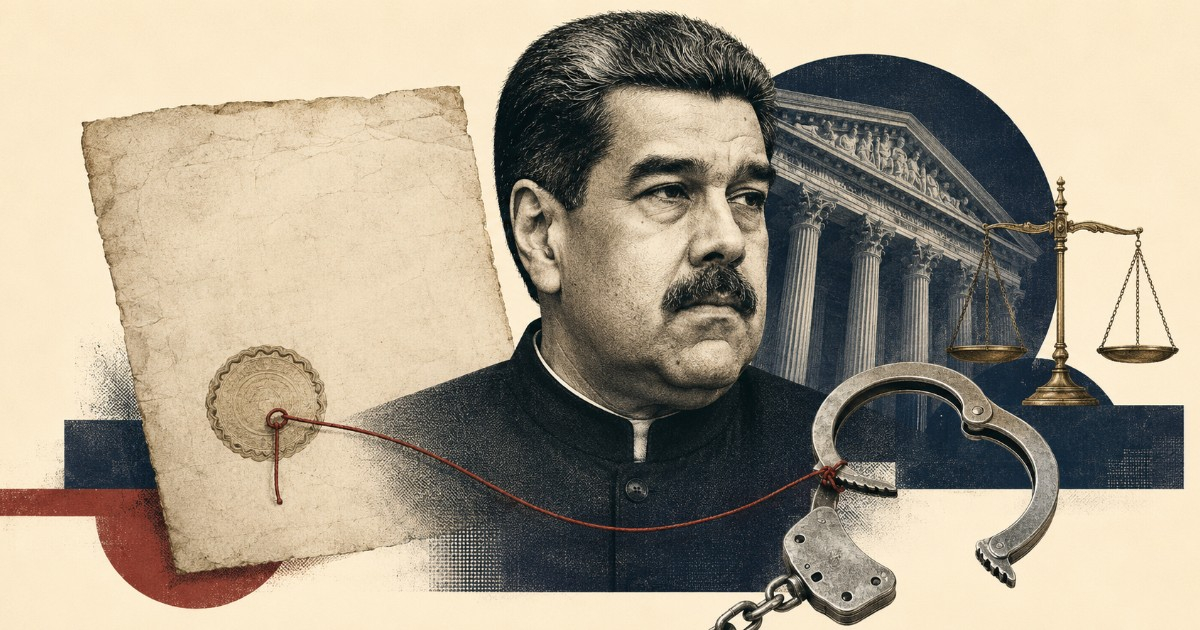
An extradition treaty established over a hundred years ago between the United States and Venezuela might become a significant hurdle in the legal proceedings against Nicolás Maduro, according to an opinion piece published in The New York Times.
The author argues that should this legal interpretation gain traction, the U.S. may be compelled to release Maduro.
This contentious case will return to court on Wednesday, July 22, before Judge Alvin Hellerstein of the Southern District of New York's Federal Court. This marks the third judicial appearance for Maduro since his arrival in the United States.
The 1922 Extradition Treaty: A Legal Challenge
The crux of the legal issue lies in the 1922 bilateral extradition treaty, which was endorsed by both the U.S. Senate and the President, thus possessing the full force of law.
A pivotal clause within the treaty specifies that "all differences between the contracting parties, relating to the interpretation or execution of this treaty, shall be decided by arbitration."
The Venezuelan government has openly asserted that Maduro's arrest was unlawful under international law.
According to the column's author, this dispute might represent a "difference between the contracting parties" sufficient to trigger the arbitration clause.
Potential Outcomes and Legal Opinions
Furthermore, the perspective offered in the column suggests that Judge Hellerstein should pause the proceedings and refer the matter to an independent arbitration panel.
If this panel determines that the arrest violated the treaty, the U.S. might be required to release Maduro.
Legal scholar David Sloss, editor of "The Role of Domestic Courts in Treaty Enforcement," indicated that it wouldn't be particularly surprising for the dispute to be temporarily removed from the courts and referred to arbitration.
This process, he noted, aligns with the typical judicial approach to agreements containing arbitration clauses.
International law expert Steven Ratner added that unless otherwise specified, arbitrators would likely adhere to the principles outlined in the Vienna Convention on the Law of Treaties and scrutinize the agreement in light of "the relevant rules of international law of 1922."
Historical Precedents and Implications
The Supreme Court has upheld the underlying principle on three different occasions.
In 1886, during the United States v. Rauscher case, the Court ruled that a defendant couldn't be tried for charges other than those for which they were extradited from the United Kingdom.
In 1927, then-Chief Justice William Howard Taft emphasized that the court's right to detain foreign defendants "for trial" depended on the applicable treaty.
In 1992, in the United States v. Alvarez-Machaín case, the Court permitted the trial of a Mexican citizen abducted by the DEA but reaffirmed that a defendant "cannot be tried in violation of the terms of an extradition treaty."
The primary distinction between the 1992 precedent and the Maduro case is that the treaty with Venezuela, unlike the one with Mexico, includes a mandatory arbitration clause for resolving any disputes regarding its interpretation.
The analysis concludes that "the trial cannot legally proceed without this step" and warns that "any attempt by the United States to bypass the arbitration" would render the operation "blatantly illegitimate also under U.S. law."
Understanding the Legal Complexities of Maduro's Case
What is the significance of the 1922 extradition treaty in Maduro's case?
The 1922 extradition treaty between the U.S. and Venezuela includes an arbitration clause for disputes over interpretation, which could influence the current legal proceedings against Nicolás Maduro.
How might the arbitration process affect Maduro's legal case in the U.S.?
If arbitration is initiated and it is concluded that Maduro's arrest violated the treaty, the U.S. might be compelled to release him, halting the current legal proceedings.
What historical precedents exist regarding extradition treaties and legal trials?
The Supreme Court has ruled on similar issues in the past, emphasizing that trials must adhere to the terms of the applicable extradition treaties and supporting the arbitration process for disputes.