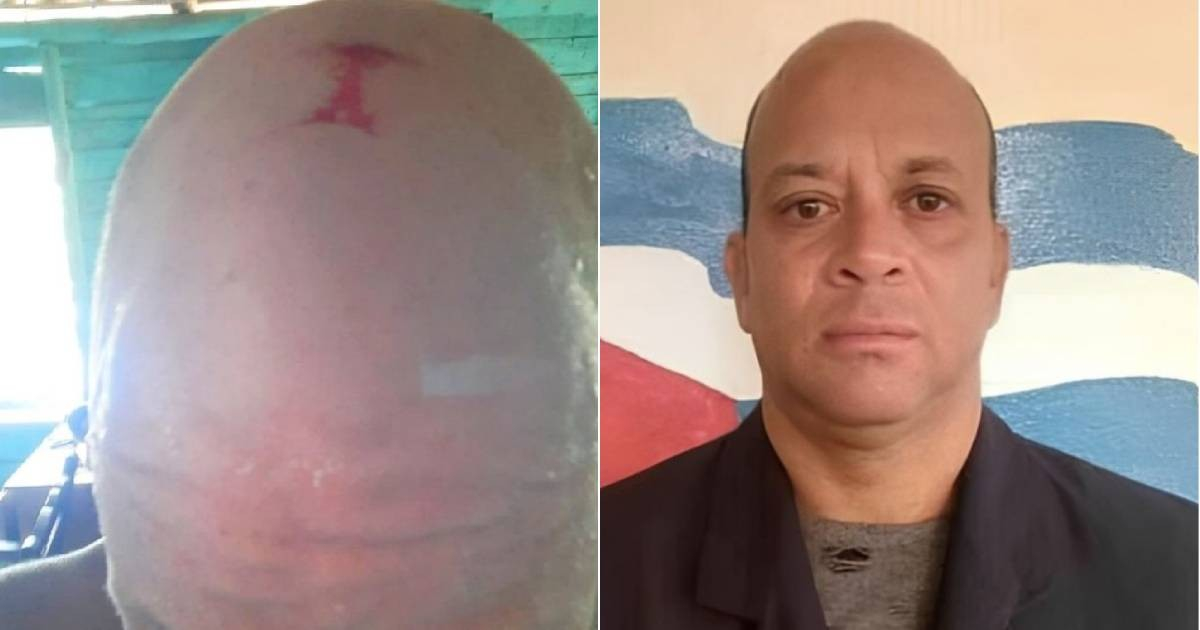
Independent journalist José Antonio López Piña was detained, assaulted, and threatened with death by police and State Security agents on July 18 in Santiago de Cuba. The incident occurred while he was filming in the city streets, according to López Piña's own account.
He reported being physically attacked by five police officers in public. Photographs released after the event reveal a severe open wound on his head, with visible traces of blood on his scalp.
Detention and Threats
After the attack, López Piña was taken to the police station known as El Palacete, where he was handed over to officials from the Technical Investigations Department (DTI). "I was filming on the street when the police appeared and assaulted me. They then took me to El Palacete, claiming to be the group fighting against counter-revolution. They broke my phone," the journalist recounted.
During his interrogation, a State Security officer identified as Robert took the lead in making threats. "They beat me below the waist. They called me a traitor, warned I could face a lengthy prison sentence, and told me to prepare for the consequences of my so-called subversive work," López Piña revealed.
Continuous Harassment
The officer even suggested that his life "could be in danger given the current state of the country," and that he and other journalists and activists might be detained "indefinitely" or charged with treason.
The destruction of his mobile phone left López Piña without his primary tool for reporting. He is currently using a borrowed device from a friend. López Piña highlighted that this incident is not isolated: "I've been attacked several times. This year alone, it happened twice."
The journalist's history of persecution dates back to 2019 when he was arrested and beaten for participating in a campaign against the constitutional referendum.
Ongoing Struggle for Press Freedom
Following the July 11, 2021 protests, the regime initiated a criminal case against him for "incitement to commit crimes" due to his coverage of the demonstrations, a case that remains open. In 2022, he faced over 25,000 pesos in fines which he deemed arbitrary.
In August 2023, agents unlawfully entered his home, dragged him out, assaulted him, and fined him 4,120 pesos. By 2024, the organization Cubalex documented threats from State Security to charge him with "usurpation of functions" for his independent journalism, warning of a 15-year prison sentence if he did not leave the country. In 2025, a "pre-criminal dangerousness" file was opened against him.
This attack occurs amid a broader crackdown in Cuba, with the Cuban Observatory for Human Rights reporting nearly 2,000 repressive actions in the first half of 2026, including 257 arbitrary detentions. The Cuban Institute for Freedom of Expression and Press (ICLEP) recorded at least 47 journalists arrested in July alone for covering anti-government protests.
Cuba remains one of the most repressive countries in the hemisphere concerning press freedom, according to Reporters Without Borders and Human Rights Watch, which classify the island as one of the most hostile environments globally for those reporting outside the Communist Party's controlled media.
Understanding the Repression of Independent Journalism in Cuba
What happened to José Antonio López Piña in July 2026?
In July 2026, José Antonio López Piña was detained, beaten, and threatened with death by Cuban police and State Security agents while filming in Santiago de Cuba.
How has the Cuban regime responded to independent journalism?
The Cuban regime has consistently harassed and persecuted independent journalists, with actions ranging from physical assaults to arbitrary detentions and heavy fines, aiming to suppress dissent and control narratives.
Why is Cuba considered hostile to press freedom?
Cuba is considered hostile to press freedom due to the extensive control the Communist Party exerts over media, along with the severe repression and censorship faced by journalists who attempt to report independently.