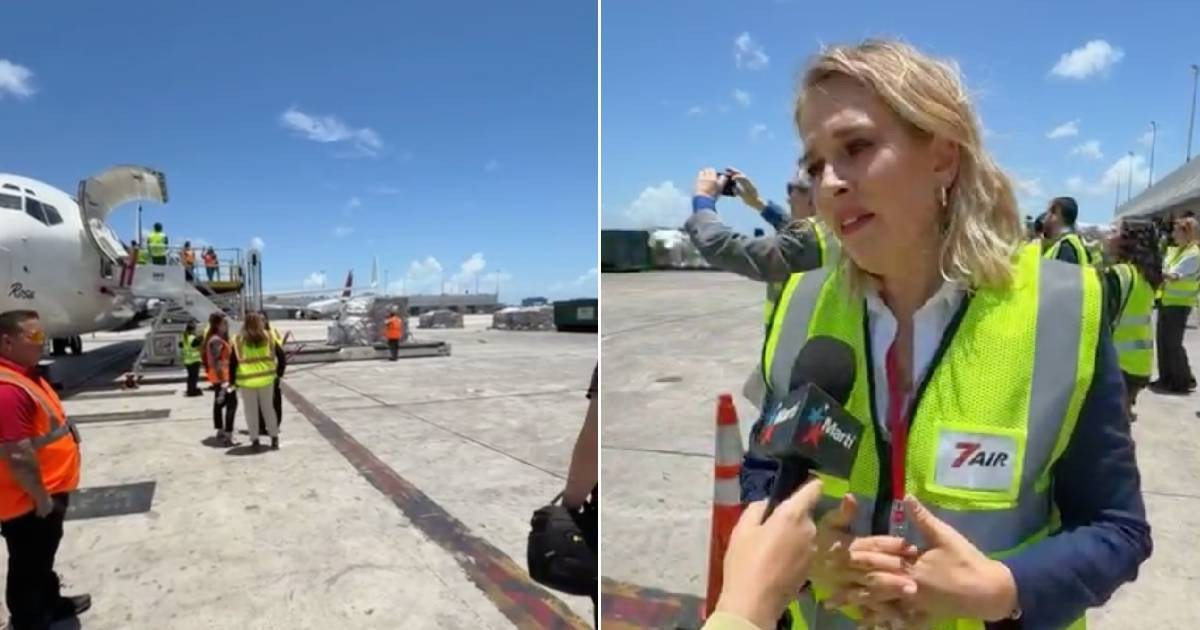
A Boeing 737-800BCF cargo plane from 7 Air Cargo, named "Rosa," took off from Miami on Tuesday carrying the first shipment of a substantial $100 million humanitarian aid package from the United States intended for the Cuban people.
This flight directly counters claims made by Havana's regime, and the State Department delivered a firm warning: the Cuban government will not be able to seize these resources.
The inaugural shipment contains 700 hygiene kits and 700 food items destined for Havana. Prior to departure, American officials held a press conference at the Miami airport runway.
Humanitarian Aid Distribution: A Secure Plan
The distribution will be handled solely by Catholic Relief Services, Cáritas Cuba, and the Catholic Church in Cuba, with no involvement from the Cuban government.
Jeremy P. Lewin, Acting Under Secretary of State for Foreign Assistance, was clear: "This is not their aid... They are not in a position to make decisions about this," warning that any interference by the regime would hold them accountable to their own people and the U.S.
The system was carefully crafted to safeguard the resources: Catholic Relief Services purchases the goods directly in the U.S. and ships them to Cuba; Cáritas Cuba does not handle any cash transactions.
Contradicting the Cuban Leadership's Claims
Tuesday's flight directly refutes statements made by Miguel Díaz-Canel on June 19 to a Dominican broadcaster, where he claimed the aid wouldn't begin until after September and would exclude food and medicine, dismissing the offer as a "joke."
The State Department unequivocally countered: "That is completely and utterly false. The shipments include food, as evidenced during inspections in the humanitarian aid phases following Hurricane Melissa."
Despite his public criticisms, Díaz-Canel had officially accepted the aid in writing.
Massive Aid Package Announced
The comprehensive $100 million package was announced by Secretary of State Marco Rubio on May 13, 2026.
Of this amount, $60 million will be managed by the Catholic Church and $40 million by independent non-governmental organizations. It is estimated that the entire package will benefit between 100,000 and 120,000 families across the island.
On Monday, U.S. Ambassador to the U.N., Mike Waltz, met with the executive director of Catholic Relief Services to coordinate direct delivery, describing the effort as a way to "bypass the greedy and hypocritical communist regime in Havana."
This shipment adds to two previous deliveries totaling nine million dollars, initiated in response to Hurricane Melissa, which struck eastern Cuba on October 29, 2025, affecting over three million people.
Cáritas Cuba reported utilizing 82% of those prior funds, aiding approximately 8,800 families in Santiago de Cuba, Holguín, Las Tunas, Bayamo, and Guantánamo, reaching even remote areas via ox carts without state mediation.
Diplomatic Tensions at a Peak
The flight occurs amid heightened diplomatic tensions: on Monday, the State Department released the report "Cuba, Capital of 21st Century Communism," accusing the regime of nearly seven decades of espionage and subversion in the U.S.
Díaz-Canel retaliated on Tuesday by attacking Rubio, labeling him "one of the most corrupt officials of the current administration, with proven ties to drug traffickers and terrorists in Florida."
The State Department concluded its official statement with a message to the Cuban people: "This assistance underscores the importance of the sustained commitment of the United States to the Cuban people, by providing essential humanitarian aid and crucial support to those facing an increasing shortage of food, medicine, fuel, and other essential services."
Understanding U.S. Humanitarian Aid to Cuba
Why can't the Cuban regime access the U.S. aid?
The aid distribution is exclusively managed by Catholic Relief Services, Cáritas Cuba, and the Catholic Church, ensuring no government involvement or access to the resources.
What does the $100 million aid package include?
The package includes essential items such as food and hygiene kits, and is meant to benefit between 100,000 and 120,000 Cuban families.
How did the U.S. respond to claims by Díaz-Canel?
The State Department firmly refuted Díaz-Canel's claims, asserting that aid shipments do indeed include food and medicines, contradicting his statements.