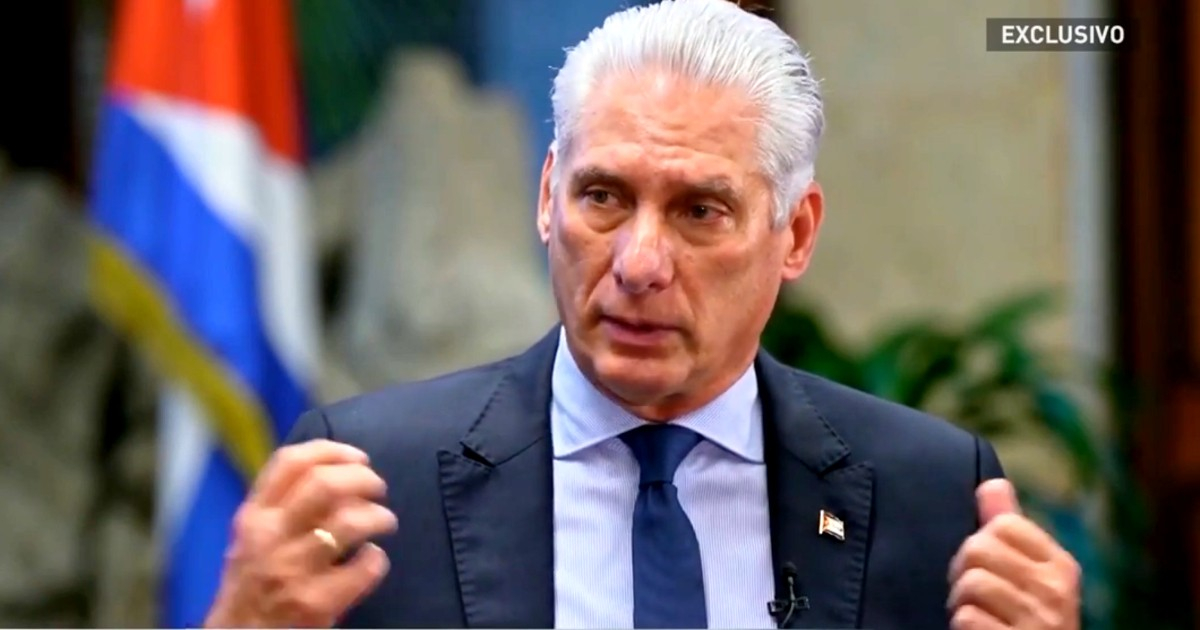
Miguel Díaz-Canel has publicly defended the ongoing negotiations between Cuba and the United States, with Raúl Guillermo Rodríguez Castro, known as "El Cangrejo," playing a central role despite having no formal institutional position. Díaz-Canel made these comments during an interview with RT en Español, providing an implicit justification for El Cangrejo's involvement in talks led by the Cuban-American Marco Rubio, a key figure in the Trump administration.
During the interview, Díaz-Canel emphasized that the dialogue with Washington is being conducted by "us," with the participation of the "General of the Army," referring to the 94-year-old Raúl Castro, who remains the true arbiter of strategic decisions in the regime.
This statement followed an exclusive interview El Cangrejo gave to USA Today two weeks earlier, where he positioned himself as a key intermediary with Washington and expressed his willingness to negotiate directly with Trump. "I can negotiate with anyone designated by the U.S.," he stated, highlighting his readiness to engage with Trump if given the opportunity.
The remarks from El Cangrejo sparked a wave of indignation, even among regime supporters. Musician Israel Rojas from Buena Fe and other public figures like journalist Ana Teresa Badía and playwright Irán Capote voiced their discontent. Even the mother of Díaz-Canel's press chief publicly questioned El Cangrejo's authority.
In an attempt to mitigate the backlash, Prime Minister Manuel Marrero Cruz assured the public on July 10 that the negotiating team had the endorsement of both Díaz-Canel and Raúl Castro. Now, Díaz-Canel himself reiterates this claim, emphasizing a "monolithic unity" within the leadership, despite acknowledging earlier this year the lack of genuine unity and the challenges of bureaucracy and inertia within the Communist Party.
This contradiction underscores the opaque and authoritarian nature of the regime, where the Castro family maintains a parallel structure to the formal state apparatus. Reports from Axios in February suggested a direct communication channel between El Cangrejo and Rubio, describing the exchanges as "surprisingly cordial" and focused on the future rather than past disputes.
Although the State Department has not officially confirmed a personal conversation between Rubio and El Cangrejo, it has not denied the contacts either. Meanwhile, Trump publicly stated that Washington is engaged with individuals at "the highest levels in Cuba."
Díaz-Canel admitted in April that he has neither spoken directly with Marco Rubio nor met him in person, while El Cangrejo had already met with Rubio's team in Saint Kitts in February. This illustrates Díaz-Canel's marginalization in these crucial negotiations, despite efforts to assert his leadership.
When faced with questions about internal divisions, Díaz-Canel dismissed them as "speculations," "diversionary actions," and "manipulative actions," asserting that the regime will not provide explanations to avoid falling into the traps set by these actions.
This incident highlights the real power dynamics in Cuba, where the "General of the Army" holds the reins, and Díaz-Canel invokes his "historical experience" to legitimize decisions that he does not truly control.
Key Insights into Cuba-U.S. Negotiations
Who is leading the negotiations between Cuba and the U.S.?
The negotiations are reportedly led by Raúl Guillermo Rodríguez Castro, also known as "El Cangrejo," with the involvement of Marco Rubio on the U.S. side.
What role does Díaz-Canel play in the negotiations?
Díaz-Canel publicly supports the negotiations and claims a unified leadership, though he has admitted to not having direct involvement in talks with Marco Rubio.
How has the Cuban public reacted to El Cangrejo's involvement?
El Cangrejo's involvement has sparked controversy and criticism among the Cuban public, including from regime supporters and public figures.