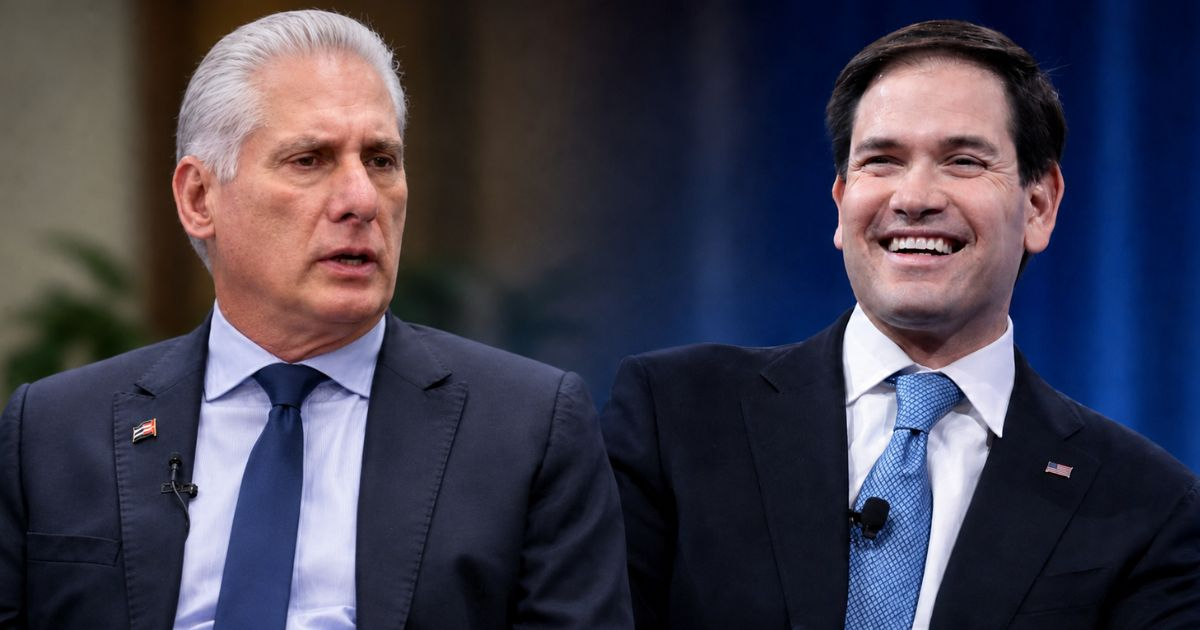
On Monday, Miguel Díaz-Canel unleashed a barrage of accusations on X, targeting Secretary of State Marco Rubio following the release of a State Department report. The report accuses the Cuban regime of a nearly seven-decade-long campaign of espionage, infiltration, and subversion against the United States.
Without explicitly naming Rubio, the Cuban leader described him as "one of the most corrupt members of the current administration, with proven ties to Florida's drug traffickers and terrorists."
Díaz-Canel began his thread with a popular saying: "The thief believes everyone else is a thief too."
Even though the Cuban leader did not provide evidence or specify whom he was referring to, his comments were aimed at Rubio, who had disseminated the report and claimed the State Department was revealing "the full history of Cuban espionage and subversion" in the U.S.
The assertion regarding alleged drug trafficking connections might reference Orlando Cicilia, Rubio's brother-in-law, who was arrested during the 1987 Operation Cobra and convicted in a federal drug trafficking case in 1989.
Cicilia was sentenced to 35 years in prison but was released early in 2000. He was identified as a significant player in a cocaine trafficking organization that handled up to $75 million. However, these events do not implicate Rubio in his brother-in-law's criminal activities.
A 2016 Univision report, based on court documents obtained by Miami New Times, revealed that Rubio lived with his family for about a month in a house owned by Cicilia when Rubio was 14 years old. The files indicated the residence was used for cocaine storage and preparation. Rubio has consistently denied that he or his parents were aware of Cicilia's criminal activities and stated in his autobiography that he was shocked by the arrest.
The catalyst for Díaz-Canel's Monday thread was the State Department's report titled "Cuba: The Capital of 21st Century Communism." This 100-page document accuses the regime of a long-standing campaign of espionage, ideological infiltration, and support for left-wing terrorism against the U.S.
The document draws connections between Havana and historical movements like the Black Panthers and Weather Underground, as well as contemporary groups linked to Antifa and Black Lives Matter.
The report's release came four days after Rubio led a conference in Washington on the resurgence of political terrorism, with participation from leaders, experts, and security officials from over 60 countries. During the event, the State Department released a fact sheet indicating that extreme left-wing actors were responsible for 63% of all anti-government attacks or plots recorded in the U.S. during 2025.
In his thread, Díaz-Canel described Washington's policy as "transnational neo-McCarthyism" driven by "a clearly fascist current," claiming that this approach "resorts to lies to justify aggressions against Cuba and curtail civil liberties in the U.S."
The Cuban leader also insisted that the island "has never acted to harm the American people, nor has it sought to undermine U.S. national security," portraying the regime's actions as a defensive response to "successive and endless aggressions."
The thread concluded with the hashtag #CubaNoEsAmenaza, aiming to counter the accusations in the report and the international campaign promoted by Washington against so-called "radical left terrorism."
This is not the first time Díaz-Canel has lashed out at Rubio. In April 2026, he admitted to never having spoken with or personally knowing Rubio. A year earlier, he described Rubio as "a gray figure for us within the current administration" and accused him of pushing for tougher sanctions against the Cuban regime.
Questions About Díaz-Canel's Accusations Against Marco Rubio
Who is Orlando Cicilia?
Orlando Cicilia is the brother-in-law of Marco Rubio, who was arrested in 1987 during Operation Cobra for his involvement in a cocaine trafficking organization. He was sentenced to 35 years in prison but was released early in 2000.
What is the State Department report about Cuba?
The State Department report, titled "Cuba: The Capital of 21st Century Communism," accuses the Cuban regime of a lengthy campaign of espionage, infiltration, and support for left-wing terrorism against the United States.
How did Díaz-Canel respond to the accusations in the State Department report?
Díaz-Canel described the accusations as "transnational neo-McCarthyism" and claimed that the Cuban regime's actions were defensive responses to continuous aggressions. He concluded his response with the hashtag #CubaNoEsAmenaza.