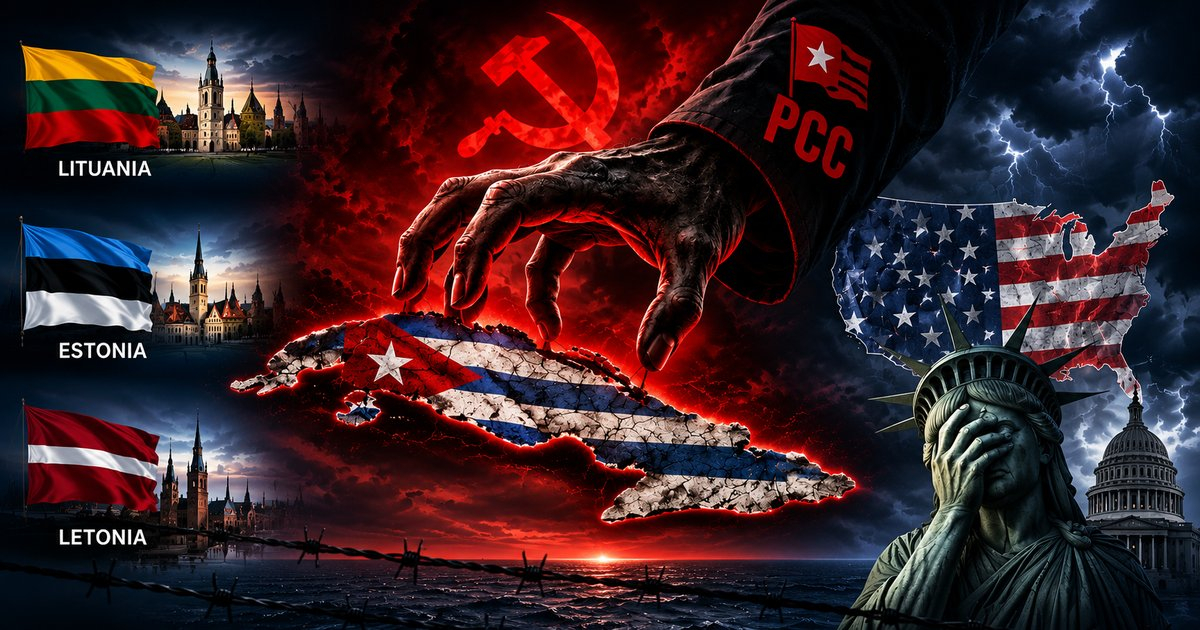
This Monday, Washington gathers champions of democracy, former dissidents, political leaders, and representatives from nations that have firsthand experience with communist rule. The Captive Nations Summit 2026 is not merely a ceremony to recall past tragedies; it serves as a critical warning about present dangers.
Particular attention should be paid to the experiences of Lithuania, Estonia, and Latvia. These Baltic nations endured decades of occupation and annexation by the Soviet Union. Their independence was reclaimed due to their people's steadfast national identity, resistance to Russification, and the opportune collapse of the communist empire.
The Baltic States: Frontline Defenders of Europe
Currently, these nations find themselves once again on the frontline of Europe's defense. Vladimir Putin's longing for Soviet imperial power and his disregard for the sovereignty of former Soviet territories is no secret. The invasion of Ukraine extends beyond a mere territorial dispute; it represents a broader conflict against the rights of smaller nations to choose their political systems, alliances, and futures freely.
Despite Russia maintaining military initiatives in various Ukrainian sectors, it has not secured a decisive victory. Ukrainian forces remain resilient, targeting Russian military installations, refineries, and logistical centers. While the Kremlin prolongs destruction and suffering, it has not dismantled the Ukrainian state nor broken its national spirit.
Western Unity and Russian Ambitions
Putin bets on the exhaustion of the West. He believes that Russia can endure longer than the Western democracies, which he anticipates will tire of supporting Ukraine's defense. He hopes that political divisions in the United States and Europe will achieve what his military has not managed on the battlefield.
Domestically, the Russian president maintains control over security apparatuses, media, institutions, and key economic elites. Despite high approval ratings, these figures should be viewed with caution in a regime where criticizing the war risks imprisonment, job loss, persecution, or even death.
Potential Threats to the Baltic Region
Although an immediate conventional invasion of Estonia, Latvia, or Lithuania seems unlikely, given Russia's military engagement in Ukraine, one must not confuse improbability with impossibility. Dictators do not always act with the rationality expected by democracies. Putin's miscalculations in Ukraine illustrate this.
Should Putin perceive Western withdrawal from Europe or a divided NATO, the danger increases. Before a full-scale invasion, Moscow might resort to sabotage, cyberattacks, misinformation campaigns, or provocations involving Russian-speaking communities.
Strengthening Baltic Defense to Safeguard Freedom
The Baltic defense cannot be merely symbolic. Estonia has a UK-led combat group, Latvia hosts a Canadian-led multinational brigade, and Lithuania is receiving a permanent German brigade. All three nations have hosted U.S. forces, with calls for a more sustained American presence.
American troops provide more than military capability; they place the U.S. commitment directly on the ground, transforming a potential Russian attack from an abstract diplomatic issue into an immediate assault on American and allied soldiers.
The Baltic and Cuba: A Shared Struggle for Democracy
The security of Estonia, Latvia, and Lithuania is intricately linked to Cuba's freedom. Havana's regime is not neutral; it has supported Russia's narrative and strengthened political and military ties with Moscow. At the recent UN General Assembly, Cuba pushed for a debate on U.S. sanctions, a move not supported by the Baltic countries.
Estonia has publicly announced a shift in its UN behavior, linking pressure on Havana with Cuba's support for Russia's war and its human rights abuses. Baltic nations understand that a dictatorship can leverage propaganda, diplomacy, and fear to legitimize itself, and they know the importance of democratic solidarity.
Defending Ukraine protects Lithuania, Estonia, and Latvia, while safeguarding the Baltic nations fortifies all of Europe. A robust Europe, aware of Russian threats and intolerant of Moscow's allied dictatorships, is crucial for Cuba's quest for freedom.
Western security is indivisible. The same imperial logic denying Ukraine's right to exist supports the regime denying Cubans their freedom of choice. The propaganda justifying Russia's invasion attempts to portray Cuba's tyranny as a perpetual victim rather than the primary oppressor it is.
During this Captive Nations Week, the message is clear: Europe cannot be secure while Russia believes it can re-conquer its neighbors. Similarly, Cuba cannot achieve freedom if democracies tolerate Havana as Moscow's strategic outpost in the Western Hemisphere.
The defense of the Baltic and the freedom of Cuba are integral to the same struggle: the battle for peoples' right to live in democracy, free from occupations and dictatorships.
Key Considerations in Baltic and Cuban Freedom
Why is the defense of the Baltic States important for Cuba?
The defense of the Baltic States is vital for Cuba as it challenges authoritarian regimes like Cuba's that align with Russian interests. Strong Baltic defense supports a broader democratic solidarity against authoritarianism.
How does Putin's strategy impact global democracy?
Putin's strategy aims to exploit Western exhaustion and political divisions, threatening global democracy by undermining smaller nations' sovereignty and encouraging authoritarian practices.
What role does the Baltic defense play in European security?
The Baltic defense is crucial for European security as it deters Russian aggression, ensuring the sovereignty and independence of Eastern European countries, and maintaining a united front against authoritarian expansion.