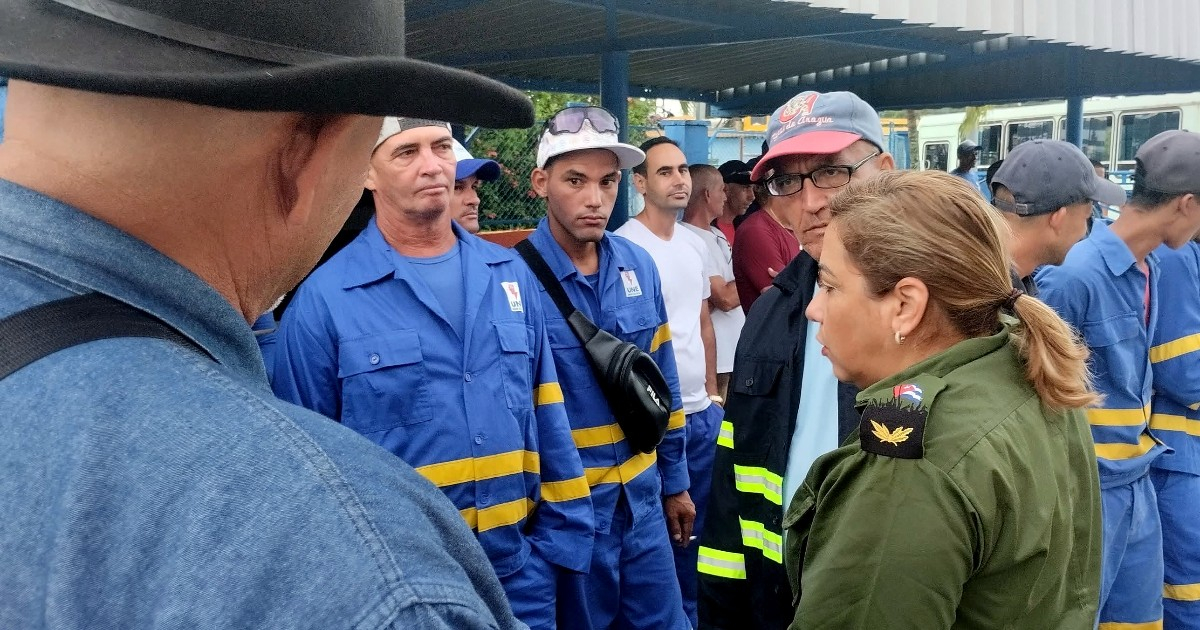
On Monday, the Cuban Electrical Union (UNE) issued a statement on their official Facebook page urging citizens to express appreciation towards linemen by offering them "a glass of water or a little coffee" whenever they are seen working in their neighborhoods.
This institutional message comes amid the country's most severe energy crisis in history and just days after two linemen were caught illegally selling electricity in Havana.
In the statement, the state entity highlighted that the linemen's work is more challenging due to current circumstances rather than the tasks themselves. They attributed the sector's difficulties to what they described as an "energy blockade," a euphemism the regime uses to refer to the U.S. embargo.
The message also stated that the workers "do not seek applause or recognition, but are content with the grateful gesture of their communities."
This appeal for gratitude surfaces during a period of heightened social tension: the National Electric System (SEN) has collapsed five times in 2026, with a deficit exceeding 2,341 MW on July 10th, when only 935 MW were available against a demand of 3,100 MW.
Reports indicate that Matanzas experienced blackouts lasting up to 87 consecutive hours in July; Granma endured 72-hour outages, while Havana averaged between 15 to 35 hours daily without electricity, according to data monitoring Cuba's blackout crisis.
Corruption Scandals and Social Outcry
The context of this gratitude call is particularly striking: On July 16th, residents of Calabazar in Havana's Boyeros municipality caught two UNE linemen in the act of illegally selling electricity to private businesses while the residential area had endured months with barely an hour of electricity daily.
The workers were found intoxicated, with stacks of cash and boxes of beer in the official company vehicle.
A local resident, Isol G, posted the incident on Facebook with the now-viral phrase: "They provide it to those who pay."
The following day, UNE issued a statement acknowledging the incident, condemning the actions as inconsistent with the conduct, ethics, and values of their workers, and announcing legal measures.
This is not an isolated case: In 2024, three linemen in Mariel diverted over 21 million pesos using official vehicles; in June 2025, seven employees and 14 customers were convicted of fraud and bribery in Havana's Electric Company; and in June 2026, illegal connections to prioritized circuits were detected in Guantánamo, while in Mantilla, service restoration was offered for $200.
Dangerous Working Conditions
Meanwhile, linemen work under conditions that have claimed lives: since 2022, at least six workers have died from electrocution or falls. The most recent was Osmani Rosales Núñez, who died on June 14, 2026, in Cárdenas, Matanzas, and in September 2025, Cleivi Pujada Castro died in Artemisa on an unprotected line.
The energy crisis has sparked an unprecedented wave of protests: June 2026 saw a record 107 street protests in Cuba, and this past Sunday, residents of Lawton in Havana staged another demonstration demanding electricity.
The UNE's call for offering coffee and water to linemen, issued amidst corruption scandals, workplace fatalities, and mass protests, was perceived by many Cubans as a provocation and an attempt to distract from the failed management of the national electric system.
Understanding Cuba's Energy Crisis
What led to the current energy crisis in Cuba?
The energy crisis in Cuba has been exacerbated by outdated infrastructure, a lack of investment, and external factors such as the U.S. embargo. This situation has resulted in frequent power outages and growing public discontent.
How are residents responding to the power outages?
Residents have responded with increasing frustration, leading to numerous protests across the country. Many are demanding reliable electricity and accountability from the government for the ongoing crisis.
What actions are being taken to address the corruption among linemen?
The UNE has issued statements condemning corruption and announced legal measures against those involved. However, systemic issues persist, and there are calls for more comprehensive reforms to prevent future incidents.