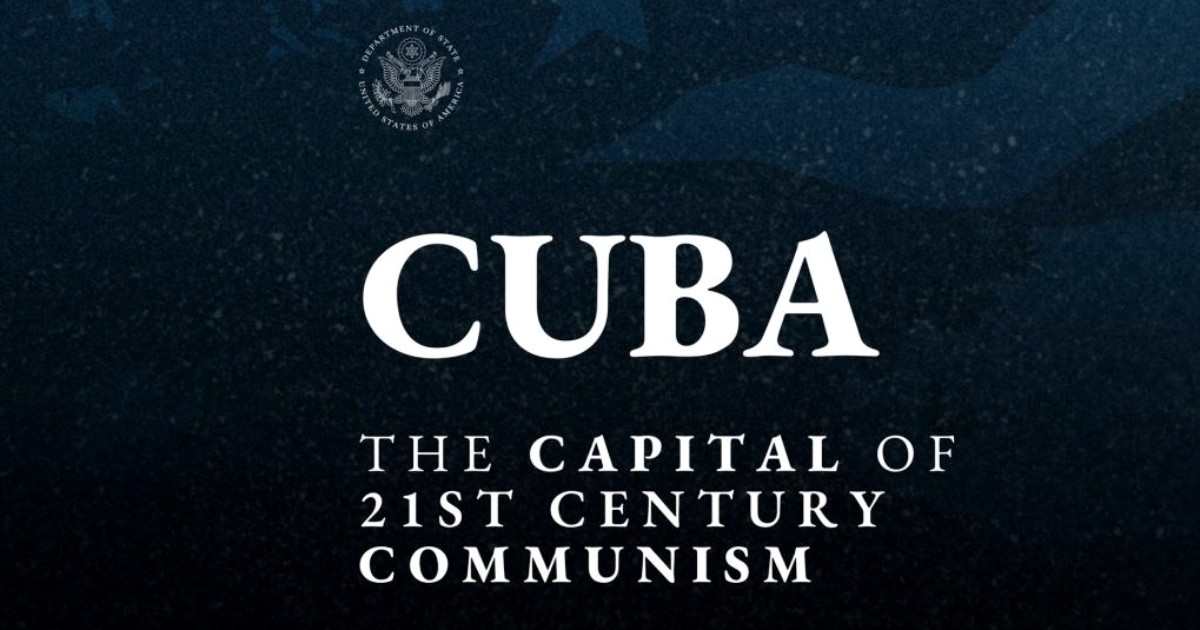
The U.S. Department of State released a comprehensive 100-page report on Monday, detailing nearly seventy years of espionage, ideological subversion, and revolutionary exportation by the Cuban regime against the United States. The report brands Cuba as "the epicenter of 21st-century communism."
Secretary of State Marco Rubio shared the document through his official account on X, delivering a pointed message: "For over six decades, the Cuban regime has led the charge in spreading radical leftism and third-worldism in America. The American public deserves to know this."
The report highlights that Cuba's campaign against the U.S. is unparalleled, as it combines espionage, infiltration, sabotage, and ideological warfare into a singular revolutionary endeavor, unmatched by any other hostile state.
The origins of this strategy can be traced back to a letter written by Fidel Castro in 1958, wherein he vowed that Americans would pay dearly for their actions. He foresaw a larger conflict ensuing post-revolution.
One chapter of the report focuses on Cuba's intelligence operations, particularly the Directorate of Intelligence (DI), featuring cases that have rattled the U.S. government for decades. Ana Belén Montes, who was recruited in 1984 while a graduate student at Johns Hopkins, rose to become the principal Cuba analyst at the Defense Intelligence Agency. She disclosed the identities of at least four undercover agents and revealed the location of a secret military base in El Salvador before her arrest in September 2001.
Victor Manuel Rocha, a former ambassador and National Security Council official, spied for Cuba for nearly half a century before his arrest in December 2023, resulting in a 15-year prison sentence. Then-Attorney General Merrick Garland described it as "one of the deepest and most enduring infiltrations of the U.S. government by a foreign agent." In 2026, the Department of Justice moved to revoke his citizenship.
The dossier also outlines direct connections between Havana and movements such as the Black Panthers, Weather Underground, and the Puerto Rican FALN, which executed up to 130 bombings between 1974 and 1983. During an 18-month span from 1971 to 1972, the FBI recorded around 2,500 bombings on U.S. soil, averaging nearly five per day.
On a contemporary note, the report warns of 18 known signal intelligence facilities hosted in Cuba, with three operated by China and two by Russia, whose personnel numbers have tripled on the island since 2023. The Wall Street Journal reported that China and Cuba have entered a covert agreement to construct a new facility, capable of intercepting communications in the southeastern U.S., in exchange for several billion dollars.
Furthermore, since 2023, Cuban mercenaries have been fighting in Ukraine on behalf of Russia, and in June 2026, the National Network on Cuba (NNOC) distributed a rapid response plan with instructions for coordinated actions against federal installations, military bases, and ICE detention centers within 24 hours of any U.S. military action against Cuba.
The report concludes with a stark warning encapsulating its central thesis: "Mistaking Cuba's poverty for harmlessness is a grave misunderstanding of the threat. Its power has always been ideological, subversive, and parasitic."
This publication aligns with the Trump administration's maximum pressure policy, which since January 2025 has reinstated Cuba on the list of state sponsors of terrorism, imposed over 240 sanctions, and declared a national emergency in January 2026, designating the island as an extraordinary threat to national security.
Key Insights into Cuban Espionage and Subversion
What is the main focus of the U.S. Department of State's report on Cuba?
The report focuses on nearly seven decades of espionage, ideological subversion, and revolutionary exportation by the Cuban regime against the United States.
How has Cuba's espionage strategy been unique compared to other hostile states?
Cuba's espionage strategy is unique because it combines espionage, infiltration, sabotage, and ideological warfare into a comprehensive revolutionary project, unmatched by any other hostile state.
What recent developments have been highlighted regarding Cuban intelligence activities?
The report highlights Cuba's hosting of 18 signal intelligence facilities, including those operated by China and Russia, and recent agreements for constructing new facilities to intercept communications in the U.S.