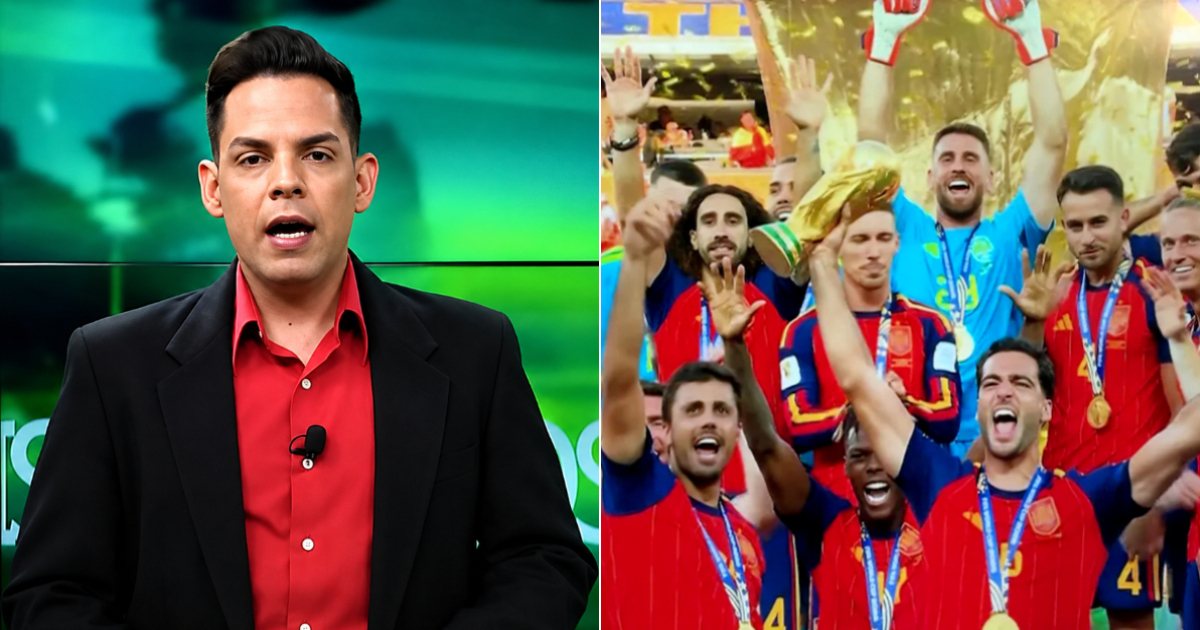
Lázaro Manuel Alonso Castro, one of the Cuban regime's most prominent media voices, has once again stirred up social media discussions.
This time, the buzz isn't about his fervent defenses of the communist government or his usual criticisms of dissidents and independent journalists. Instead, it revolves around his enthusiastic message celebrating Spain's national soccer team.
After Spain's victory, Alonso took to Facebook, writing, "We are champioooons. Great Spain in the final," a statement that caught the attention of his followers, with many interpreting it as a personal alignment with the Spanish team.
The post reignited longstanding speculation regarding his possible acquisition of Spanish citizenship.
In January 2025, the news site CubitaNOW reported that Alonso had obtained Spanish nationality through family descent and was planning a trip to Spain, citing sources close to the official spokesperson. The report also recalled that years earlier, Alonso's application for a U.S. visa had been rejected.
Although Alonso has never publicly confirmed his Spanish citizenship, his use of "we" to celebrate Spain's win has been seen by many as further evidence of his connection to the country.
The spontaneity of the post, made in the heat of Spain's victory, seemed to break from the usual political caution that characterizes one of the most visible figures in the Cuban regime's communication apparatus.
Comments on his post quickly followed. One notable exchange happened when a user wrote, "We are not, you are Cuban," to which Alonso responded, "Better not answer you here. Haha."
Rather than quelling speculation, his response fueled further debate. Another commentator chimed in to assert that Alonso is also Spanish, a claim he did not deny.
While the conversation doesn't conclusively prove his Spanish nationality, coupled with previous reports about his citizenship, and his own use of "we," it presents new elements that many interpret as an implicit admission or at least a refusal to deny a status he has not publicly acknowledged.
From a purely linguistic standpoint, the Royal Spanish Academy (RAE) defines "subject" as a "natural or citizen of a country subject to its political authorities," making it synonymous with "citizen."
In Spain's case, this implies being a subject of the Kingdom of Spain, a particularly striking circumstance for someone so visibly associated with Cuban state propaganda.
The irony has not gone unnoticed by observers. For years, Alonso Castro has been a vocal defender of the Cuban regime.
After the July 11, 2021, protests, he participated in media campaigns against activists, artists, and independent journalists, defended the official narrative on the demonstrations, and received the Juan Gualberto Gómez National Journalism Award that same year for his propagandistic work against the song "Patria y Vida."
More recently, he has aligned with the government by calling for sanctions against officials who, according to him, obstruct the implementation of 176 economic measures approved by the National Assembly, insisting on reinforcing political control over those deviating from state policy.
Given his role, his exuberant celebration of Spain's victory takes on a political dimension that transcends sports.
Someone who has spent years as a staunch defender of a one-party system, lacking free elections, political pluralism, and press freedom, seemed to identify with a parliamentary democracy enough to speak of it in the first person plural.
The contradiction is glaring. While dedicating much of his career to justifying the positions of Cuba's totalitarian regime and discrediting opponents, activists, artists, and independent journalists, he celebrated with a spontaneous "we" the victory of a country whose Constitution enshrines many of the rights and freedoms that the Cuban state restricts or denies.
It is indeed a paradox that a leading spokesperson for the Castro dictatorship would express pride—even if only in sports—over a status associated with a democratic state to which hundreds of thousands of Cubans have emigrated in search of freedoms and opportunities absent in their homeland.
Perhaps the euphoria of the moment got the better of him. Or perhaps, in his excitement over soccer, he voiced what he had so far chosen not to publicly confirm.
At least on the soccer field, Lázaro Manuel Alonso Castro chose to speak in the first person plural.
"We are champioooons."
One word was enough to reopen the debate over his potential Spanish citizenship and expose a hard-to-ignore contradiction: a Cuban regime spokesperson who, in a moment of enthusiasm, seemed to proudly assert his affiliation—legal or sentimental—with a European democracy.
Exploring Lázaro Manuel Alonso's Alleged Spanish Citizenship
Why is Lázaro Manuel Alonso's Facebook post controversial?
Alonso's post celebrating Spain's victory sparked controversy because it suggested a personal connection to Spain, fueling speculation about his Spanish citizenship, a sensitive topic given his role as a spokesperson for the Cuban regime.
Has Lázaro Manuel Alonso confirmed his Spanish citizenship?
No, Alonso has not publicly confirmed obtaining Spanish citizenship. However, his recent comments and previous reports have led many to speculate about his possible dual nationality.
What is the significance of Alonso's use of "we" in his post?
The use of "we" in his post was interpreted as a personal identification with Spain, implying a possible legal or emotional connection, which stands in contrast to his public role defending the Cuban regime.
What does this situation reveal about Alonso's political stance?
The situation highlights a contradiction in Alonso's public persona, as he appears to embrace aspects of a democratic nation while continuing to support a regime known for its authoritarian practices.