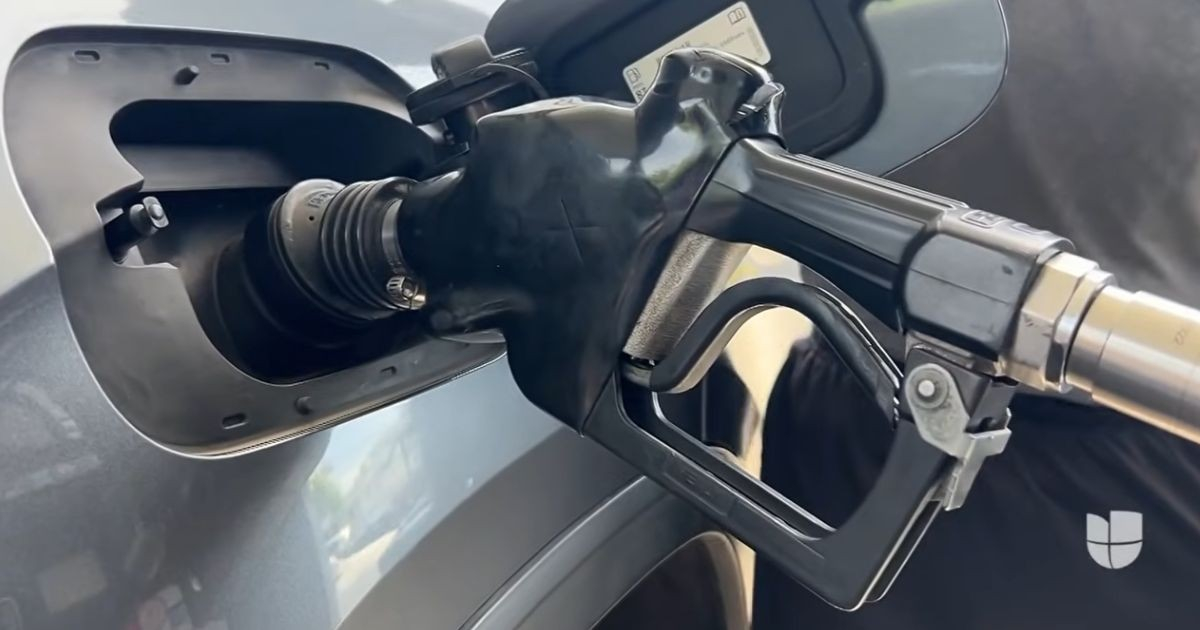
This Monday, the average price of gasoline in the United States climbed back to $4 per gallon, driven by the resurgence of military hostilities between Washington and Tehran.
The increase was confirmed by the American Automobile Association (AAA), as reported by the Associated Press. This spike follows a temporary dip in prices that fell below the $4 mark due to a provisional agreement between the U.S. and Iran.
However, the fragile peace was shattered when Tehran's regime targeted commercial vessels in the Strait of Hormuz on July 6 and 7, prompting President Donald Trump to initiate a new wave of heavy bombings.
Since then, the United States has executed at least seven consecutive nights of airstrikes against Iran, hitting over 300 military targets.
On July 18, Iran announced it was suspending the agreement with Washington. On July 11, the newly appointed Supreme Leader, Mojtaba Jamenei, had already ordered the continuation of attacks, ruling out any return to negotiations in the near future.
The current gasoline price of $4 per gallon marks an increase of nearly 90 cents compared to the average of $3.14 from a year ago.
Being a national average, the price variation is significant across different states. Some drivers have been paying well above $4, while others are still below this level, depending on local supply and state-specific taxes and fees.
In Florida, the state average hovers around $3.91 per gallon, slightly under the national average, although in Miami, prices have already exceeded $3.97. The year's peak was reached on May 2, when the national average hit $4.48 per gallon, with spikes reaching $5.39 in Miami Beach.
On the international stage, Brent crude oil, a global benchmark, rose by 3.2% to $90.95 per barrel on Monday, while the U.S. benchmark, West Texas Intermediate (WTI), increased by 2.8% to $84.04 per barrel.
The conflict between these two powers originated on February 28, 2026, with Operation Epic Fury, a joint U.S. and Israeli assault on Iranian nuclear and military facilities.
Since the onset of this crisis, gasoline prices in the U.S. have surged by approximately 50%, largely due to disruptions in the Strait of Hormuz, a passageway for 20% to 25% of the world's oil supply.
Understanding the Impact of U.S.-Iran Tensions on Gasoline Prices
Why have gas prices increased in the U.S. recently?
Gas prices have surged due to the renewed military conflict between the U.S. and Iran, which has disrupted oil supply routes, particularly through the Strait of Hormuz.
How does the Strait of Hormuz influence global oil prices?
The Strait of Hormuz is a critical chokepoint for the global oil supply, with 20% to 25% of the world’s oil passing through it. Disruptions here can lead to significant increases in oil prices worldwide.
What factors contribute to regional variations in gasoline prices?
Regional gasoline price differences are influenced by local supply conditions, state taxes, and fees, as well as transportation costs from refineries to distribution centers.