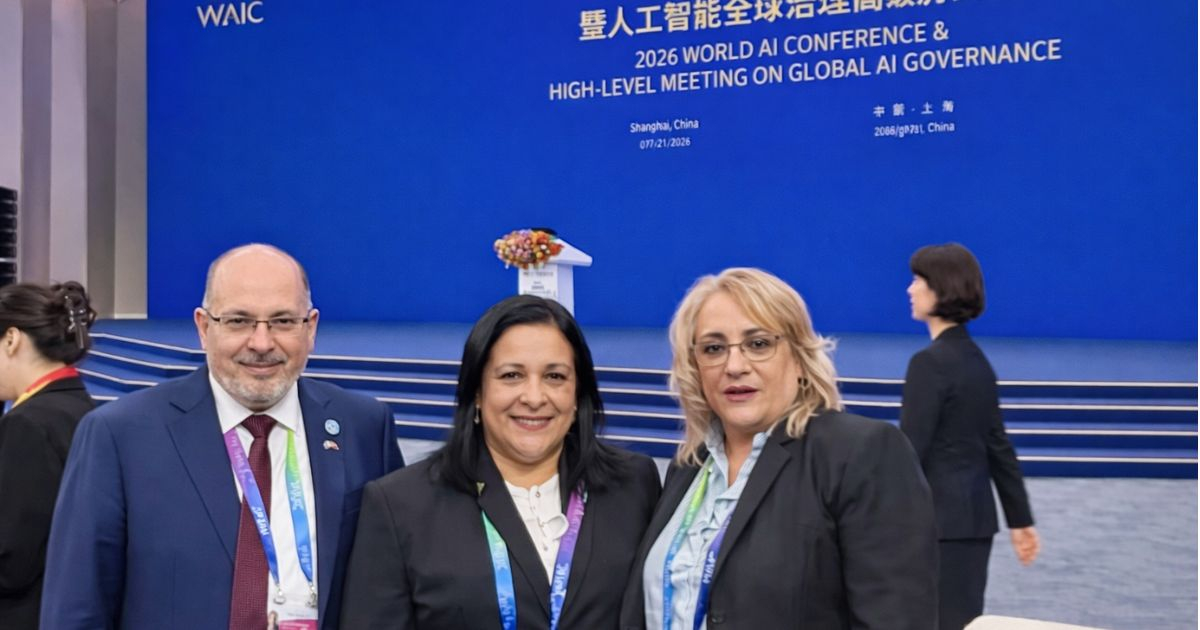
On July 16, amidst one of its most severe energy crises in decades, Cuba became a founding member of the World Artificial Intelligence Cooperation Organization (WAICO), established in Shanghai with 29 other countries ahead of the World Artificial Intelligence Conference.
Leading the Cuban delegation, the Minister of Communications, Mayra Arevich Marín, signed the founding agreement, announcing the country's participation via her social media profile on X. She emphasized that this step "reaffirmed the national commitment to inclusive global AI governance that respects sovereignty."
The minister stated that within WAICO, Cuba aims to "narrow the technology gap, promote open-source initiatives, and collectively address the risks associated with AI development," according to reports.
This new organization, largely driven by China under Xi Jinping's leadership—who hailed it as "a significant milestone in AI development history"—is positioned as the first intergovernmental body exclusively dedicated to AI, with its permanent headquarters in Shanghai. Other founding members include Russia, Belarus, Venezuela, Brazil, Serbia, Kazakhstan, Pakistan, Indonesia, and Laos.
Although WAICO is open to all sovereign nations without political conditions, analysts point out that it lacks binding enforcement mechanisms, which limits its tangible impact beyond verbal commitments.
Irony of AI Aspirations Amidst Power Outages
The stark contrast between the official announcement and Cuba's reality did not go unnoticed. Just two days before the Shanghai signing, Cuba experienced its fifth nationwide power outage in 2026. On the day of WAICO's establishment, the country's electricity generation deficit reached 2,240 MW, with peak availability at a mere 990 MW, less than half of what is needed.
In Havana, power cuts have exceeded 20 hours daily throughout July. On July 10, a record electricity deficit of 2,341 MW left over 70% of the country simultaneously without power. Nine out of sixteen thermoelectric units remain offline, and prolonged outages have severely disrupted internet access. In such a context, even discussing AI, let alone a functional internet connection, seems ironic.
Cuba’s Previous AI Engagements
Cuba's involvement in AI is not entirely new. In November 2025, the regime launched its first National AI Consortium with 22 founding members, including state-run entities like ETECSA and BioCubaFarma. In April 2025, President Díaz-Canel signed an agreement with Russia for a joint AI laboratory, and in October 2024, Cuba joined the BRICS AI Alliance Network.
Arevich Marín's presence in Shanghai also carries geopolitical implications: she was sanctioned by the U.S. Treasury's Office of Foreign Assets Control (OFAC) on May 18, 2026, further evidencing Havana's explicit alignment with the China-Russia bloc against Washington.
While the regime signs international AI agreements, Cuba teeters on the brink of total collapse due to the energy crisis. Without stable electricity, reliable connectivity, or basic tech infrastructure, any dreams of AI development clash with a reality shattered by 67 years of dictatorship.
Understanding Cuba's Role in Global AI Cooperation
What is WAICO and its purpose?
WAICO, the World Artificial Intelligence Cooperation Organization, is a newly established intergovernmental entity dedicated to AI technology. It aims to foster international collaboration in AI development and is headquartered in Shanghai.
Why is Cuba's participation in WAICO significant?
Cuba's participation is significant because it highlights the regime's effort to engage in global AI initiatives despite facing severe domestic energy and connectivity challenges. It also reflects Cuba's geopolitical alignment with China and Russia.
How does the energy crisis affect Cuba's AI ambitions?
The ongoing energy crisis severely undermines Cuba's ability to pursue AI developments. With frequent power outages and limited internet access, the infrastructure necessary for AI growth is critically lacking.