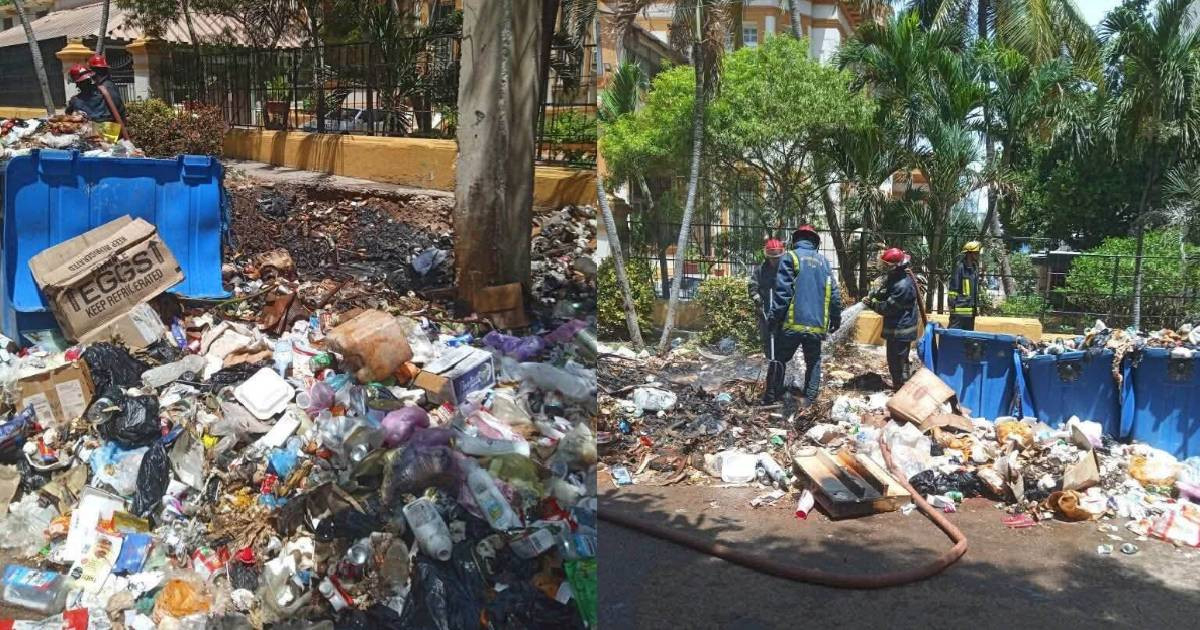
This past Saturday, a fire consumed part of a large trash heap at the intersection of 15th and K in El Vedado, near the national headquarters of the Committees for the Defense of the Revolution (CDR). This incident serves as yet another indicator of the declining state of public services in Havana.
Cuban citizen Cesario Navas shared images of the blaze on his Facebook page, noting that such occurrences are common in the numerous makeshift dumps that have become prevalent across the city.
Navas reported that the fire damaged several new waste containers, necessitating the intervention of a firefighting brigade.
The dump is located behind the CDR's national office and across from a building housing the Ministry of the Interior's General Directorate of Penitentiary Establishments, he said.
For Navas, the fact that such a significant pile of garbage has remained for months next to the CDR's main office without any visible action being taken is "incoherent."
In his social media post, the activist painted a bleak picture of a city plagued by garbage accumulation, landfill fires, blackouts, and shortages of water, food, and medicine. "Cuba is suffering! Enough is enough!" he wrote.
Comments on his post echoed these sentiments. Several residents pointed out that the trash heap has occupied the corner for months, making it nearly impossible for vehicles to pass due to the overwhelming amount of debris.
Others described the neglect as "shameful" and questioned why the CDR has not taken any corrective measures.
Contradictions in Waste Management
The irony is striking, as this corner lies within the area covered by the Popular Council of Rampa, which just two weeks prior had launched with much fanfare a local development project called El Rampeño. This initiative aims to collect solid waste door-to-door using electric tricycles in Vedado.
The project kicked off on July 6th with only five out of the 30 planned tricycles, charging households 100 pesos monthly and starting at 15,000 pesos for private businesses.
State TV and official Cuban media covered the launch enthusiastically, though the skepticism among locals was apparent from the outset.
Systemic Issues and Public Health Risks
The incident at 15th and K is not isolated. On the same Saturday, the corner of Monte and Águila in Jesús María was also reported as an open-air dump, showcasing the same pattern of waste accumulation.
Earlier this year, it was revealed that only 44 out of 106 garbage trucks in the capital are operational due to diesel shortages and mechanical failures.
Havana produces between 24,000 and 30,000 cubic meters of solid waste daily, yet up to 23,814 cubic meters go uncollected each day, according to official statistics.
The public health ramifications are severe. Cuba ended 2025 with at least 81,909 cases of dengue and chikungunya and 65 officially reported deaths. The outbreak continues into 2026 with over 2,800 cases across 134 municipalities.
Historian Julio César González Pagés grimly described the situation: "Havana, surrounded by garbage dumps and fecal matter, approaches summer with scarce water, hygiene, and medicines, echoing the worst of its colonial past."
FAQs on Havana's Waste Management Crisis
Why is waste management failing in Havana?
Waste management is failing due to shortages of diesel, mechanical deterioration of garbage trucks, and ineffective management by local authorities.
What are the health impacts of the waste crisis in Havana?
The crisis has contributed to public health issues including outbreaks of dengue and chikungunya, with thousands of cases reported and numerous fatalities.
How do residents view the local waste management projects?
Many residents are skeptical of local projects like El Rampeño, citing lack of resources and inefficiency despite official media enthusiasm.