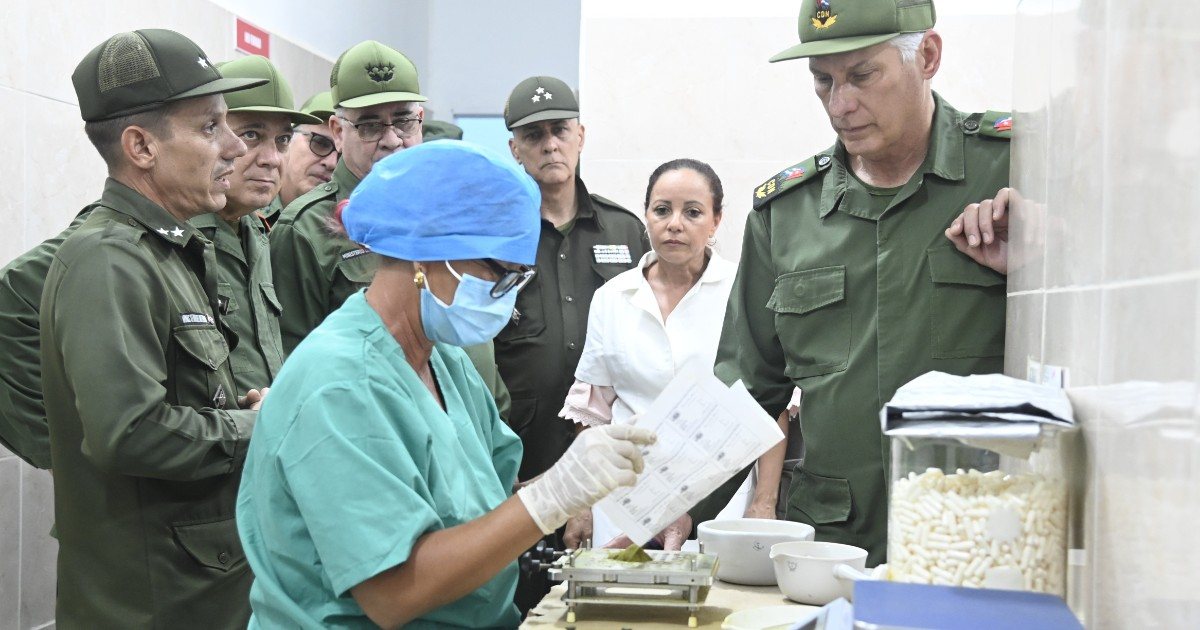
This past Saturday, the Cuban government showcased what it described as a scientific milestone: a meeting between Miguel Díaz-Canel and the leadership along with researchers from the Ministry of the Interior (MININT), under the grandiose banner "Knowledge Serving the Nation."
The Cuban Presidency stated that the gathering aimed to explore how "science and innovation" are applied within this state agency to boost the country's economic and social progress.
During the meeting, they examined the utilization of artificial intelligence, energy carrier conservation, and the modernization of services such as identification cards, visas, driving licenses, and the Soberanía digital platform.
Díaz-Canel also toured a MININT laboratory focused on producing syrups, nutritional supplements, and natural products derived from medicinal plants, which were presented as an "effective alternative for health protection."
The irony of the setting was hard to ignore. MININT, known as the most repressive institution in the Cuban regime, is now being portrayed by the government as a scientific pioneer in the use of medicinal plants.
This surreal visit follows only months after the agency admitted it lacked physical cards to issue identity documents due to raw material shortages. Now, they are touting the service as a triumph of knowledge management.
The regime recently revealed plans for the most significant update to the Cuban identity card in decades, featuring voice and iris registration—an ambitious technological goal that starkly contrasts with the inability to print a plastic card.
While the use of artificial intelligence within this Cuban state entity is not new, the government's boast about it in the midst of the current energy crisis has sparked ridicule.
In June, the regime promoted its commitment to this technology, prompting Cubans on social media to ask: "With what electricity?", "What energy powers this artificial intelligence, coal?" and "You have neither electricity, internet, nor cloud services. You're delusional, but at a chronic level."
Díaz-Canel's photo-op tour of the MININT labs where "syrups from medicinal plants" are made comes at a time of extreme political tension on the streets of Cuba and in relations with the United States.
Accompanying the leader on his tour were Roberto Morales Ojeda, Secretary of Organization of the Central Committee of the Party, and General of the Army Corps Lázaro Alberto Álvarez Casas, Minister of the Interior.
Cuba's Technological Ambitions and Challenges
What was the purpose of Díaz-Canel's meeting with MININT officials?
The meeting aimed to explore the application of science and innovation within the Ministry of the Interior to contribute to Cuba's economic and social development.
How is artificial intelligence being used by MININT?
Artificial intelligence is being employed for various services, including the modernization of identity cards, visas, and other administrative processes, despite ongoing energy challenges in Cuba.
What ironic situation is highlighted by the visit?
The irony lies in the Cuban government's attempt to present MININT, known for its repressive nature, as a leader in scientific innovation, particularly in using medicinal plants.