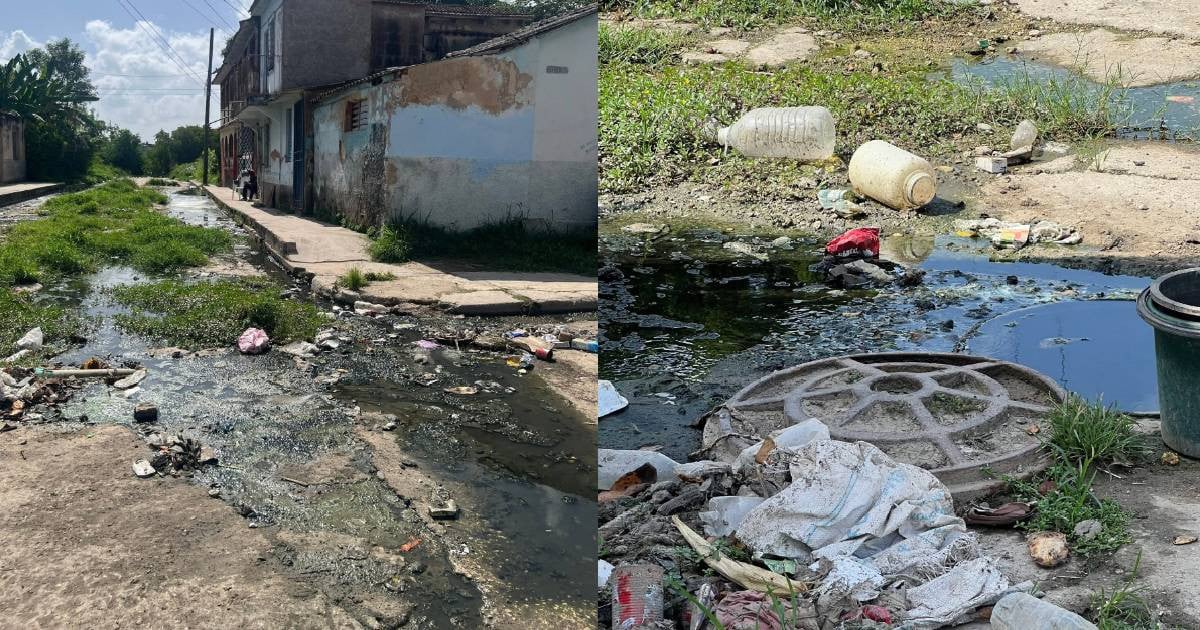
The residents of La Marina in Matanzas are grappling with a dire public health crisis characterized by streets flooded with sewage, unregulated trash heaps, and sewerage systems that have become makeshift drains for wastewater.
A Facebook post by local resident Leydis Martínez Ramos exposed roads completely submerged in stagnant water and littered with solid waste—plastic bags, bottles, and debris—alongside deteriorating buildings. The post highlighted an Etecsa utility box that residents have repurposed to divert their wastewater due to the lack of functional sanitation infrastructure.
One local clarified in the comments that what was photographed "is not a cesspit, but an Etecsa utility box that residents have diverted their wastewater into." This statement underscores the desperation that has led to such dangerous improvisations with severe health implications.
Critical Areas and Citizen Frustration
The intersection of Velarde and Santa Teresa is noted as one of the most critical areas, where the accumulation of trash and sewage obstructs vehicle passage.
The sentiment expressed in the post reflects years of accumulated frustration among the residents. "This place has been utterly neglected for over a century; there's never been any concern for this area," wrote one resident.
Another comment directly called out state responsibility: "There's a governor drawing a salary to oversee this, and a municipal office of Popular Power whose president gets paid... Why do citizens have to do this work for free?"
Voices from La Marina
A 62-year-old resident shared that neighbors have been forced to divert sewage onto the streets "because there is no systematic maintenance," adding that they are tired of cleaning without institutional support.
She also noted the historical neglect of the neighborhood: "This was the only neighborhood that wasn't mentioned for better or worse on July 11, so what's the point here?"
Summing up the community's plea, Martínez stated clearly: "Living among trash and wastewater should not be an acceptable reality for any resident of Matanzas."
Wider Sanitary Collapse
La Marina's crisis is not an isolated incident but the most acute expression of a sanitary collapse affecting the entire province since early 2026.
The Municipal Waste Company of Matanzas is operating with just 11 out of its 24 garbage trucks due to a shortage of diesel fuel, with daily allocations ranging from 300 to 550 liters—far short of the more than 2,700 liters required to cover all routes. Of a workforce of around 1,400, only 930 are active.
This shortfall has led to overflowing dumpsites throughout the city, illegal burnings producing toxic smoke, and emerging trash heaps in neighborhoods like Versalles, Embarcadero, and La Marina.
In early June, health authorities confirmed an outbreak of hepatitis A, with seven new positive cases and 49 suspected cases emerging in just one week, according to a report by the Provincial Center for Hygiene, Epidemiology, and Microbiology.
Over 300,000 residents of the province lack a stable potable water supply, exacerbating the epidemiological situation.
Even the official Communist Party newspaper in Matanzas, Girón, admitted in May that "what's at stake now is not just Matanzas' image, but the health and future of its residents," a rare acknowledgment of the crisis's severity.
Understanding the Sanitary Crisis in Matanzas
What is causing the sanitary crisis in La Marina?
The crisis is largely due to inadequate sanitation infrastructure, leading to streets flooded with sewage, uncontrolled trash accumulation, and the use of makeshift drains.
How are residents coping with the lack of sanitation?
Residents have resorted to redirecting wastewater into utility boxes and streets due to the absence of systematic maintenance, reflecting their desperation.
What are the broader implications for Matanzas?
The crisis in La Marina is symptomatic of a larger sanitary collapse across the province, marked by fuel shortages, inactive waste collection vehicles, and an outbreak of hepatitis A.