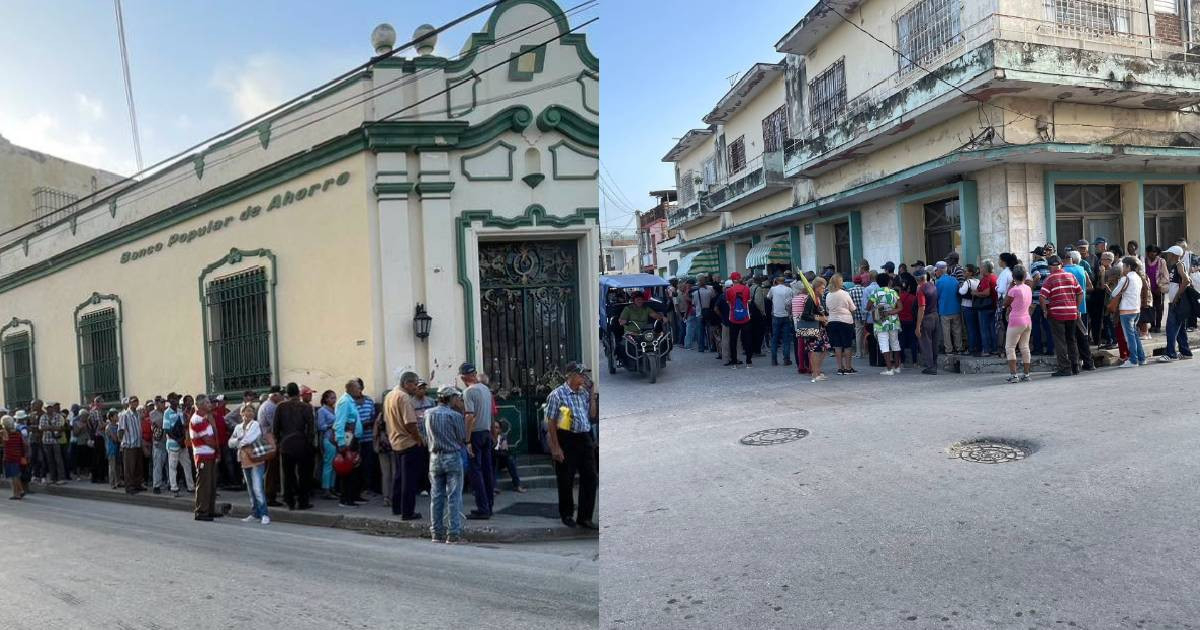
Despite being fully equipped with electricity, cash, and internet connectivity, the Banco Popular de Ahorro in Holguín abruptly closed at 3:00 p.m. on Friday, leaving numerous retirees without their pension payments. This incident was reported by Pedro Lorenzo Hechavarría Pupo on Facebook, highlighting the bank's disregard for its elderly customers.
"If Wednesday was bad for withdrawing pensions in Holguín, today, Friday, was even worse. What has changed? NOTHING. What has improved for the retirees?… NOTHING," Hechavarría lamented, sharing images of extensive queues encircling the colonial-style bank building at Aguilera and Maceo streets, in the heart of the city known as the City of Parks.
According to Hechavarría, bank employees announced, "We have to close now, please," effectively ending the service for the day, ignoring the many people still waiting under the sun.
Systemic Flaws and Proposed Solutions
Hechavarría further questioned the bank's operational logic: if they can delay services due to lack of resources, why can't they extend hours when everything is functioning? He suggested a staggered lunch break for employees in branches with multiple service windows to maintain uninterrupted service.
"If we talk about giving autonomy to municipalities, can't any municipality safeguard its retirees? Is there no expertise to resolve the retirees' plight?" Hechavarría inquired.
This Friday's scenario is a recurring ordeal for Holguín's retirees, who face the same struggle month after month. In May, Hechavarría documented similar queues at the same branch.
Public Outrage and Government Accountability
The public outcry in response to the situation was unanimous. "This pension withdrawal process is inhumane, with elderly people waiting for hours in the sun just to receive their meager pensions," one person commented, emphasizing the dire conditions faced by many who arrive without even having breakfast.
Another commenter criticized the authorities directly: "This happens because those in charge simply don't care about the people's reality. They live in a parallel world where they don't face power outages or endless queues. If banks were privately owned like in the real world, these issues wouldn't exist."
One individual called on local leaders to intervene and protect the vulnerable population, highlighting the government's and the Party's inaction.
The problem extends beyond this single bank. "The central post office in Holguín operates similarly, and now that the 12-story post office is gone, it's even worse," another person remarked.
Wider Implications Across Cuba
The struggle in Holguín is not isolated. On the same Friday, a retired journalist from the state-run Granma newspaper reported spending eight hours in line at a Havana bank for her pension, while a photojournalist from the same outlet described chaotic scenes at another capital branch, with "cries, shouts of frustration, cane-wielding, and loud accusations."
The national banking infrastructure is crumbling: over 50% of ATMs are out of service or empty, only 3.77% of transactions are digital despite three years of forced digitization, and the maximum pension of 4,000 pesos per month is worth less than seven dollars on the informal market, while basic food costs exceed 30,000 pesos.
In response, the Cuban Central Bank announced on Friday the national rollout of pension payments through local businesses, implicitly admitting the state's inability to sustain its social security system. A similar pilot project in Holguín launched in May reached just 5,000 of the municipality's more than 52,000 retirees, less than 10%.
Understanding Cuba's Pension System Challenges
Why did the bank in Holguín close early despite having resources?
The bank closed early due to internal policies and operational decisions, despite having the necessary resources to continue operations.
What issues are retirees facing in Cuba regarding pension withdrawals?
Retirees in Cuba face long waits, inadequate service, and a lack of basic resources like cash and functional ATMs, making it difficult to access their pensions.
What solutions have been proposed to improve pension access in Cuba?
Suggestions include extending bank hours when resources are available, staggering employee breaks, and implementing pension payment schemes through local businesses.
How is the Cuban government addressing the pension payment crisis?
The government has begun to extend pension payments through local businesses as a measure to alleviate the strain on the traditional banking system.