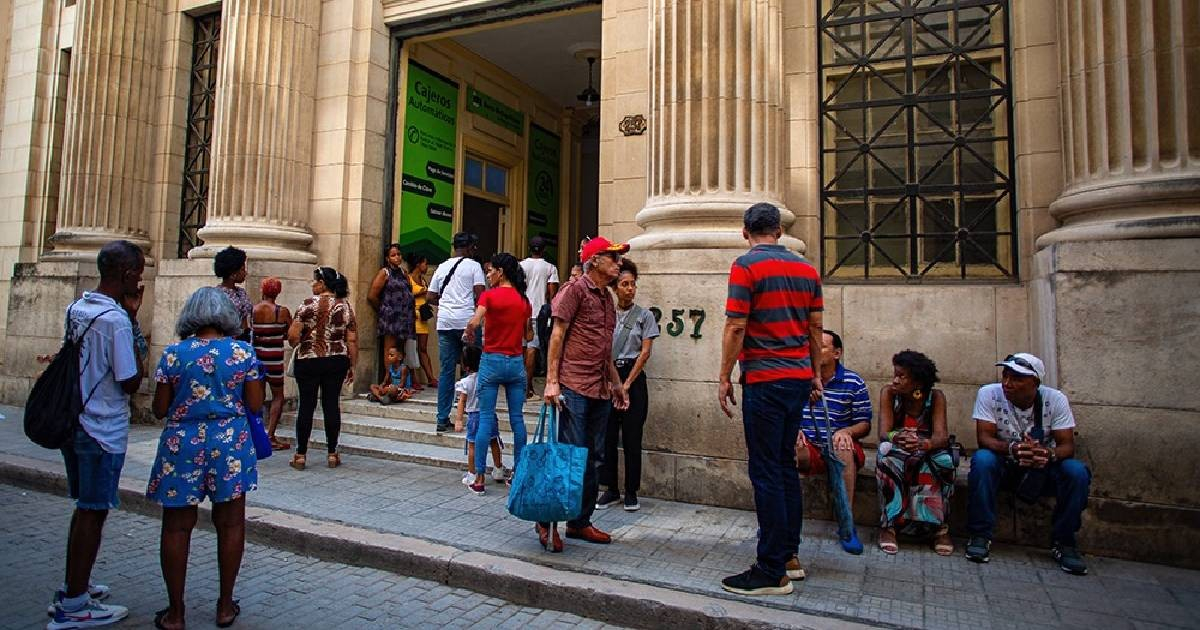
This Saturday, the recent initiatives from Cuba's Central Bank (BCC) aimed at boosting digital payments and expanding pension disbursement via local businesses were met with a mix of skepticism and dark humor across social media platforms.
Cubans pointed out the inherent contradiction highlighting the nation's economic woes: while restrictions on cash transactions are lifted, banks are devoid of cash.
Through Resolution 74/2026, the BCC declared a significant shift in its banking strategy, abolishing the 5,000 Cuban peso cap on cash transactions among economic actors, a policy that had been in place since August 2023.
Signed by the Central Bank's president, Juana Lilia Delgado Portal, on July 10, the regulation will become effective on Monday, July 20.
The measures include immediate payment credits within the same bank starting August 1, a reduction of merchant fees from 1.5% to 0.8%, consumer and merchant discounts of 4% and 2% respectively for online payments, elimination of cash deposit fees, and a 0.2% fee for cash withdrawals.
Public Reactions and Criticisms
The public's response was swift and sharp. "There's no limit on cash payments now, but the issue is there's no cash in the banks," one citizen noted. Another plainly stated, "Cuban banks have no money." Summarizing with irony, a third remarked, "Good joke, government, now seriously, where can I withdraw cash?"
Critics also targeted the infrastructure challenges that would hinder any large-scale digitalization efforts.
"Sure, bank transfers are great where there's electricity, internet, and a bank. I want to know how folks in rural areas will manage," a Facebook user questioned.
Another bluntly asked, "With what electricity and internet?" A comment encapsulated the sentiment: "Transfers with no power or connectivity. This government is out of touch."
Concerns Over Local Business Involvement
There was also apprehension regarding the plan for local businesses to handle pension payments using their daily cash sales.
"This is the final blow to totalitarianism. Private entrepreneurs now run the pension system," a user on social media platform X wrote.
Another warned, "The official says they'll be covering 'part' of these payments to retirees, but we know it'll be the whole amount."
A third pointed out the political implications: "Soon, they'll blame the small business owners for Cuba's economic and social chaos, prompting people to target their businesses instead of the Communist Party if payments fail."
The Failure of Mandatory Banking
In 2026, only 3.77% of transactions in Cuba were digital, less than 10% of private businesses regularly accepted transfers, and over half of Havana's ATMs were non-operational in May.
The regime imposed 15,240 fines and ordered 269 business closures without reversing the trend of rejecting transfers.
Simultaneously, the informal market for converting transfers to cash saw fees soar from 15% in September 2025 to 40% in Santiago de Cuba by July 16, where transferring 1,000 pesos meant receiving just 600 in cash.
Cuba's 1.7 million retirees live on a minimum pension of 4,000 pesos monthly—less than seven dollars on the informal exchange rate—while the basic food basket exceeds 30,000 pesos.
"Regarding the effectiveness of these economic measures, as Elpidio Valdés cartoons would say: We'll have to see that, compay! The Cuban economy is a vicious cycle," a Facebook user concluded.
Key Questions on Cuba's Economic Policies
What are the new measures introduced by Cuba's Central Bank?
The Central Bank of Cuba has introduced measures including the removal of cash transaction limits, reduced merchant fees, immediate payment credits, and changes to pension payment systems through local businesses.
How has the public reacted to the Central Bank's new policies?
The public has responded with skepticism and humor, pointing out contradictions such as the lack of cash in banks despite lifted transaction limits, and questioning the feasibility of digital payments given the infrastructure challenges.
What challenges face the digitalization of payments in Cuba?
Cuba faces significant challenges in digitalizing payments, including limited internet access, frequent power outages, and an insufficient banking infrastructure, especially in rural areas.