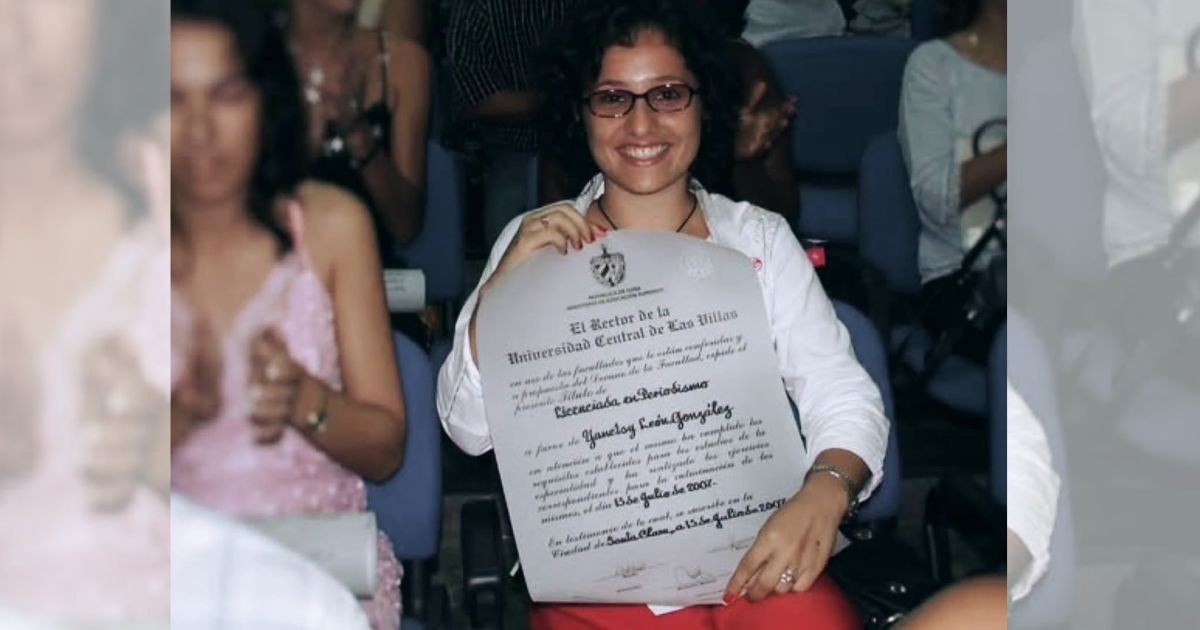
Yanetsy León González, a journalist affiliated with the Cuban state and an alumna of the Central University of Las Villas, shared a poignant reflection on social media this past Saturday. Her post captures the growing disillusionment that young Cubans experience toward higher education today.
Her commentary, titled "Why Does a Degree Matter?", coincides with her 19th anniversary since graduating in Journalism. It emerges at a time when Cuba's university system is facing an unprecedented crisis.
Changing Perspectives on Education
Working for the state-run newspaper Adelante in Camagüey, León González describes mentoring a young woman who has just started her studies but is already working to pay rent. This starkly contrasts with her own student days in Santa Clara, when she managed with money orders from her parents and weekends eating simple meals at her scholarship-funded accommodation.
"From my scholarship days, I remember the weekends, the solitude, the frogs in the bathroom, the cold, and the friends who became like siblings over time," she reminisces.
The Decline of Academic Aspirations
The core of her reflection highlights a deeper societal shift in Cuba: "Now, knowledge no longer seems profitable. Many children don't dream of a profession but of a job that can earn them money quickly. A counter, any small stand, a vendor's position suffices. The same exploited vendor as always."
León González acknowledges a stark reality: "In Cuba, it has become normalized to say that studying is not worthwhile," a claim supported by statistics. According to the Union of Young Communists, by December 2022, around 800,000 young Cubans were neither studying nor working, nearly eight times the number in 2019.
Economic Pressures and Educational Disengagement
A significant factor in this disillusionment is the salary crisis. State professionals in Cuba earn between 4,000 and 9,400 pesos monthly, equivalent to eight to 20 dollars at the informal exchange rate, while hotel construction workers can earn between 32,000 and 40,000 pesos, doubling or tripling the income of doctors and engineers.
In June, the regime suspended university entrance exams for the 2026-2027 academic year due to the energy crisis, exacerbating the perception of a collapsing system.
That same month, students at the University of Havana demanded answers with the slogan, "We won't attend classes until we get answers."
The Paradox of a Cuban Degree
However, León González points out a paradox that clearly defines the situation: "That same piece of paper that seems worthless here travels in suitcases, gets legalized, translated, and validated. It crosses borders because, even though we've learned to distrust it, in many places it still proves knowledge, effort, and history."
This contradiction is underscored by numbers: Spain validated over 5,551 Cuban university degrees just in the first half of 2025, reaffirming that while a Cuban diploma retains value abroad, it does not guarantee even survival within the island.
More than a million Cubans have left the country since 2021, mostly young people aged 20 to 40, many of whom hold university degrees that the system failed to retain.
The journalist concludes her reflection with a defense of knowledge that transcends material value: "I still believe that a degree doesn't matter for the paper it's printed on or the salary it guarantees—if it guarantees any—but for how it taught us to see the world. Perhaps that remains its most profound usefulness. And that's something that no one has been able to devalue."
Understanding the Cuban Higher Education Crisis
What factors contribute to the disillusionment with higher education in Cuba?
The disillusionment stems from economic pressures, low salaries for state professionals, and a perception that knowledge is no longer profitable. Many young people prefer immediate income from jobs like vending over pursuing long-term professional careers.
Why was the entrance exam for Cuban universities suspended?
The Cuban regime suspended the university entrance exams for the 2026-2027 academic year due to the ongoing energy crisis, further impacting the already struggling educational system.
How do Cuban university degrees hold value outside the island?
Despite their diminished perceived value within Cuba, Cuban university degrees are often recognized and validated abroad, such as in Spain, where they continue to serve as proof of education, effort, and expertise.