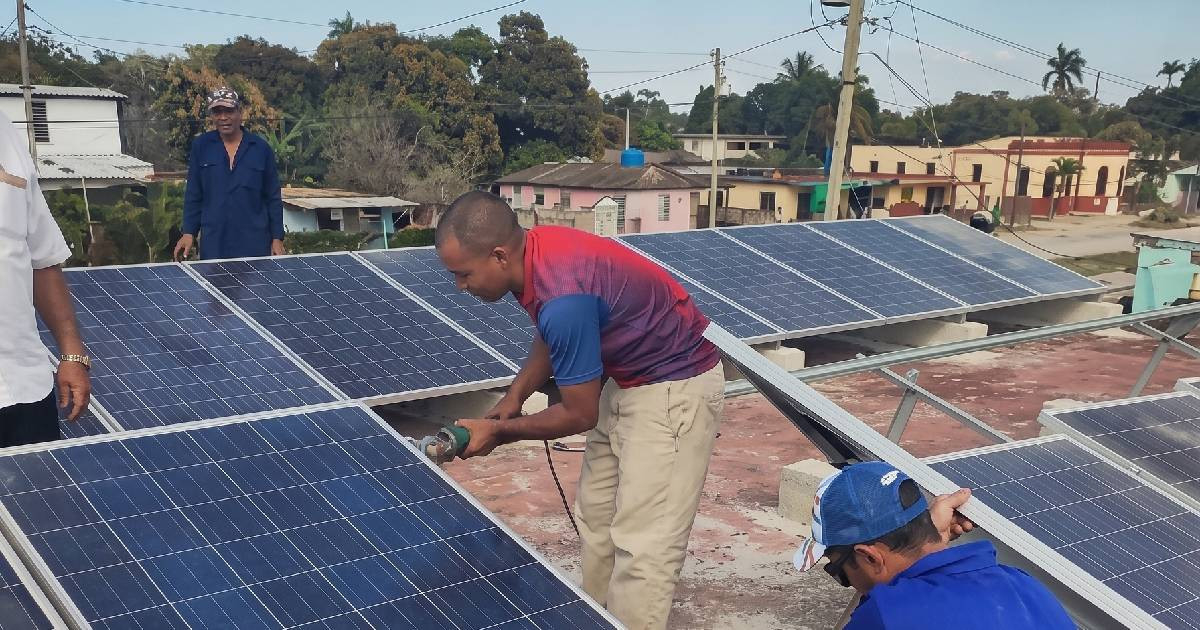
In Cuba, enduring blackouts have transformed solar panels into symbols of status and survival. While millions of Cubans remain tethered to a crumbling electrical grid or resort to outdated living methods, those who can afford solar power are setting themselves apart.
Throughout history, societies have often been divided by ideology, religion, or political parties. Today, in Cuba, where power outages are nearly constant, the divide is marked by the rooftops of homes. On one side are those who have managed to install solar panels; on the other, those who still light matches to cook or endure long hours in the dark. Writer José Poveda Cruz reflected on this new social divide on his Facebook profile this Friday.
The Solar Survival Strategy
Far from being a luxury, photovoltaic systems have become essential survival tools for families who can afford them, either through support from relatives abroad, private sector earnings, or personal resources. The real issue lies not with those escaping the darkness but with the fact that such an escape is contingent upon a crisis impacting the rest of the population.
Escalating Demand and Economic Disparity
The scarcity of solar equipment has turned these systems into highly sought-after commodities. As the electrical crisis deepens, prices soar, driven by uncertainty and growing demand. The ability to keep a fan running, charge a phone, or preserve food increasingly hinges on a family's financial resources.
A Society Divided by Technology
The stark contrast is evident in many neighborhoods. Some homes light up the night with inverters, batteries, and solar panels, while others resort to firewood for cooking. These two realities exist just meters apart—one powered by technology, the other forced to revert to methods thought obsolete generations ago.
Poveda notes that the small lights powered by batteries or makeshift solar setups are signs of resilience against the collapse of the National Electrical System (SEN), yet they also highlight the widening gap between those who can secure some energy independence and those entirely reliant on an unstable public service.
The Social Impact of Energy Inequality
Citizens' comments underscore the deep social wound. "There's now a new layer of inequality—not just socio-economic disparity, but also the privilege of having power in a darkened country," one citizen remarked. Another pointed out that "there's a direct correlation between the number of panels someone has and how they perceive and treat those who have none."
A third voice summed up the collective exhaustion: "We've been divided. To the point where everyone is thinking of escaping this terrible misery in any way possible."
The fracture also affects those who believed in education as a social elevator. "Perhaps the greatest irony falls on professionals," writes Poveda Cruz, "those men and women who for decades believed a university degree was a passport to a better life, now finding that a diploma illuminates less than a lithium battery."
His reflection captures the transformation the energy crisis has wrought on Cuban society: "In the Cuba of blackouts, electricity is no longer a service; it has become the most visible form of inequality."
Economic Barriers to Solar Access
This crisis-driven fracture is unprecedented, with a collapsed SEN experiencing at least eight total disconnections in just 18 months. In Matanzas, outages have reached up to 87 consecutive hours, while in Havana, residents face daily power cuts averaging 15 to 24 hours without electricity.
In such a context, acquiring a solar panel is an unattainable luxury for most. On the informal market, a single panel costs between $990 and $1,000—more than two years' worth of the average state salary, which hovers around $17.5 per month. A full residential kit ranges from $2,750 to $5,200. Resellers and inflation exacerbate the situation, with prices for what once cost less than $100 now ranging from $200 to $300.
Only those receiving remittances from abroad, owning private businesses, or having access to foreign currency can afford such an investment. A solar panel is no longer just technology; it has become a privilege.
The irony of the regime is hard to overlook. On July 8, just two days after a total blackout, leader Miguel Díaz-Canel toured a solar panel factory in Havana to showcase "innovative energy solutions," as reported by the official Granma newspaper. The official report inadvertently revealed that the factory had to install panels on its own roof to "become independent from the National Electrical System and not halt production."
Understanding Cuba's Energy Crisis
Why are solar panels considered a symbol of status in Cuba?
In Cuba, prolonged blackouts have made solar panels a symbol of status and survival, as they provide a reliable source of power in a country where the national grid is frequently failing.
What are the economic barriers to acquiring solar panels in Cuba?
Solar panels are prohibitively expensive for most Cubans, with prices on the informal market ranging from $990 to $1,000 for a single panel and $2,750 to $5,200 for a full kit. This is far beyond the reach of the average state salary.
How does the energy crisis affect daily life in Cuba?
The energy crisis has led to frequent and prolonged power outages, affecting all aspects of daily life, from cooking and preserving food to communication and comfort.