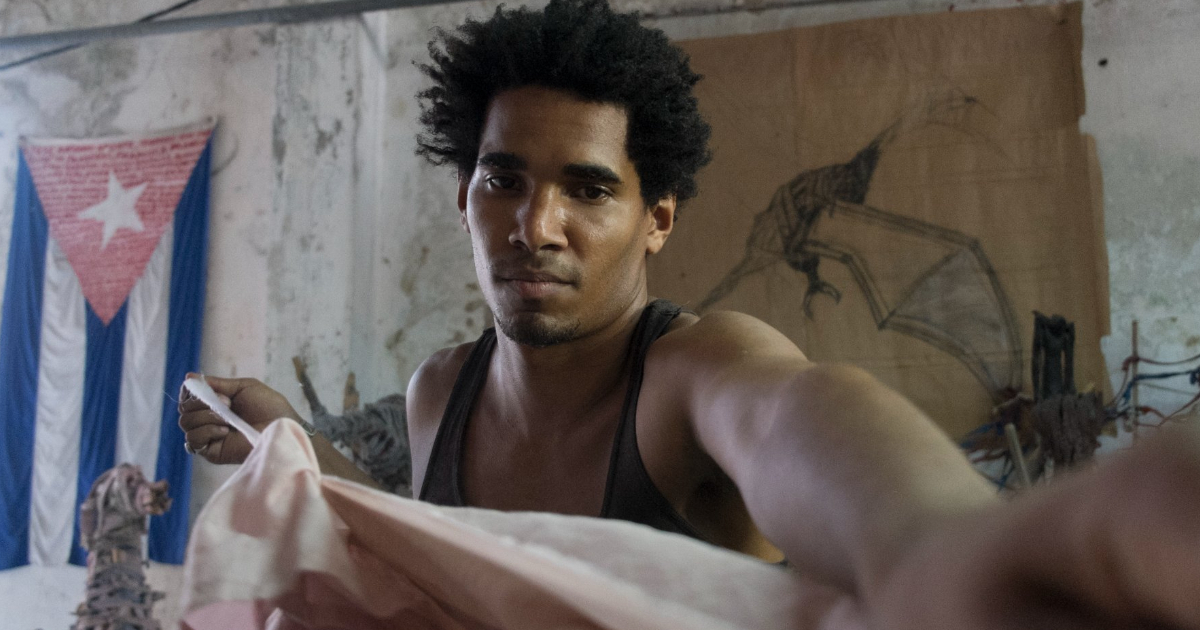
The renowned Cuban artist and activist, Luis Manuel Otero Alcántara, is expected to arrive in the United States tomorrow, Saturday, to seek asylum, as reported by a U.S. embassy official to CNN journalist Patrick Oppmann. This development comes after his humanitarian parole application was finally approved following several weeks of negotiations, although the founder of the San Isidro Movement (MSI) remains in an undisclosed location under state security detention.
The artist's official Facebook page confirmed the news with a statement on Friday, saying, “After several weeks of continuous efforts, we announce that Luis Manuel Otero Alcántara's parole application to enter the United States has been approved.”
The Uncertain Path to Freedom
Despite this positive news, those closest to Otero Alcántara caution that his freedom is not assured until he is actually on the plane. Anamely Ramos, a prominent MSI activist in exile, conducted a live broadcast on Facebook urging patience and outlining the uncertainties of the situation.
"Luis Manuel will not be free until he sets foot on the plane," stated Ramos. She emphasized that it would be irresponsible to disclose the exact time and place of his arrival while he remains under the regime's control. Ramos reiterated, "Saying anything else right now would be irresponsible." Meanwhile, Martí Noticias reported that "the artist is expected to arrive in Miami in the coming hours."
Communication Under Surveillance
Ramos detailed the conditions under which she has communicated with Otero since his captivity: phone calls made from state security phones, on speaker, with no privacy whatsoever. She described the entire process as inherently violent, even in its most hopeful outcome. "This is a process that remains violent, and it will continue to be so even when Luis Manuel arrives in Miami and can finally embrace us," she declared.
Additionally, Ramos speculated on the regime's motivation for allowing his departure: "Perhaps the Cuban government simply wants to rid themselves of Luis Manuel, at least by removing him from the national territory."
Forced Exile: A Common Tactic
Otero Alcántara should have been released on July 9, 2026, the formal end of his five-year sentence imposed following the July 11, 2021 protests. Instead, on July 7, state security agents transferred him from the maximum-security prison in Guanajay without notifying his family or disclosing his destination. Since then, he has remained missing under political police custody somewhere in Havana.
The organization Cubalex filed a habeas corpus petition on July 13, which the regime ignored, violating the legal 72-hour response time. The UN Committee on Enforced Disappearances also took action on the case, and Amnesty International recognized him as a prisoner of conscience.
The artist's Facebook page emphasized that exile was not a free choice: "Since early 2023, Luis accepted exile as the only way to continue his work as an artist and activist, after enduring relentless repression. State security left him no other option for release from prison."
Otero Alcántara's case fits a pattern the regime has used with other political prisoners from the July 11 protests: forced exile as a tactic to eliminate troublesome figures without granting them formal release. Activist Sissi Abascal went into exile in Miami in May 2026, and opposition leader José Daniel Ferrer was exiled in 2025. Meanwhile, human rights organizations reported between 775 and 1,281 political prisoners in Cuba as of May 2026, with 338 directly linked to the July 11 protests.
Ramos urged the Cuban community to wait for an official announcement before heading to the airport and reminded them that Otero's arrival does not mark the end of the struggle: "The only important thing here is that we still have a dictatorship. We continue to fight against that dictatorship. We still have hundreds of political prisoners in jails."
Frequently Asked Questions About Luis Manuel Otero Alcántara's Exile
Why is Luis Manuel Otero Alcántara going into exile?
Luis Manuel Otero Alcántara is going into exile as it has become the only viable option for him to continue his work as an artist and activist, due to the severe repression he has faced from the Cuban government.
What are the conditions of Otero Alcántara's release?
His release is contingent on his departure from Cuba, and freedom is not guaranteed until he is physically on the plane. He remains under the regime's control until that moment.
How has Otero Alcántara communicated with the outside world?
Otero has communicated through phone calls made from state security devices, on speakerphone, with no privacy, reflecting the oppressive conditions of his detention.