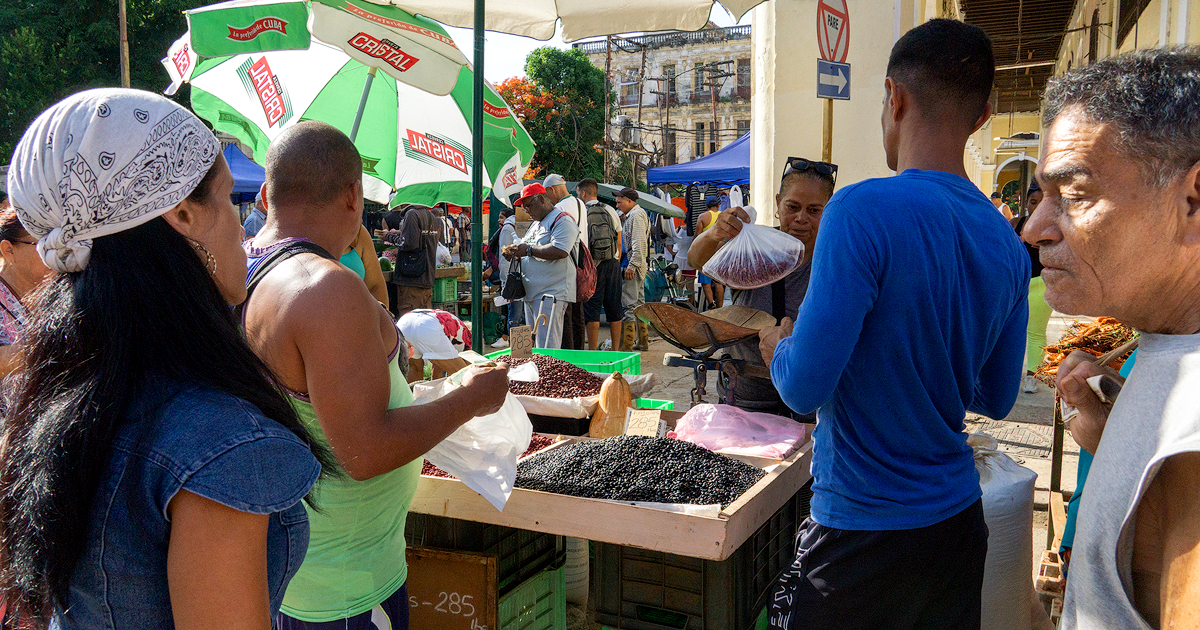
Yoani Sánchez, a journalist and founder of 14ymedio, shared her thoughts on Facebook this past Friday regarding the rampant inflation in Cuba. Using prices listed on a chalkboard in an informal market, she painted a stark picture of the daily economic challenges faced by Cubans.
In her Facebook post, Sánchez argues that there's no need for economic reports to grasp the situation: "Just pause for a few moments in front of the chalkboard at any market to see how Cubans’ purchasing power is shrinking."
The figures she outlines are striking: a pound of rice costs 360 pesos, black beans reach 450, a kilogram of wheat flour exceeds 1,000 pesos, a carton of eggs is around 3,000, and a liter of vegetable oil goes over 2,000 pesos.
Considering these prices, the average monthly salary in Cuba remains under 7,000 pesos, making every shopping trip an impossible equation to solve.
Sánchez captures the dilemma vividly: "You look at these numbers written on a whiteboard and realize they’re not just prices. They are choices. Do I buy rice or oil? Do I get eggs or save for transportation? Do I cook beans today or wait until next month?"
The Everyday Face of Inflation
The journalist highlights that inflation has transcended being a mere technical term and has become a daily reality: "It has the face of a mother recounting her bills before entering a store. The retiree circling the block again with empty hands. The worker who gets paid and, before the first week is over, finds out their salary has lost another battle."
Official statistics support this assessment. According to the National Office of Statistics and Information, the year-on-year inflation rate in Cuba in June was 18.27%, with a monthly change of 2.82% and a cumulative half-year rate of 12.24%, driven by increases of 14.79% in oil and 6.76% in pork.
However, independent economists estimate that the real inflation rate, including the informal market, hovers around 70% annually. Economist Elías Amor Bravo described Cuba's inflation as "out of control" due to the regime's inaction, predicting that by 2026, Cuba could end up among the Latin American economies with the highest inflation, with figures between 40% and 50%.
The Widening Gap Between Income and Costs
The gap between wages and prices is staggering. The average state salary is approximately 6,930 pesos per month, equivalent to between five and 12 dollars at the informal exchange rate. The new minimum wage set at 3,210 pesos as of July 1 is about 4.65 dollars, barely enough to buy a carton of eggs. Economists estimate that a person needs about 96,000 pesos monthly to meet basic needs, a gap more than 13 times the average salary.
The deterioration has been exacerbated by additional factors: the dollar in the informal market rose from 435 pesos in December 2025 to 670 pesos in July 2026, and the regime lifted price caps on essential imported goods in June through Resolution 150/2026, further worsening the situation for consumers.
Sánchez warns that the most alarming issue isn't just the rising cost of food, but the normalization of poverty: "A few years ago, finding a pound of rice for 360 pesos would have seemed outrageous. Today, many people see that number, sigh, and hand over their bag to the vendor. Even the capacity for astonishment is devalued."
She concludes that inflation "not only makes food more expensive. It also erodes expectations, forces sacrifices on nutritious foods, reduces portion sizes on the plate, and turns every market visit into a survival math exercise."
Understanding Cuba's Economic Struggles
What are the current inflation rates in Cuba according to official data?
As per the National Office of Statistics and Information, the year-on-year inflation rate in Cuba in June was 18.27%, with a monthly variation of 2.82% and a half-year cumulative rate of 12.24%.
How do independent economists view Cuba's actual inflation rate?
Independent economists estimate that the real inflation rate, considering the informal market, is around 70% annually.
What impact does inflation have on the daily lives of Cubans?
Inflation affects Cubans by making essential goods increasingly unaffordable, forcing them to make difficult choices between necessities such as food and transportation.
Why is the gap between income and prices so significant in Cuba?
The gap is significant due to the low average state salary, which is insufficient to cover basic needs, combined with high inflation rates and the rising costs of goods.