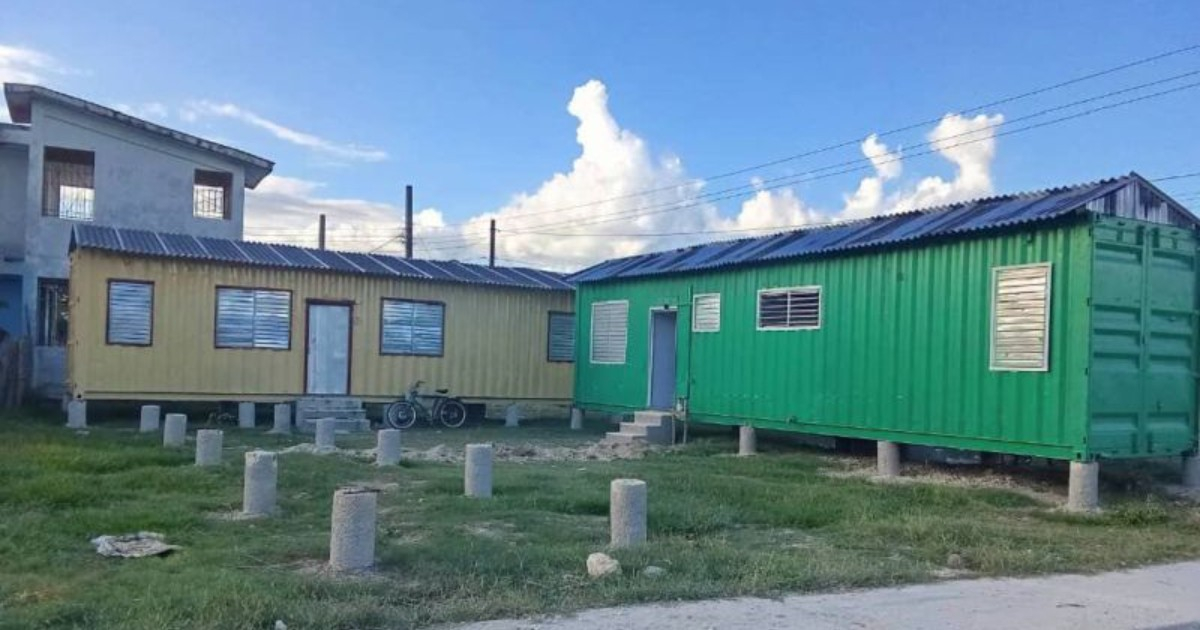
The state-run newspaper, Escambray, revealed on Thursday that the initiative to convert shipping containers into homes in Sancti Spíritus is significantly behind schedule. Only 17 structures are currently being assembled out of the more than 100 that were supposed to be completed by 2026.
This figure was confirmed by Maribel Vázquez Bernal, head of the Housing Development Department at the Provincial Housing Directorate. She specified that these 17 units are scattered across Cabaiguán (seven), Taguasco (five), and La Esperanza in Guayos (five), with all still under construction and none finalized.
The state media's report, titled "Containers for Housing: A Program in Debt," conceded that "overall, the implementation of housing projects in Sancti Spíritus for the current year shows limited progress."
Challenges Hindering the Initiative
The primary obstacle stalling this project is the same one affecting traditional construction in Cuba: a shortage of essential materials and specific components needed for this format, including doors, windows, and coatings suitable for the metal modules. In the absence of supplies, builders turn to local alternatives, many provided by non-state actors.
Introduced in 2025, the container housing program was pitched as a "circular economy" solution to the chronic housing deficit, utilizing containers phased out from transporting goods—particularly those used to import parts for photovoltaic solar parks. The provincial goal, as confirmed by the province's Housing Director to Radio Sancti Spíritus, was to construct 133 such homes across the eight municipalities.
Widespread Construction Failures
The failures are not isolated to container homes. The traditional Housing Program in the province also falls short of its targets: out of 161 planned buildings for 2026, only about twenty have been completed, mainly in Yaguajay, Taguasco, and the provincial capital, due to shortages of cement, aggregates, and steel.
This pattern is mirrored nationwide. The Cuban government acknowledged in November 2025 the failure of the container housing program, despite having released over 1,700 units across the country. By April 2026, only 133 homes of this type had been delivered in Cuba, and during a governors' meeting with Prime Minister Manuel Marrero Cruz, it was confirmed that a mere 19 were officially finished.
Housing Crisis: A National Issue
The first two modular homes in Havana were handed over on May 2, 2026, with Miguel Díaz-Canel and Marrero Cruz in attendance, in the Marianao municipality. This event was touted as a milestone but starkly contrasts the scale of the issue: Cuba faces a housing deficit exceeding 929,000 homes, with 35% of existing ones in poor or fair condition, and the 2025 state construction plan met only 22% of its target: 2,382 out of 10,795 planned homes.
The cost of a container home for beneficiaries ranges between 900,000 and one million Cuban pesos, equating to more than ten years of the average salary, payable through bank loans.
A reader named "Don José" summed up the growing frustration in the comments on Escambray: "Name a project that gets completed on time or shows any progress."
Common Questions About the Container Housing Program in Cuba
What is the current status of the container housing program in Sancti Spíritus?
The program is significantly delayed, with only 17 out of over 100 planned homes in the assembly phase and none completed yet.
What are the main challenges facing the container housing program?
The main challenges include a lack of essential building materials and specific components necessary for adapting metal modules, forcing reliance on local and non-state supplied alternatives.
How does the container housing program relate to the overall housing crisis in Cuba?
Despite being introduced as a solution, the program has struggled to deliver on its promises, with only a small fraction of planned homes completed amidst a national housing deficit that exceeds 929,000 homes.