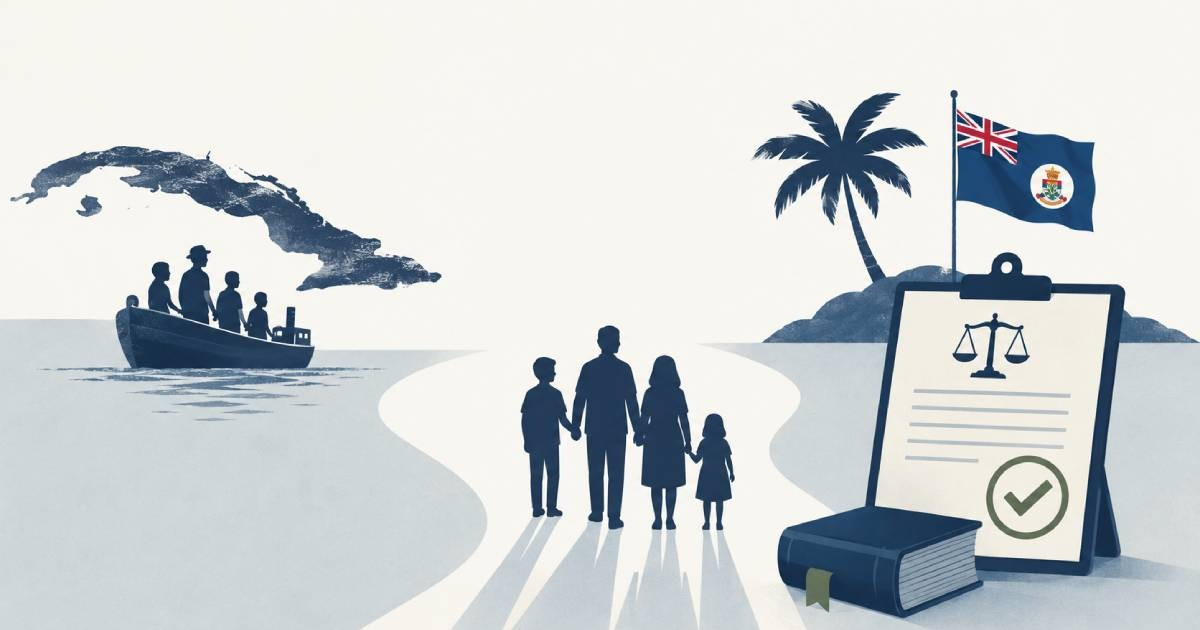
The government of the Cayman Islands announced on Thursday plans to introduce a new law aimed at regularizing the immigration status of the children, grandchildren, and even great-grandchildren of Caymanians who emigrated to Cuba during the last century and returned to the archipelago after the 1959 Revolution, as reported by Cayman News Service.
This legislative effort seeks to address the challenges faced by approximately 300 individuals, many of whom were born and raised in the Cayman Islands, where they have established their families, yet have lived for decades without a fully regularized immigration status.
The root of this issue dates back to the return of numerous families of Caymanian descent who had moved to Cuba, primarily to what was then the Isle of Pines (now the Isle of Youth). Upon their return, they were granted temporary residency but were never properly informed by authorities about the necessity to formally apply for permanent status for themselves and their descendants.
Voices from the Community
Julie Hunter, a representative for West Bay West, shared with Radio Cayman that many of these individuals always believed they had an inherent right to reside in the territory.
"A lot of people just assumed they had the right to be here, and past governments did not make it clear that they needed to apply for status for themselves and their families," she stated.
Most of those affected live in the district of West Bay on Grand Cayman. From there, representatives Julie Hunter and Rolston Anglin, alongside former lawmaker McKeeva Bush, have been advocating for a definitive solution.
An Urgent Legislative Initiative
Anglin highlighted that the initiative is specifically aimed at those who already reside in the Cayman Islands and became entangled in a legal limbo after returning from Cuba.
"We’re talking about those Cuban-Caymanians who fought to leave Cuba after the revolution," he noted, emphasizing that many families were held up for years on the island and could only depart when the regime under Fidel Castro allowed it.
As an initial step, the ruling National Coalition for Caymanians (NCFC) agreed last month to create a task force. This group is responsible for identifying the affected families, gathering information, and presenting recommendations to expedite the regularization process in the most efficient manner possible.
Historical Ties to Cuba
The presence of a Caymanian community in Cuba dates back to the early 20th century when many fishermen emigrated to the Isle of Pines, about 312 kilometers from Grand Cayman, seeking better economic opportunities.
Following the success of the Cuban Revolution in 1959, many of these families attempted to return to their homeland, but numerous individuals were stranded on the island for years and could only leave later.
The Caymanian government's announcement comes amid growing uncertainty in the Caribbean regarding Cuba's situation. Since early 2026, the archipelago's authorities have maintained contingency plans for a potential increase in migration from the island, particularly from the Isle of Youth, where many individuals of Caymanian descent still reside.
The Cayman Islands previously faced a similar situation during the 1994 migration crisis when they received over a thousand Cuban rafters. As per official figures, by March 2026, the territory had deported 20 Cuban migrants and held another 24 in immigration custody.
Key Questions on Cayman Islands' New Legislation for Cuban Descendants
What is the purpose of the new legislation in the Cayman Islands?
The new legislation aims to regularize the immigration status of descendants of Caymanians who emigrated to Cuba and returned after the 1959 Revolution, addressing the legal limbo faced by these individuals.
Who are the main advocates for this legislative change?
Representatives Julie Hunter and Rolston Anglin, along with former lawmaker McKeeva Bush, are key advocates for this initiative, working to provide a permanent solution for affected families.
Why did the Caymanians originally move to Cuba?
Many Caymanians moved to Cuba, particularly the Isle of Pines, in the early 20th century seeking better economic opportunities, primarily in the fishing industry.