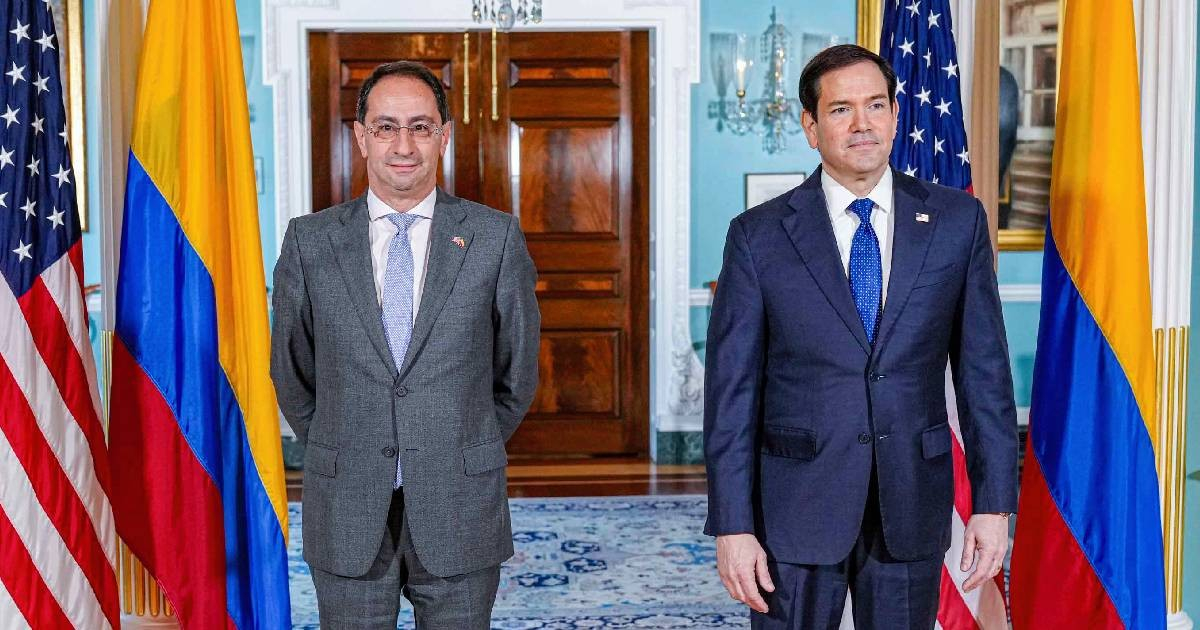
On Wednesday, U.S. Secretary of State Marco Rubio engaged in discussions with Colombia's Vice President-elect, José Manuel Restrepo, at the State Department in Washington D.C. This meeting symbolizes the start of a renewed diplomatic chapter between the two nations following years of strained relations under Gustavo Petro's leadership.
According to an official statement from the State Department, the meeting was initiated by the president-elect, Abelardo De La Espriella, as part of the diplomatic mission titled "The Miracle Homeland."
The Colombian delegation was composed of the designated ministers for Foreign Affairs, Defense, Commerce, Industry and Tourism, and Finance.
State Department spokesperson Tommy Pigott conveyed Rubio's congratulations to the incoming administration and reiterated Washington's position: "The Trump administration aims to be Colombia's partner of choice, offering transparent and high-standard options in key sectors vital to economic security for the United States and the region."
Rubio also shared his sentiments on social media: "Had a productive meeting with the Vice President-elect to discuss the future of the U.S.-Colombia partnership. We look forward to collaborating with President-elect De La Espriella's administration to bolster security cooperation and expand economic ties."
Restrepo, in turn, described the meeting as a highlight of their Washington visit and elaborated on the topics discussed: "We reaffirmed Colombia's interest in joining the Shield of the Americas and enhancing security cooperation, eradicating illicit crops, restoring order, and strengthening our military forces, all while fully respecting national sovereignty."
The Vice President-elect also emphasized the economic aspect of their engagement: "We explored new opportunities to expand trade, attract investment, and stimulate economic development," adding that "strengthening the alliance with the United States means generating more jobs, increasing household incomes, and accelerating the social transformation Colombia requires."
This meeting marks a significant shift from the four-year tenure of the Petro government, characterized by frequent tensions with Washington.
The most notable crisis erupted in January 2025 when Colombia refused military flights carrying deported Colombians, leading to tariff threats and a heated exchange between Petro and Rubio.
As a result, Colombia was excluded from the Shield of the Americas summit held in Miami in March 2026.
The situation shifted dramatically with De La Espriella's victory in the June 21, 2026 runoff, where he secured 12,959,515 votes against Iván Cepeda's 12,708,695, a narrow margin of 250,820 votes. Rubio congratulated him the following day, asserting that "Colombia's best days are ahead."
The new Colombian administration has already announced it will not establish embassies in Cuba or Nicaragua, labeling them as "long-standing dictatorships," and that Colombia will formally join the Shield of the Americas on August 7, 2026, the date of De La Espriella's inauguration.
U.S.-Colombia Relations Under New Leadership
What was the purpose of Marco Rubio's meeting with Colombia's Vice President-elect?
The meeting aimed to initiate a new era of diplomatic relations between the United States and Colombia, focusing on security cooperation and economic ties.
What stance did the Trump administration express towards Colombia?
The Trump administration expressed a desire to be Colombia's preferred partner, offering transparent and high-standard options in critical economic sectors.
How did the new Colombian government plan to address relations with Cuba and Nicaragua?
The new Colombian government announced it would not establish embassies in Cuba or Nicaragua, referring to them as "long-standing dictatorships."