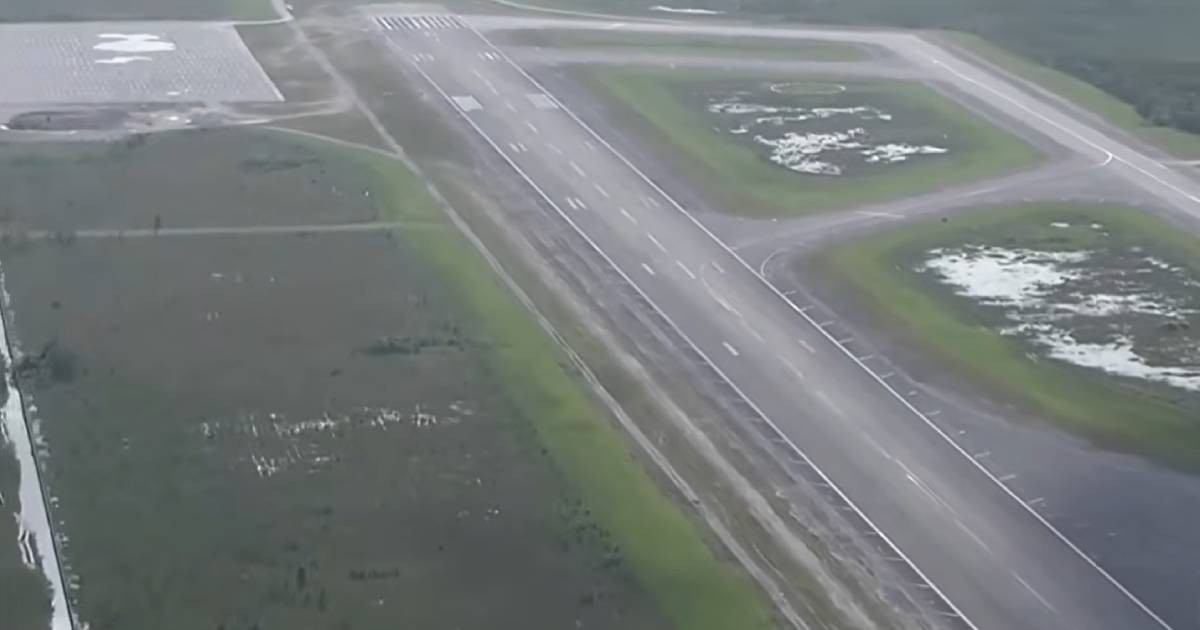
The immigrant detention center known as Alligator Alcatraz in Florida, once a symbol of the state's harsh immigration policies, has been dismantled. Aerial footage taken by channel WPLG this past Tuesday shows the site now completely empty, with no sign of the infrastructure that once held thousands of migrants.
From a helicopter, the images depict a barren landscape: the large white tents, generators, light towers, and the iconic blue sign that marked the center have vanished. Workers can be seen removing the perimeter fence surrounding the Dade-Collier Training and Transition Airport's runway in Ochopee, located about 45 miles west of Miami.
The final closure was announced on June 25 by Florida Governor Ron DeSantis, alongside White House border czar Tom Homan. DeSantis stated, "It served its purpose during its time. The demobilization efforts at these facilities are already underway."
Throughout its year of operation, the center facilitated the deportation of around 21,000 individuals. DeSantis defended the center's role, asserting that it bolstered the state's security. "There's no doubt this mission has made Florida safer," he claimed.
Rapid Construction and Limited Operation
Alligator Alcatraz was constructed in record time, taking only eight days, and opened its doors on July 3, 2025. It was the first state-run detention center exclusively for immigrants in irregular situations. Although it had a capacity for 3,000 to 5,000 people, it never reached its full potential.
In early June, authorities announced a temporary closure, citing safety concerns during hurricane season. Migrants were relocated to detention centers in Florida, Texas, Louisiana, Arizona, and California. For about a week, families and lawyers were left in the dark about the migrants' whereabouts.
Allegations of Poor Conditions
During its operation, the center faced numerous complaints from human rights organizations and the detainees themselves. Reports included food contaminated with worms, broken bathrooms, floors flooded with sewage, mosquito and insect infestations, and restricted access to showers, which were sometimes allowed only every three to four days.
In April 2026, guards used pepper spray to break up a protest by detainees demanding better access to phones to communicate with their families and legal representatives.
Financial Burden and Criticism
The project was also criticized for its exorbitant costs. Official figures reveal that the center's operation exceeded $1.2 billion, with a daily expense per detainee of approximately $3,571—far surpassing the roughly $165 daily rate paid by the Immigration and Customs Enforcement (ICE) at private facilities.
Florida sought a federal reimbursement of $608 million but had only received $58 million prior to the closure. The Florida Immigrant Coalition harshly criticized the project, stating, "The only winners were the corporations and contractors who made millions while Republicans pushed a nonexistent immigration emergency."
The Future of the Land
Following the dismantling of the facility, Miami-Dade County Mayor Daniella Levine Cava announced plans to sell the more than 17,000 acres of land to the National Park Service, aiming to integrate it into the Everglades restoration efforts. "We are awaiting the formal return of the property. We are also very keen to restore this site to nature and conservation, so we will explore the best ways to achieve this as soon as possible," she stated.
However, the closure of the center does not end the controversy. Environmental groups have filed a federal lawsuit alleging that the construction proceeded without the necessary environmental impact study. They claim that at least 20 acres were paved within the Everglades ecosystem without the requisite evaluation.
As the legal battle unfolds, the Federal Aviation Administration (FAA) has kept the airport runway closed to air traffic, with restrictions in place at least until September 2026.
FAQs on the Closure of Alligator Alcatraz
Why was Alligator Alcatraz closed?
The detention center was closed following an announcement by Florida Governor Ron DeSantis, citing that it had fulfilled its purpose. Additionally, safety concerns during hurricane season and ongoing controversies regarding the facility's conditions contributed to its closure.
What were the conditions reported at Alligator Alcatraz?
Reports from detainees and advocacy groups described substandard conditions, including contaminated food, broken facilities, infestations, and limited access to basic necessities like showers.
What will happen to the land where Alligator Alcatraz was located?
The land is intended to be sold to the National Park Service to be incorporated into the Everglades restoration efforts, following the formal return of the property from the state.