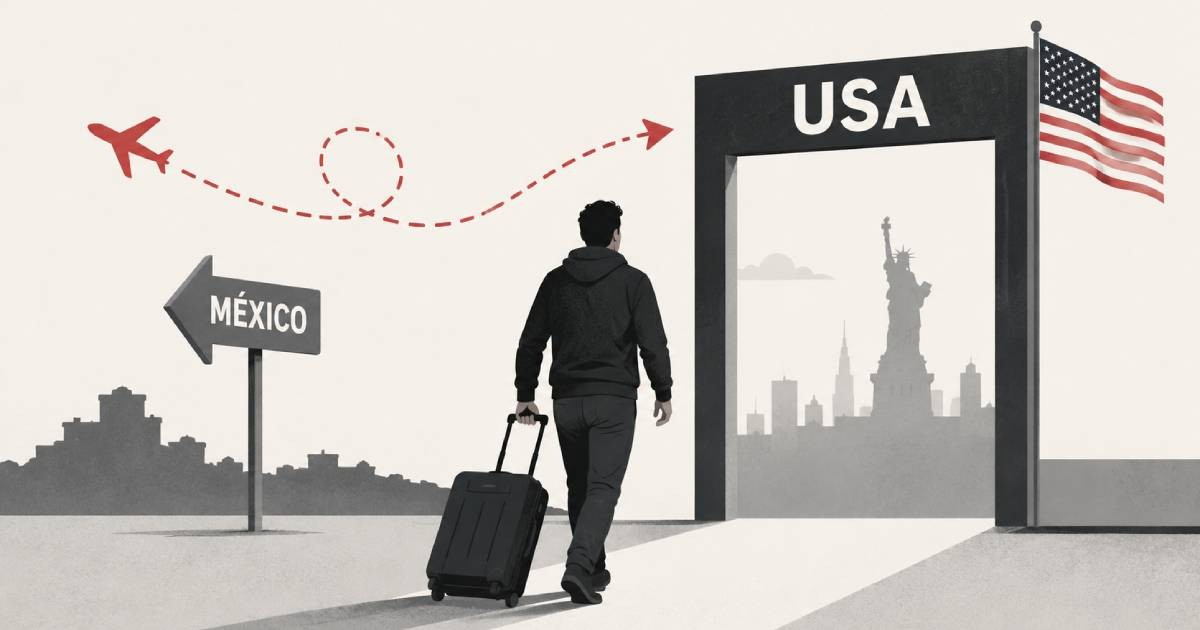
Lázaro Romero León, a 59-year-old Cuban who spent nearly thirty years living in Puerto Rico, finally made it back to the United States on May 8 after being stranded for almost three months in southern Mexico. He was mistakenly deported there despite a federal judge's explicit order prohibiting his removal from the country.
This case, detailed by BBC Mundo, highlights the flaws in the U.S. immigration system and the legal limbo that left Romero León caught between two nations, without documents, resources, or a clear path back home.
An Unjust Deportation
Romero León had been residing in Aguadilla, Puerto Rico under the supervision of the Immigration and Customs Enforcement (ICE) agency. Although a deportation order had been issued against him since 2002, it was never enforced because Cuba refused to accept citizens with criminal records.
"For 28 years, I never missed an appointment. Then on May 20, 2025, six agents grabbed me outside my house without explanation and took me away," he recounted.
After being moved to ICE detention centers in Adelanto, California, and Florence, Arizona, he filed for habeas corpus in December 2025. Federal Judge Hernán Diego Vera ordered that Romero León should not be removed to Mexico until his case was resolved.
"The petitioner shall not be transferred from the United States to Mexico until this court has fully resolved the petition," the judge declared.
Stranded and Forgotten
Despite this, on February 16, 2026, ICE agents took him to the border and deported him to Chiapas, Mexico. Months later, the U.S. government acknowledged that a "communication error" was to blame.
In Mexico, Romero León faced a harrowing ordeal. Without documentation, money, or belongings, he survived on the streets of Tapachula, relying on donations. His struggles included multiple detentions by Mexican immigration authorities, who even transported him to the Guatemalan border.
"I saw many others like me—elderly Cubans, some sick, penniless, and without papers, condemned to a life of destitution," he said.
Legal and Bureaucratic Hurdles
Meanwhile, his public defender, Margaret Farrand, fought to bring him back to the U.S. ICE attempted to arrange his return, but Mexican authorities rejected the documentation for a flight to Tijuana. Farrand even purchased a bus ticket for him on April 11, but Mexican immigration officers intercepted him and sent him back to a detention center. A second attempt met the same fate.
"How is it possible to have mechanisms to deport someone to a country that isn't theirs, yet none to bring them back?" Farrand questioned.
Legal Gaps and Challenges
During the legal proceedings, Special Prosecutor Whitney Wakefield acknowledged that the informal agreement between the U.S. and Mexico only covered the transfer of migrants from the United States to Mexico, with no provision to correct erroneous deportations.
Judge Vera warned the government of potential contempt sanctions during an April 23, 2026, hearing.
Ultimately, Romero León returned to the U.S. on May 8.
A Broader Immigration Crackdown
Romero León's story unfolds against the backdrop of a tightening immigration policy under the Trump administration.
The Cato Institute reports that ICE arrests of Cuban nationals surged from fewer than 200 per month at the end of 2024 to over 1,000 monthly a year later. Additionally, a Human Rights Watch report from May reveals that between January 2025 and March 2026, about 13,000 foreigners were sent to Mexico by the U.S., including 4,353 Cubans, the largest national group.
The Department of Homeland Security labeled Romero León as "an illegal immigrant with an extensive criminal record" and claimed he received "full due process." Romero León, who served time for crimes committed between 1997 and 2001, simply responded, "I've already paid."
Now residing in Palmdale, California, he continues to report periodically to an ICE office in Los Angeles as his immigration status remains unresolved.
Reflecting on the thousands of Cubans stranded in southern Mexico—approximately 800 in Tapachula and around 3,000 in Villahermosa, according to activists—Romero León offers a sobering insight:
"It feels like they want us to die there."
FAQs About Immigration Challenges Facing Cubans
What led to Lázaro Romero León's deportation to Mexico?
Romero León was mistakenly deported to Mexico due to a communication error, even though a federal judge had explicitly prohibited his deportation.
How did Romero León survive in Mexico?
Without documents or money, Romero León survived in Tapachula, Mexico by relying on donations and sleeping on the streets.
What actions did his legal defender take to bring him back?
Margaret Farrand, Romero León's legal defender, attempted to coordinate his return to the U.S. by arranging transportation and challenging the deportation legally, despite Mexican authorities rejecting their efforts.