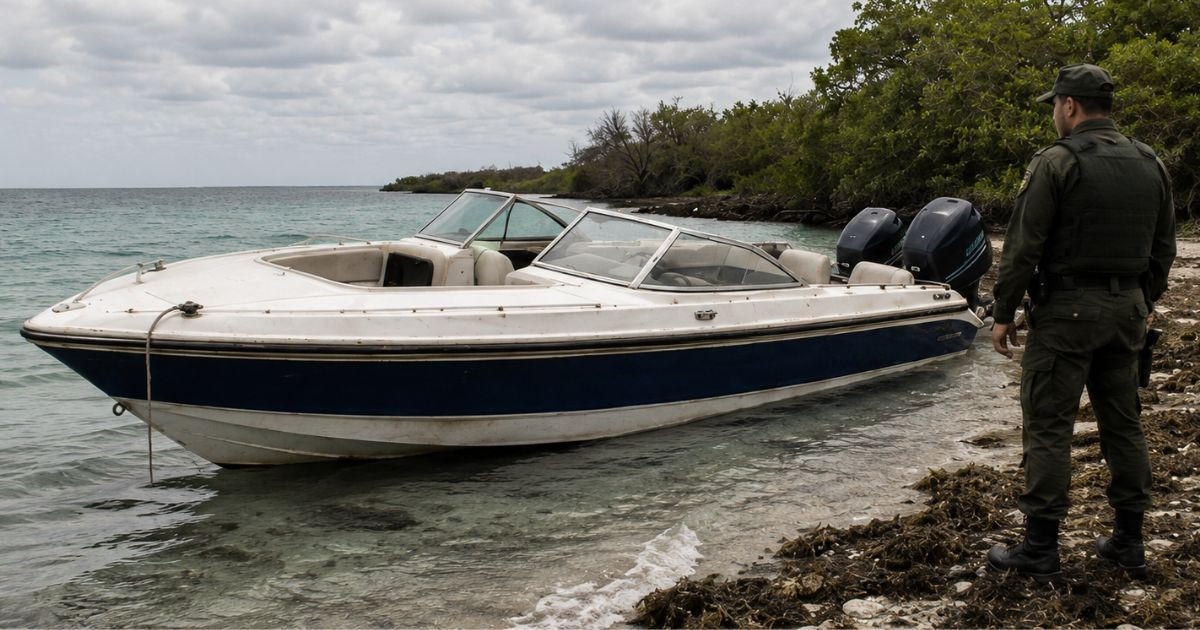
The Cuban Ministry of the Interior (MININT) announced on Wednesday the seizure of two vessels discovered in isolated coastal areas of Camagüey and Guantánamo.
The Border Guard Troops Division stated that these confiscations were formalized through resolutions issued by the Head of the National Port Captaincy Department on May 27, 2026, although the discoveries occurred months earlier.
The first vessel is a fast white and blue fiberglass speedboat, with the markings "Cynthia SLI534" on the starboard bow and "FDC 002123" on the port bow, powered by a 175 HP Yamaha outboard motor with four cylinders.
This speedboat was located by the Border Guard Troops on December 3, 2025, at Cayo Cruz in the Esmeralda municipality of Camagüey, and its seizure was formalized through Resolution No. 03/2026.
Previously, the Nuevitas Captaincy had reported this vessel as found in late 2025, initiating an initial period for claims. When no owner claimed it, the formal seizure proceeded in May 2026.
Unidentified Boat Found in Guantánamo
The second vessel, a white aluminum boat without any identifying data—no name, registration, or motor—was discovered on January 8, 2026, in an area known as "Mesa Abajo, Playa Rufino," Cayo Güin, Baracoa municipality, Guantánamo province.
Its seizure was formalized under Resolution No. 04/2026, though the Guantánamo Port Captaincy did not publicly report the discovery until April 9, 2026, over three months after the actual finding.
Legal Framework for Confiscations
Both seizures are backed by Resolution No. 1/2015 from the Minister of the Interior, which regulates the procedures for the Cuban state to take possession of vessels found in its territorial waters.
This regulation specifies that affected parties have 20 calendar days from a publication in a national newspaper to file a written claim with the Head of the Border Guard Troops Division.
This practice of vessel seizures by the Cuban regime is systematic. In May 2026, MININT had already seized a Bahamian-flagged speedboat named "Bombay 2," found in November 2025, also in the Esmeralda area of Camagüey.
Cayo Cruz and Cayo Güin are remote coastal locations often linked to attempts at illegal emigration or drifting vessels, making them frequent sites for maritime discoveries that the regime converts into state appropriations.
As of 2026, MININT has announced at least three rounds of similar confiscations, a recurring trend that in 2022 included the capture of 11 speedboats by the Border Guards throughout the year.
Understanding Vessel Confiscations in Cuba
What is the legal basis for vessel confiscations in Cuba?
The legal basis is Resolution No. 1/2015 from the Minister of the Interior, which details the procedures for the Cuban state to seize vessels found in its territorial waters.
How can affected parties contest a vessel confiscation in Cuba?
Affected parties have 20 calendar days from the publication of the seizure in a national newspaper to submit a written claim to the Head of the Border Guard Troops Division.
Why are Cayo Cruz and Cayo Güin significant in the context of vessel seizures?
These areas are often associated with illegal emigration attempts or drifting vessels, making them common sites for maritime discoveries that lead to state confiscations.