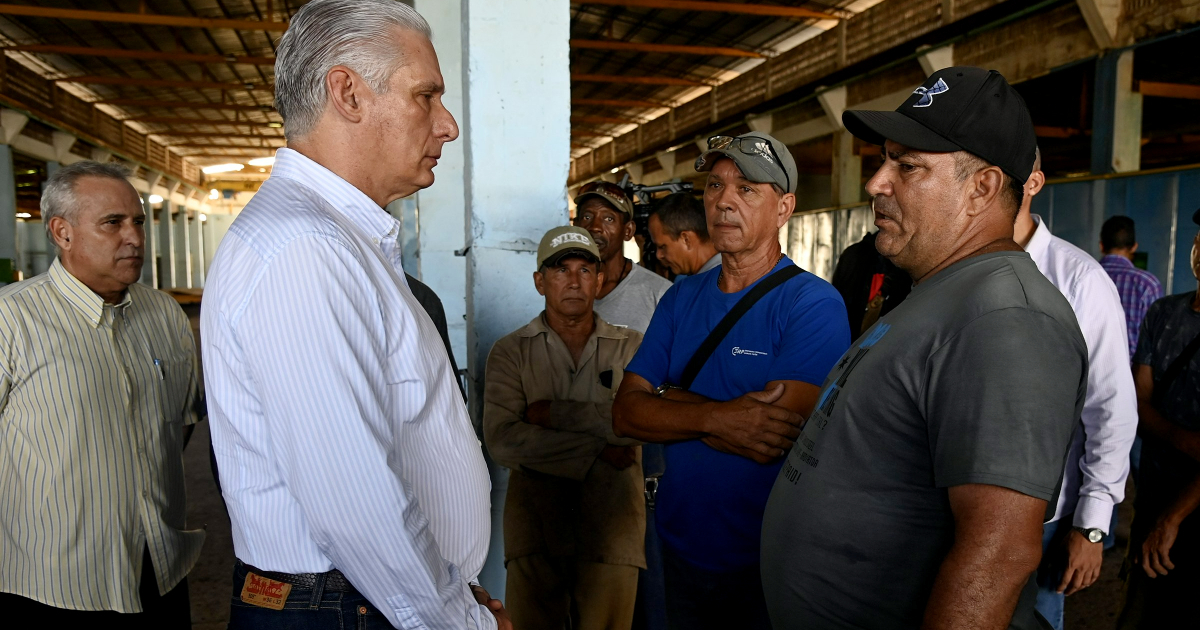
Miguel Díaz-Canel emphasized the importance of granting increased autonomy to Cuban state enterprises during a visit on Tuesday to various industrial entities in Habana del Este. He urged executives to prepare for the expanded powers that the government promises to implement as part of new economic transformations.
According to information from the Presidency, the leader stressed that companies must undertake responsibilities such as managing fuel and supplies, performing import and export operations, handling foreign currency accounts, and distributing profits. These competencies are part of the economic reform package introduced by the government to attempt to revitalize an economy plagued by resource scarcity, low productivity, and an energy crisis.
These statements were made during a tour of what will be the country's first public charging station for electric vehicles, constructed by the microenterprise 5ta. Avenida Motores on Vía Blanca, as well as a visit to the Guanabo Industrial Base Business Unit, where containers will be assembled mainly to enhance garbage collection in Havana.
While state media portrayed the tour as evidence of progress in several industrial projects, the primary political message centered on the implementation of the economic reforms announced weeks earlier. The main goal is to broaden the management capabilities of the socialist state enterprises.
The measures revealed by the authorities include allowing companies to develop new economic activities, manage part of their foreign income, participate more flexibly in foreign trade operations, and make decisions previously dependent on central bodies.
The reform also envisions greater interaction between state enterprises and private actors, alongside mechanisms to attract investment and invigorate strategically important sectors. Additionally, the government proposes introducing procedures for bankruptcy, liquidation, and restructuring for state enterprises with sustained losses.
The overhaul of the state enterprise system also includes eliminating subsidies, granting more management autonomy, transforming companies into commercial entities, and gradually allowing private and individual shareholders. However, the government has emphasized that these changes do not signify a shift in the economic model but rather an update in its operation.
Experts have noted that the extent of these reforms will depend on the regulations yet to be approved and the actual decision-making power that companies ultimately possess. Past decentralization efforts were curtailed by administrative controls and the persistent concentration of decision-making within the state apparatus.
Díaz-Canel's visit also highlighted some of the contradictions facing the country. While authorities promote projects to expand electric mobility through solar-powered charging stations, Cuba remains entrenched in a severe energy system crisis, characterized by frequent blackouts and challenges in ensuring energy generation.
Simultaneously, the government prioritized assembling new containers for garbage collection in Havana, a service long hampered by fuel shortages, the deterioration of the vehicle fleet, and a lack of material resources.
Rather than announcing new measures, the leader's statements aim to reinforce a key pillar of the economic reform program. The challenge will be to see if the promised autonomy translates into effective changes for state enterprises or if it remains constrained by the high level of centralization that defines the Cuban economic system.
Understanding Cuba's Economic Reforms and Challenges
What are the key components of Cuba's economic reform package?
The reform package includes granting state enterprises more autonomy in managing resources, allowing them to engage in foreign trade, handle foreign currency accounts, and make independent decisions in certain areas. It also promotes interaction with private entities and introduces mechanisms for dealing with unprofitable enterprises.
How do experts view the potential success of these reforms?
Experts believe the success of the reforms will largely depend on the regulatory environment and the extent of decision-making freedom granted to enterprises. Past attempts at decentralization have been limited by administrative controls and centralized decision-making.
What contradictions are present in Cuba's current economic situation?
Cuba is pushing for electric mobility projects while simultaneously grappling with a severe energy crisis, marked by frequent power outages. Additionally, efforts to improve garbage collection in Havana are hindered by resource shortages and vehicle fleet deterioration.