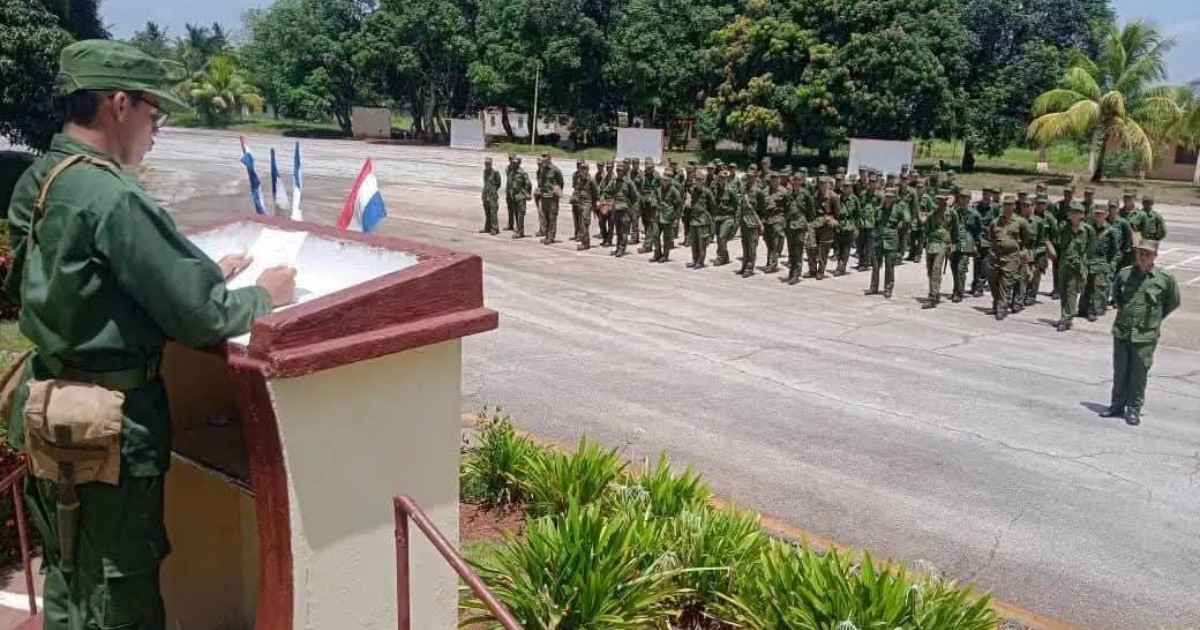
This week, the Ministry of the Revolutionary Armed Forces (MINFAR) shared a post on its official Facebook page, boasting about the "basic military training" that recruits in the Active Military Service undergo. The post featured an image of numerous young individuals in olive-green uniforms standing in formation before an officer on a podium. However, this display of triumphalism by the regime was met with a torrent of criticism from Cubans.
The text accompanying the image described the training as "a series of actions and procedures aimed at increasing the conscious influence of leaders over the collectives that form the unit at all levels." This bureaucratic jargon starkly contrasted the reactions from former recruits, parents, and citizens who voiced their concerns in the comments.
Voices of Dissent: Public Outcry Against Military Service
The predominant sentiment was outrage. One comment that encapsulated the general feeling said: "They are abusers forcing children to starve and become cannon fodder if anything happens. Many have died, and those who don't show up face imprisonment threats."
Another user questioned the actual value of the training: "These aren't recruits, they're hostages... young boys who go to the firing range a couple of times a year, at most in my day when there were more resources, seven bullets per person... they're just prisoners you expect to die first so you have time to flee."
Several comments pointed out the economic aspect of the service for the regime. "The biggest business of this trash revolution, they have free labor, guards for their strongholds, free workforce, and cannon fodder when something happens, kids forced to be there risking their lives to defend those who repress them, enduring many hardships, hunger, inhumane conditions," wrote another user.
Personal Accounts and Historical Context
A former recruit recalled his experience: "I remember when I was in the reserves (mandatory), we marched to the beat of one, two, three, four eating crap and wearing out shoes."
This MINFAR post isn't an isolated incident. On July 9, a similar post by Radio Ciudad Monumento about recruitment in Bayamo, Granma Province, sparked identical reactions, with Cubans describing the process as "leading them to the slaughterhouse" and "an abuse" preparing young people "for a war that will never come."
Tragic Outcomes: Documented Deaths and Social Rejection
Social rejection of military service has grown more intense in recent years due to a series of documented deaths. Between 2018 and early 2026, at least 67 recruits died, according to data from Archivo Cuba and Cubalex: 27 by suicide, 16 due to gross negligence, 14 in accidents, four from denial of medical care, and three in circumstances classified as murders. In 2025 alone, at least 19 young individuals perished during their service period.
Among the most recent cases, Abraham Limonta Estrada, 17, took his own life in February 2026 in Guantánamo, and Dailier Rodríguez Tamayo, 19, died in March 2026 in Havana despite having a medical ruling that prohibited him from carrying weapons or being under stress. Antonio Rassi Roque's mother, who died in August 2025, reported in July 2026 that authorities archived the case without holding anyone accountable.
Military service is mandatory for Cuban male citizens starting at age 17 and lasts for two years. Cuba does not recognize the right to conscientious objection, and Decree 103/2024 imposes fines of up to 7,000 Cuban pesos on those who fail to report when summoned, with the possibility of criminal prosecution for repeat offenders. Additionally, recruits have been seen collecting garbage in Havana, reinforcing the perception that the service operates as a source of free labor for the State.
One of the most shared comments under the official MINFAR post summed up the sentiments: "Training people to degrade their own people. The life of a Cuban is worth less than a piece of gum to these corrupt communists."
FAQs on Cuba's Compulsory Military Service
What sparked the backlash against MINFAR's recent post?
MINFAR's post boasting about basic military training was criticized for its triumphalist tone and perceived exploitation of young recruits, sparking outrage among Cubans.
Why is the military service in Cuba controversial?
The service is seen as exploitative, with reports of harsh conditions, lack of choice, and the use of recruits as free labor or cannon fodder, compounded by documented deaths and a lack of accountability.
How has the Cuban government responded to criticisms of military service?
The Cuban government has maintained its stance on compulsory military service, enforcing it through fines and legal penalties for non-compliance, without addressing the underlying criticisms.