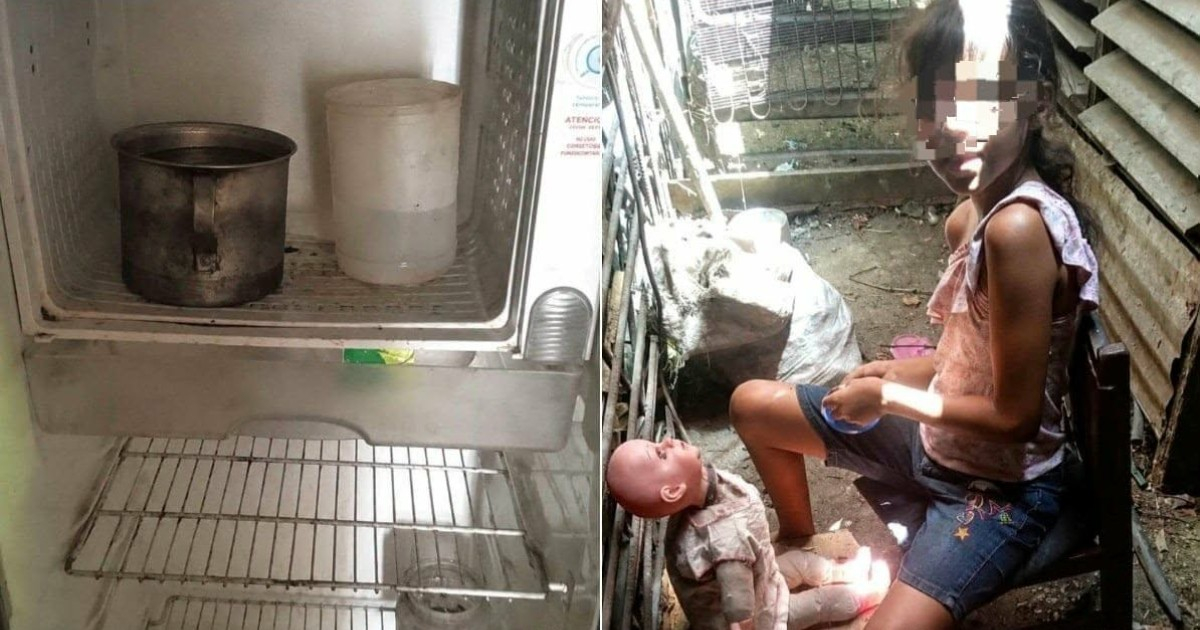
Eight-year-old Lía, residing in Bayamo, Cuba, grapples with chronic respiratory ailments while enduring living conditions that the Cuban regime seems powerless to improve.
Currently, she has been without a drop of water for over 50 days, her fridge stands empty and rusted, and her only playthings are dolls salvaged from the trash, for which she sews clothes herself.
Cuban journalist and activist Guillermo Rodríguez Sánchez, based in Mexico, highlighted her plight on Facebook. He orchestrates solidarity campaigns for critically affected families within the island.
The plea for help didn't originate from Lía's mother, Lariatne Gamboa, but from a concerned neighbor who sometimes provides them with meals and has implored for assistance on their behalf.
"She feels ashamed not to do more for this joyful girl and her very brave mom; she is embarrassed by it all, embarrassed that such good people suffer so much misery," wrote Rodríguez Sánchez about the neighbor who brought attention to their dire situation.
Dire Living Conditions and Urgent Calls for Aid
Rodríguez Sánchez painted a grim picture of the family's refrigerator, describing it as "a mass of grime, rust, crusts from never-completed freeze cycles, and whatever food could be scrounged, left to rot between power outages."
Photos corroborate this grim reality: an empty appliance with rusted racks and just a couple of containers with no visible contents.
"Just like Lía and her mother, there are thousands of mothers and daughters in Cuba," acknowledged Rodríguez Sánchez. Previously, his campaigns have successfully raised over 215,000 pesos in 24 hours for a family in Júcaro.
Those wishing to assist can do so via the BPA card 9238 1299 7955 8725, registered to Verona Bonce, a family friend, as Lariatne Gamboa lacks a bank account.
Systemic Crisis and Widespread Hardship
Contact in Cuba is available at 59659518, and those who wish to speak directly to the mother can call +53 55056528.
For international donations, Rodríguez Sánchez orchestrates direct cash delivery to their home via his Messenger profile, providing photographic evidence of the transaction.
"In the face of such desolation and hunger, let's nurture the innocent spirit of a child who has never experienced the simple delight of a gifted toy," he urged, specifically requesting a new doll for Lía.
This situation underscores a systemic crisis unrecognized and unaddressed by the regime. According to the Cuban Observatory for Human Rights, 89% of Cuban families live in extreme poverty, with an average monthly income of merely $13.
Moreover, over 100,000 Cuban children reportedly lack daily milk, a figure acknowledged by the Ministry of Food Industry, and 48.5% of children aged six to 11 do not receive school meals, according to the World Food Program.
Lía's water crisis is not isolated. In Bayamo, extended power outages disable hydraulic pumps, leaving nearly three million Cubans without regular water access. A private water truck costs up to 20,000 Cuban pesos, a price most cannot afford.
In June, the Granma Electric Company admitted it was generating only one-third of the energy the province requires, with circuits experiencing over 45 hours of service interruption. This energy collapse is the backdrop to Lía's enduring hardship.
Understanding the Crisis in Cuba
What is the primary cause of Lía's difficult living conditions?
Lía's hardship is largely due to systemic issues in Cuba, including widespread poverty, insufficient government response, and ongoing energy and water shortages.
How can people help Lía and her mother?
Assistance can be provided through financial donations to a BPA card or coordinating with activist Guillermo Rodríguez Sánchez for direct contributions and support.
What broader issues does Lía's situation highlight?
Lía's situation highlights the severe poverty, inadequate public services, and lack of basic necessities that many Cuban families face, pointing to systemic failures within the country.