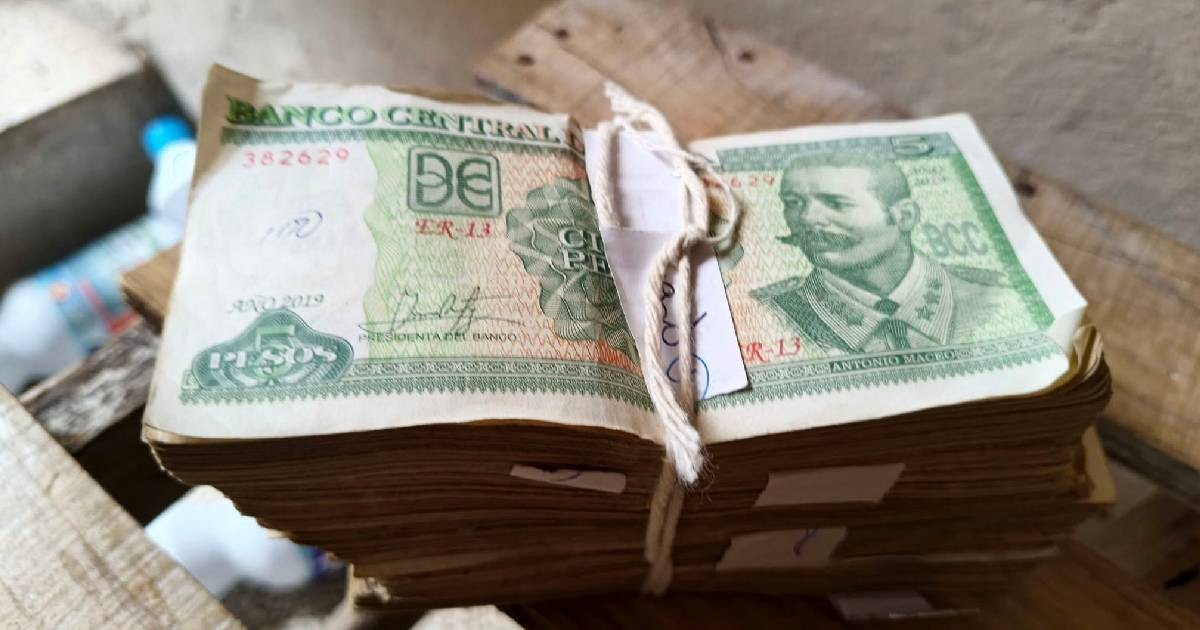
A Cuban national, Javier Pérez Álvarez, took to social media to express his frustration after the National Bank of Cuba paid his entire monthly salary in five-peso bills. The bank claimed it lacked larger denominations to fulfill the payment.
"I just received my laughable monthly salary, and the National Bank of Cuba gave it to me entirely in five-peso bills, one of the lowest denominations available, claiming there are no larger denominations for payments," Pérez Álvarez shared on Facebook.
The issue extends beyond the salary amount; it becomes impractical to use. Private businesses and MIPYMES (micro, small, and medium enterprises) routinely refuse five, ten, and twenty-peso bills due to their negligible real value. These are the very businesses that have taken over food supply responsibilities since the state stepped back.
"The owners of MIPYMES DO NOT ACCEPT THESE BILLS, DUE TO THEIR LOW VALUE. They are the ones who control food supplies (AT VERY HIGH PRICES, BUT IT'S THE ONLY OPTION)," Pérez Álvarez remarked, highlighting the catch-22 faced by state employees.
Pérez Álvarez's complaint sheds light on a paradox: the state issues currency that its own commercial partners reject. In a blunt statement, he remarked, "If the Cuban State lacks larger denominations in banks because MIPYMES have seized them... Then close all state banks and allow MIPYMES to establish private banks, as the current system's payments are WORTHLESS."
This is not an isolated incident. On July 2, the Banco de Crédito y Comercio in Ciego de Ávila issued a statement noting that refusing low-denomination bills is a "blatant violation of citizens' rights" and that all bills are legal tender under the law. However, this rule is not enforced in reality.
In April, another Cuban was forced to accept over 200,000 pesos in ten-CUP bills—around 20,000 pieces—which equated to just $384 in the informal exchange market, an event that went viral as a symbol of the monetary crisis. In December 2025, a self-employed worker in Boyeros openly refused five-peso bills, demanding only denominations of 100 CUP or higher.
The economic backdrop exacerbates the situation. The new minimum wage of 3,210 pesos, introduced in July but payable starting in August, equates to just $4.65 in the informal market, with the dollar trading between 690 and 695 pesos.
The average salary is approximately 6,989 pesos per month, while basic living costs are estimated at around 96,000 pesos, about 14 times the average salary. A carton of eggs costs between 3,000 and 4,000 pesos, surpassing the entire minimum wage.
Meanwhile, the government's promised banking reforms are floundering: over 50% of ATMs in Havana are out of service, and the Banco Metropolitano reduced the withdrawal limit from 5,000 to 3,000 pesos per transaction in June, below the legal minimum. The Central Bank issued new 2,000 and 5,000 peso bills in April, but many Cubans have yet to see them three months later.
Pérez Álvarez concluded his denunciation with a demand that resonates with many: "I'm tired of the state only creating problems and not solving them. Enough with the abuse. Let the people live in peace. If you can't even manage your own currency... JUST STEP DOWN ALREADY!"
Understanding Cuba's Currency Challenges
Why are five-peso bills being rejected by businesses in Cuba?
Businesses often reject five-peso bills due to their low real value, making them impractical for transactions in an economy where private enterprises now control food supplies.
What does the new minimum wage in Cuba translate to in dollars?
The new minimum wage of 3,210 pesos equates to roughly $4.65 in the informal market, with the dollar exchange rate fluctuating between 690 and 695 pesos.
How has the Cuban government responded to the currency issues?
The government has attempted banking reforms and issued new higher-denomination bills, but these measures have largely failed, with many ATMs out of service and new bills not widely circulated.