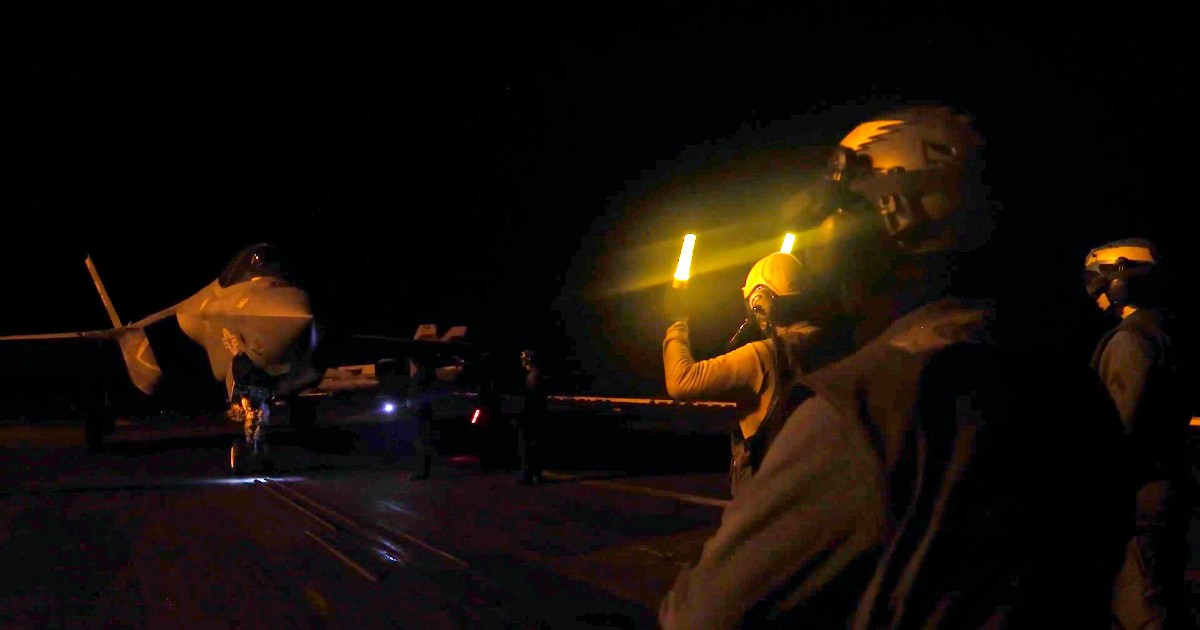
The United States military launched a fresh wave of strikes against Iranian military targets on Monday, escalating a conflict that has reached new levels of intensity following the breakdown of a ceasefire agreed upon in June.
The United States Central Command (CENTCOM) announced the successful completion of the mission at 10:15 p.m. ET on July 13, after five hours of operations. The strikes targeted locations in Bushehr, Chah Bahar, Jask, Konarak, Abu Musa, and Bandar Abbas, utilizing precision munitions against coastal defense systems, missile and drone sites, and Iran's maritime capabilities.
"CENTCOM completed the latest wave of strikes on Iran at 10:15 p.m. ET on July 13. During the five-hour mission, U.S. forces successfully hit military targets across Iran [...] to further degrade Iran's ability to threaten commercial traffic," CENTCOM stated in its release.
The attacks follow the collapse of the Memorandum of Understanding signed on June 17 and 19 in Switzerland — known as the "Islamabad Memorandum" — which had established a 60-day truce between the U.S. and Iran along with the reopening of the Strait of Hormuz and a $300 billion reconstruction fund.
The agreement unraveled after Iran attacked commercial vessels in the Strait of Hormuz between July 6 and 7. President Donald Trump declared the ceasefire over on July 8 at the NATO summit in Ankara, and on July 13 he issued a stark warning: "We are going to hit them very hard tonight and very hard tomorrow, and there's absolutely nothing they can do about it."
In retaliation, Iran launched ballistic missiles and drones against U.S. military bases in Bahrain — home to the Fifth Fleet — Jordan, Kuwait, and Oman on July 12 and 13, though some of the projectiles were intercepted by forces in those countries.
The new Iranian Supreme Leader, Mojtaba Khamenei — appointed on March 8, 2026, following the death of his father Ali Khamenei during the initial attacks of Operation Epic Fury — vowed on July 11 to avenge his father's death and ordered continued assaults on U.S. bases in the region.
The Institute for the Study of War (ISW) has described the situation as effectively ending the ceasefire, warning that the exchanges of fire in the Persian Gulf are "more intense and consistent" than during the truce. According to the ISW, "the increase in attacks and the reimposition of the blockade mark the end of the ceasefire," although the current geographic scope is smaller than the battles of March and April 2026.
The conflict began on February 28, 2026, with Operation Epic Fury, a joint U.S.-Israeli offensive that destroyed over 5,000 Iranian targets, including nuclear facilities in Natanz, Isfahan, and Fordow. Since then, the U.S. has conducted multiple rounds of bombings on Iranian territory.
CENTCOM reported that more than 50,000 American troops remain stationed in the Middle East and concluded its statement with a direct warning: "American forces remain vigilant, lethal, and ready."
Understanding the Recent U.S. Strikes on Iran
What sparked the recent U.S. attacks on Iran?
The recent U.S. strikes were prompted by Iran's attacks on commercial vessels in the Strait of Hormuz, which led to the collapse of a ceasefire agreement.
What was the "Islamabad Memorandum"?
The "Islamabad Memorandum" was a ceasefire agreement signed in June 2026, which included reopening the Strait of Hormuz and establishing a $300 billion reconstruction fund.
How has Iran responded to the U.S. strikes?
Iran retaliated by launching ballistic missiles and drones against U.S. military bases in Bahrain, Jordan, Kuwait, and Oman.