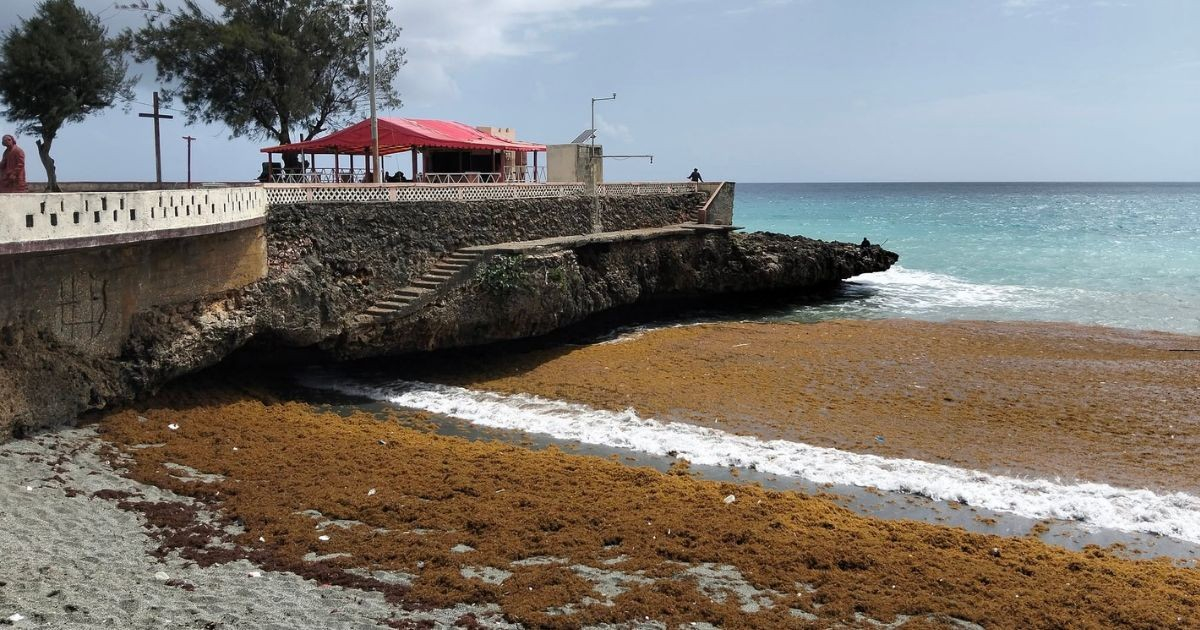
An influx of sargassum has recently engulfed the beaches of Baracoa, situated in Guantánamo province in eastern Cuba, prompting a health alert for both locals and tourists frequenting the affected coastal areas, including Playa Caribes, Pilón, and Tortuguilla.
Local sources indicate that this algae arrives in two annual waves, driven by marine currents. Contrary to some reports, the sargassum reaching the Caribbean does not originate from the Strait of Magellan, but rather from the Great Atlantic Sargassum Belt, which stretches across tropical waters from West Africa to Brazil and into the Caribbean.
The proliferation of sargassum is linked to various factors such as ocean currents, warm waters, the upwelling of nutrients, and contributions from rivers like the Amazon and Orinoco, as well as iron and phosphorus-rich Sahara dust.
The Guiana, Antilles, and Caribbean currents are responsible for pushing this macroalgae northwest towards the Cuban shores. The phenomenon typically escalates during the warmer months, and 2026 is expected to be a record-breaking season, according to scientists' predictions.
In Baracoa and other areas of Guantánamo, local authorities, along with students and faculty from the Medical Sciences field, have previously organized clean-up efforts on affected beaches. However, officials admit they are lacking the necessary technical and technological resources for effective removal and disposal of the sargassum.
This is not the first time Guantánamo has faced such a crisis. Back in June 2025, the CITMA issued a maximum alert due to the massive arrival of sargassum on the province's shores, and by May 2026, satellite data had already forecasted a critical season.
Moreover, the primary threat does not stem from the algae itself but from its decomposition. As sargassum decays, it emits hydrogen sulfide (H₂S)—notable for its rotten egg odor—and ammonia (NH₃), both toxic gases that can cause eye irritation, nausea, headaches, dizziness, and respiratory issues. In high concentrations, they may lead to neurological and cardiovascular damage.
Understanding the Sargassum Impact on Baracoa Beaches
What causes the sargassum influx in Baracoa?
The sargassum influx is primarily caused by marine currents, warm ocean waters, nutrient upwellings, river contributions from the Amazon and Orinoco, and Sahara dust, which all facilitate the algae's growth and movement towards the Cuban coast.
What are the health risks associated with decomposing sargassum?
Decomposing sargassum releases hydrogen sulfide and ammonia, which can cause symptoms such as eye irritation, nausea, headaches, dizziness, and respiratory problems. High levels of these gases can also lead to neurological and cardiovascular damage.
How are local authorities responding to the sargassum problem?
Local authorities, alongside medical science students and professors, have organized beach clean-up efforts. However, they face challenges due to a lack of adequate technical and technological resources for effective sargassum removal and disposal.