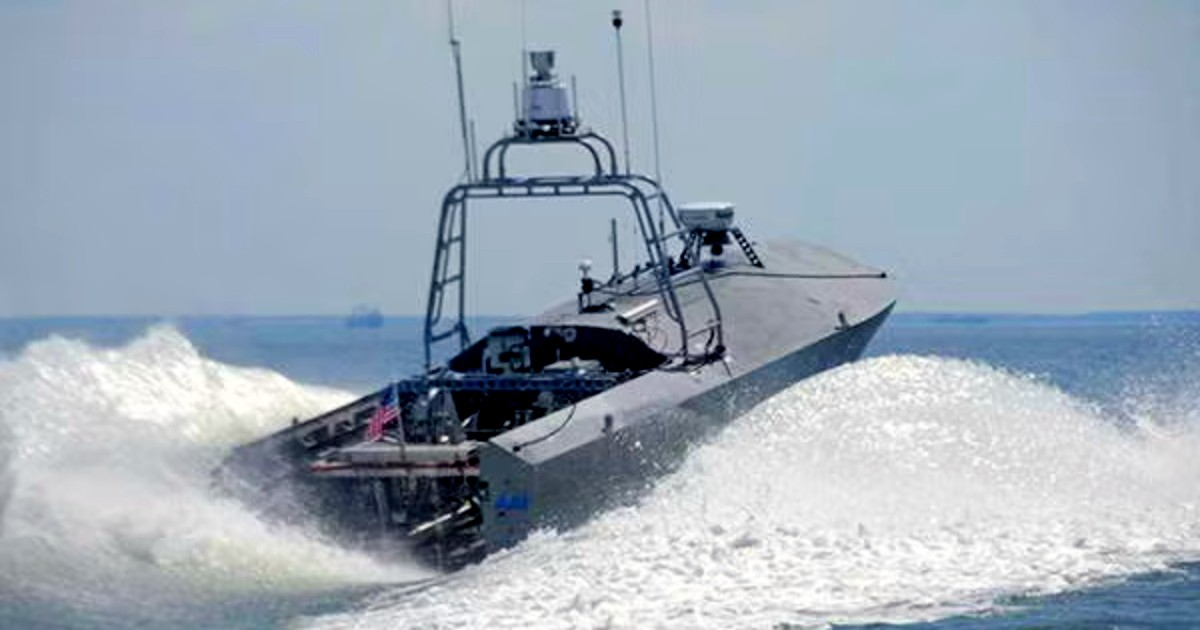
In a significant development, the United States Central Command (CENTCOM) utilized one-way maritime attack drones for the first time in combat against Iranian regime targets on Monday. This marks a pivotal moment in the evolution of unmanned naval warfare, transforming the ongoing conflict into a real-world testing ground for America's cutting-edge weapon systems.
As reported by The Jerusalem Post, CENTCOM announced that U.S. forces targeted Iranian air defense systems, coastal radar sites, missile and drone capabilities, and small vessels using a combination of fighter jets, naval ships, air-based one-way attack drones, and maritime one-way attack drones—each employed for the first time.
Although CENTCOM did not disclose the specific platforms used, it confirmed that the Sunday night operation struck numerous targets across several locations utilizing precision-guided munitions. The operation aimed to diminish Iran's capacity to disrupt international maritime traffic in the strategically crucial Strait of Hormuz.
This escalation in hostilities follows Iran's decision to attack at least three merchant ships in the Strait on July 6 and 7, including the Qatari gas tanker Al Rekayyat and the Saudi oil tanker Wedyan, violating a ceasefire established in June.
Since the offensive began on July 8, the U.S. has hit over 300 targets in three waves of attacks. The second wave destroyed more than 80 targets in southern Iran, including air defenses and over sixty Revolutionary Guard vessels.
The conflict is fast-tracking the deployment of advanced military technologies that Washington has been developing for years. In maritime operations, Task Force 59—established in 2021 under then-Vice Admiral Brad Cooper, now the head of CENTCOM—serves as the central hub for integrating unmanned surface vehicles (USVs) and artificial intelligence into naval operations.
Last June, a Corsair USV manufactured by Saronic rescued two crew members from a downed Apache helicopter in the Strait of Hormuz off the coast of Oman; these platforms are now being utilized offensively.
On land, CENTCOM has also deployed LUCAS (Low-cost Uncrewed Combat Attack System) drones, developed by SpektreWorks through reverse engineering of the Iranian Shahed-136 drone. These drones, costing approximately $35,000 each, were used in combat for the first time in February 2026.
The Pentagon's strategic shift is evident: moving away from expensive traditional cruise missiles toward affordable, disposable autonomous systems that deliver the same precision at a fraction of the cost.
Meanwhile, Qatar is attempting to mediate a de-escalation between the involved parties, as the Strait of Hormuz—through which 20% of the world's oil and liquefied natural gas pass—remains a key flashpoint.
Analysts suggest that the combination of the land-based Task Force Scorpion Strike and the sea-based Task Force 59 is aimed at building a regional drone strike network in one of the most contested areas on the planet.
Key Developments in U.S.-Iran Maritime Conflict
What significance does the use of maritime attack drones hold?
The deployment of one-way maritime attack drones marks a critical advancement in unmanned naval warfare, serving as a real-world test case for new U.S. weapon systems.
What has been the response to Iranian attacks on merchant ships?
In response to Iranian attacks on merchant vessels in the Strait of Hormuz, the U.S. has conducted three waves of strikes, targeting over 300 sites, including missile capabilities and Revolutionary Guard vessels.
How is the U.S. modernizing its military strategy in the region?
The U.S. is shifting towards the use of affordable, autonomous systems such as USVs and LUCAS drones, moving away from costly traditional weaponry while maintaining precision.