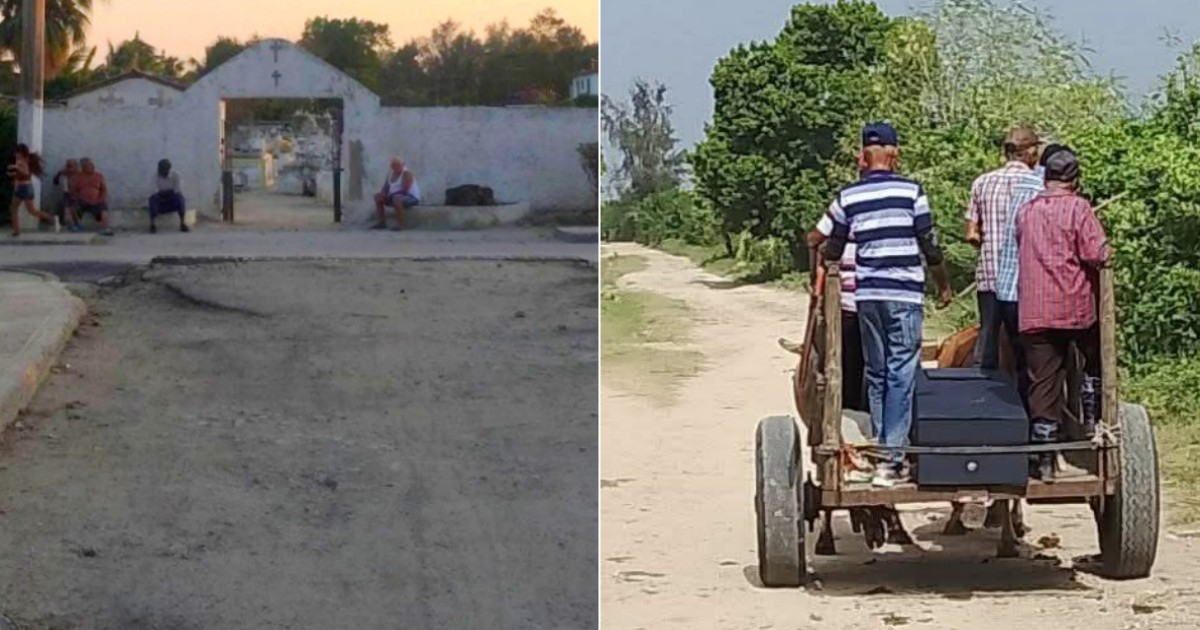
In the rural community of Cayo Cedro, located in the municipality of Cacocum in Holguín province, a deceased resident was transported to the cemetery using oxen last Saturday. The unusual procession occurred because funeral services couldn't operate a vehicle due to a lack of fuel, as reported in a public complaint on Facebook.
Nelson Alejandro Salazar brought attention to the incident when he witnessed the scene upon returning to his neighborhood. His account was shared by Irma Lidia Broek under the title "A Real Testimony: The Grim Reality of Cayo Cedro, Cacocum," which sparked outrage on social media.
"Losing a loved one is already painful; having to do it under these circumstances is inhumane," the activist expressed in her post, also questioning, "Where have our values and principles gone?"
This incident is not isolated. Just three days earlier, a funeral procession involving a casket transported by a tricycle was captured and shared by a Cuban waiting in a gasoline line, resonating across Cuba and going viral online.
Widespread Funeral Service Challenges
The pattern is evident across several provinces. In Bayamo, Granma province, horse-drawn carts are used due to gasoline shortages. In July 2024, Santiago de Cuba witnessed the transportation of two deceased individuals using a dump truck due to the lack of funeral vehicles.
By February 2025 in Ciego de Ávila, only eight out of 19 funeral cars were operational. Meanwhile, in Camagüey, the entire city relied on a single working vehicle.
Holguín's Struggle Amid Energy Crisis
The situation in Holguín is particularly dire. The province has endured power outages lasting up to 18 hours daily since 2025. In areas like Velasco, families have resorted to crafting makeshift coffins due to the state's inability to provide materials. Reports from February 2026 indicated the use of cardboard coffins due to a wood shortage.
The collapse of funeral services is a direct result of the island's ongoing energy crisis. Since December 2025, Cuba has not received regular oil shipments, resulting in a deficit of approximately 60,000 barrels daily against a demand of 100,000. By June 2026, the price of gasoline on the informal market soared to between 3,500 and 8,000 Cuban pesos per liter, and only three gas stations were operational in Havana, with wait times reaching up to 15 hours.
Cuban Minister Vicente de la O Levy acknowledged in October 2025 that the fuel supply "does not last the entire month" and that reserves are only available for "a few days."
Government's Limited Response
The regime's only response has been the deployment of approximately 15 electric funeral vehicles in Havana, serving 90% of the capital's funerals. Rural areas like Cayo Cedro remain entirely excluded from this solution.
In February 2026, Santiago de Cuba officially introduced animal-drawn funeral cars as a response to the crisis, signaling that this regression has become state policy.
The complaint regarding the Cacocum incident encapsulates the exhaustion of a community: "The scarcity of food, medicine, and basic resources is extinguishing life and youth in Cuba's countryside."
Understanding Cuba's Funeral Service Crisis
What caused the funeral procession in Holguín to use oxen?
The funeral procession in Holguín used oxen because there was no fuel available to operate a vehicle, highlighting the severe shortages impacting funeral services.
How has the fuel shortage affected funeral services in Cuba?
The fuel shortage has led to the use of unconventional and often inadequate means of transportation, such as oxen and horse-drawn carts, for funeral processions in various Cuban provinces.