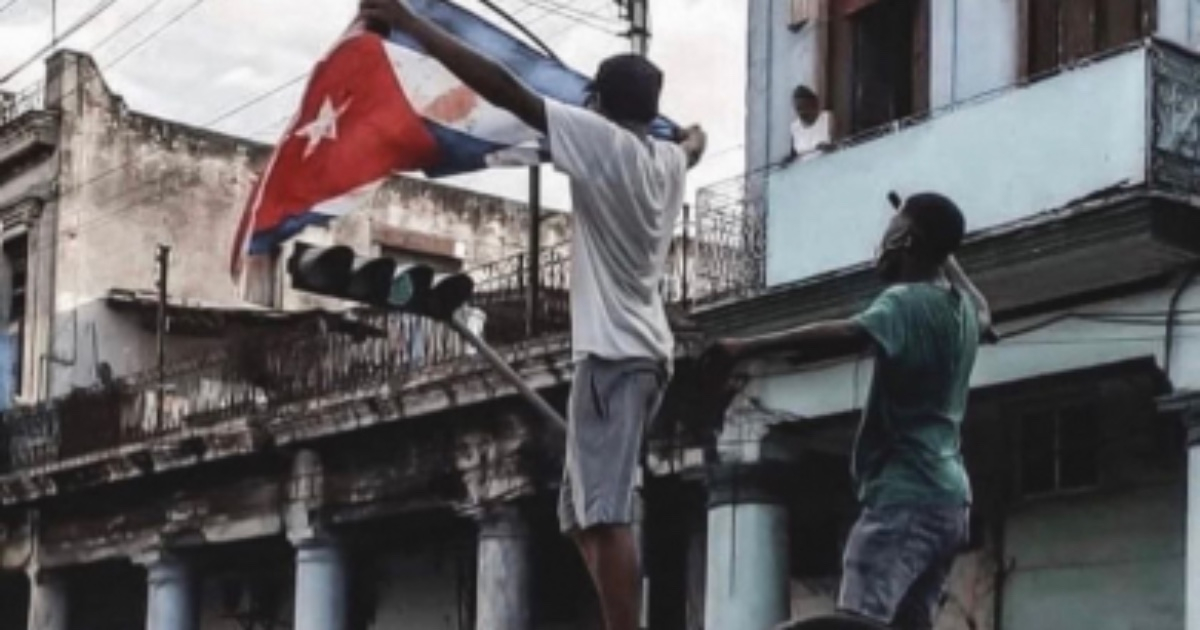
Marking the fifth anniversary of the July 11, 2021, social upheaval, sociologist Cecilia Bobes shared her insights in Rialta on the lasting impact of these protests in Cuba. Her analysis goes beyond the usual speculation about the likelihood of similar future events.
Bobes, who holds a doctorate in Sociology from El Colegio de México and serves as a research professor at the Facultad Latinoamericana de Ciencias Sociales (FLACSO), argues that the most significant consequence of the July 11th protests was not in numbers but in quality. "The main legacy of July 11th is linked to the transformation of the conditions under which protest is conceivable, feasible, and socially legitimate in contemporary Cuba," she writes, echoing the themes of her book, Protests in Cuba: Beyond July 11th.
The Shifting Dynamics of Protest in Cuba
Bobes describes July 11th as the most crucial instance of social mobilization in Cuba since 1959, where thousands took to the streets across numerous locations, driven by power outages, food and medicine shortages, and accumulated daily grievances. What set that day apart was the sheer number of participants, the geographic spread, and the socially diverse nature of the demonstrations. It was not a coordinated effort by activists but a spontaneous eruption involving ordinary citizens nationwide.
One of the most profound shifts post-July 11th, according to Bobes, is the change in the leading actors of protest. "After July 2021, the notable change is that the leading role moved from activists to the ordinary citizens," she observes. Now, those marching include women, neighbors, families, young people, retirees, and workers who previously might not have seen themselves as part of collective action.
Patterns and Peaks of Social Unrest
The sociologist has tracked a pattern of protest activity that, while inconsistent, shows an upward trend: 102 protest events in 2021, 177 in 2022, a sharp decline to 40 in 2023—largely due to repression, exhaustion, and mass emigration—followed by a rebound to 121 in 2024, a dip to 82 in 2025, and an unprecedented surge in 2026, with approximately 380 events recorded by the article's date, a number Bobes cautions is likely underreported.
Protests in 2026 have included high-intensity incidents. In March, demonstrators in Morón, Ciego de Ávila, took their grievances to the Communist Party headquarters in one of the most violent episodes documented. In Havana's Regla, Guanabo, La Lisa, and San Miguel del Padrón neighborhoods, cacerolazos, barricades, and bonfires have been recurring. Bobes interprets these actions as signs of eroding institutional mediation and a growing sentiment that there are no effective channels to address demands.
Political Evolution of Protest Demands
An essential aspect of Bobes' analysis is the increasing politicization of demands. Protests that start over electricity, water, or food issues quickly become accompanied by chants of "Freedom," "Homeland and Life," "Down with Díaz-Canel," or "We are not afraid." Bobes highlights an observation that directly challenges the regime's narrative: "Not a single protest has called for the lifting of the blockade or directed demands against the U.S. government. Instead, demands overwhelmingly target national authorities."
This escalating protest environment coexists with ongoing repression. According to Justicia 11J, 338 individuals remain imprisoned for their roles in the 2021 protests and were explicitly excluded from the April 2026 pardon that released 2,010 inmates. As of June 2026, Prisoners Defenders reports a historic high of 1,306 political prisoners in Cuba.
Bobes also examines the factors hindering a new protest wave of July 11th's magnitude: exemplary repression, mass emigration depleting young populations, and the regime's threat of foreign intervention as a unifying argument. She describes the current situation as "exclusive governance," a crisis management strategy with minimal inclusion of autonomous social actors and limited institutional mediation capacities.
"This transformation doesn’t guarantee sustained organization, political openness, or democratic transition. However, it indicates a shift in the social experience of dissent. This change might seem intangible, but it is likely one of the most significant social transformations in Cuba since 1959," Bobes concludes.
Understanding the Legacy of the July 11th Protests in Cuba
What was the main impact of the July 11th protests according to Cecilia Bobes?
Cecilia Bobes argues that the main impact was qualitative, leading to a transformation in how protests are perceived, imagined, and legitimized in Cuba, rather than simply quantitative measures like the number of participants.
How have the dynamics of protest changed in Cuba since July 11th?
Post-July 11th, the leading role in protests shifted from organized activists to ordinary citizens, such as women, families, and workers, who now feel more compelled to participate in collective actions.
What are some of the factors preventing another large-scale protest like July 11th?
Factors include severe repression, mass emigration of young people, and the regime's use of external intervention threats as a means to maintain control and cohesion.