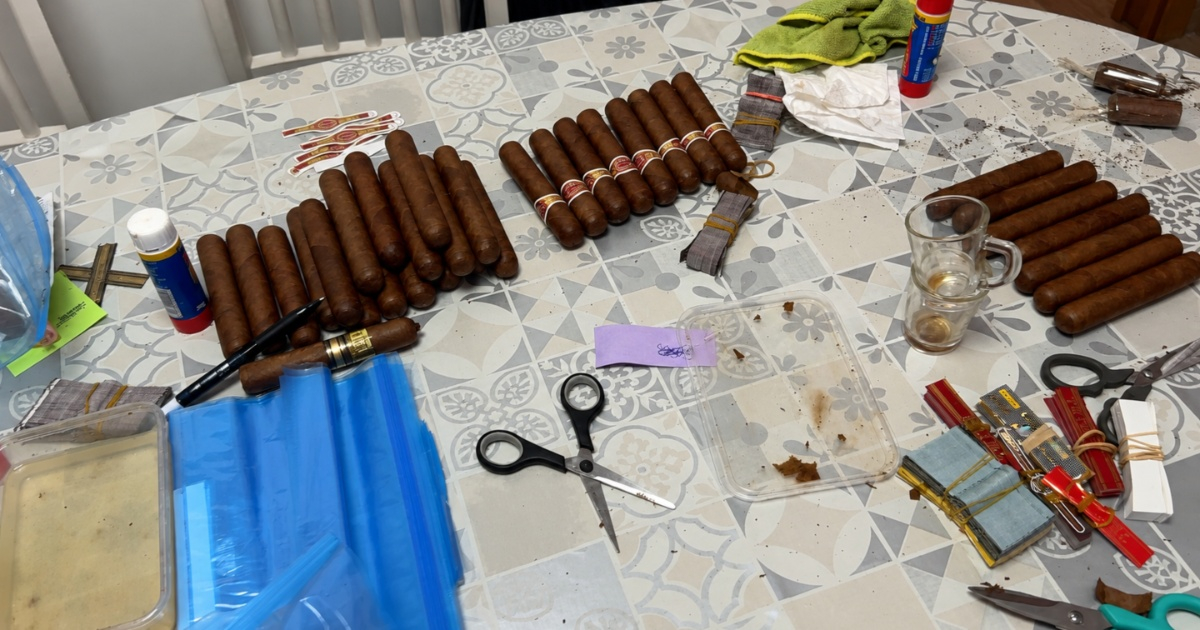
On Saturday, the Spanish Civil Guard dismantled an illegal operation involved in the production and distribution of counterfeit Cuban cigars. This clandestine workshop was discovered in a residence in Mislata, a town in Valencia province, as reported in the official statement regarding the seized counterfeit cigars.
The operation was spearheaded by Valencia's Fiscal and Border Analysis and Investigation Unit (UDAIFF), leading to the arrest of three individuals and the investigation of four others linked to a criminal network distributing fake products across Europe.
A total of 33,840 counterfeit cigars were confiscated, with 27,852 found stored in the residence itself and another 6,258 ready for international shipment.
In addition to the cigars, authorities seized 637,646 fake cigar bands—those branded rings identifying cigars—from various commercial brands, including Cohiba and Punch. They also discovered equipment used for manufacturing and packaging these counterfeit cigars.
The network's strategy involved producing low-quality cigars and adorning them with phony bands, boxes, and seals of premium Cuban brands to falsely market them as genuine Cuban cigars within the European market. In this market, a box of 25 fake "Churchill" cigars can sell for between 300 and 400 euros.
The investigation began when authorities noticed a suspicious pattern: shipments of cigars with various commercial names consistently sent from the same Mislata residence to different countries across the continent.
The occupants of the property lacked the required licenses to legally conduct such business activities.
Those arrested are facing charges of smuggling, industrial property violations, involvement in a criminal organization, and labor rights infringements.
The case has been forwarded to the Court of First Instance and Instruction in Llíria, Valencia.
This incident is not isolated. In November 2025, Cuban Customs detected over 26,000 fake cigar seals sent from the United States, and in March 2026, an attempt to smuggle more than 370 boxes of counterfeit cigars from Havana was thwarted.
Spain represents the primary European market for Habanos S.A., receiving around 35% of Cuba's official tobacco exports, making it a prime target for counterfeiting networks.
It is estimated that nearly 7 million counterfeit cigars are sold annually worldwide, accounting for up to 20% of the market in some European countries.
Understanding the Impact of Counterfeit Cigars
Why is Spain a significant market for counterfeit cigars?
Spain is a major destination for counterfeit cigars due to its role as the primary European market for Habanos S.A., receiving about 35% of official Cuban tobacco exports. This makes it attractive to counterfeit networks looking to exploit the high demand for premium Cuban cigars.
How do counterfeit cigars affect the market?
Counterfeit cigars can significantly impact the market by undermining consumer confidence and damaging the reputation of genuine brands. They represent up to 20% of the cigar market in some European countries, affecting sales and pricing of authentic products.