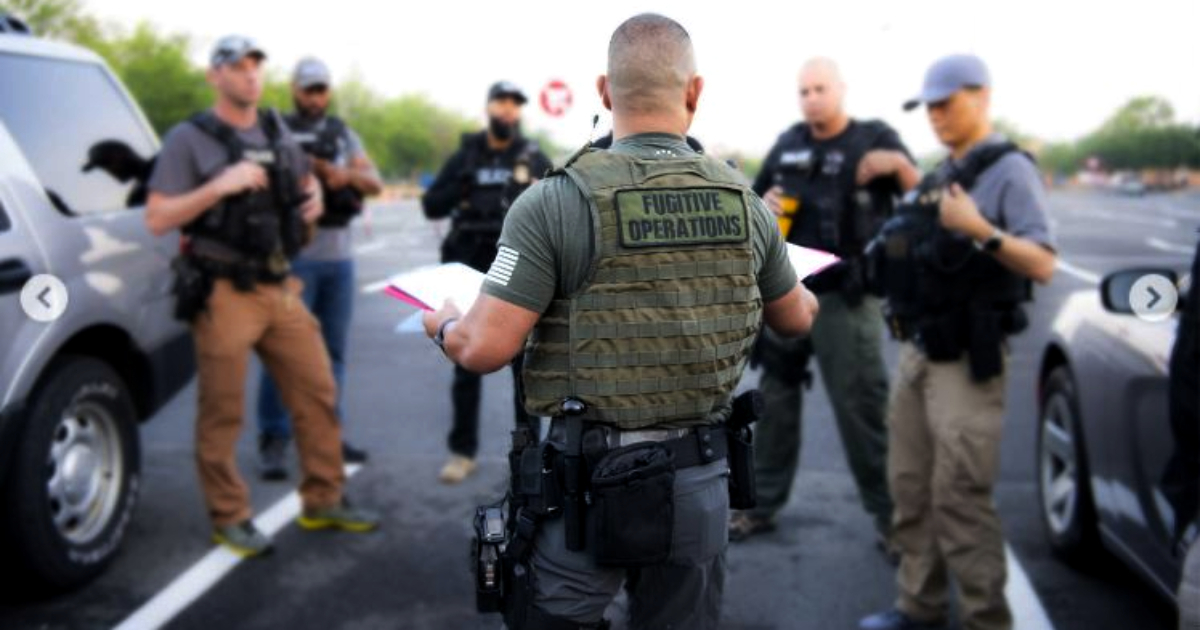
The U.S. Immigration and Customs Enforcement (ICE) highlighted its involvement as a federal partner in Operation Hurricane, a 60-day crackdown resulting in charges against 46 individuals and the seizure of 94 firearms in Palm Beach County, Florida.
ICE's official X account announced that the Miami division of its Homeland Security Investigations (HSI) played a significant role in the operation, collaborating as part of the Homeland Security Task Force.
The operation's outcomes were revealed on Thursday, July 10, in Broward County, where HSI Miami Special Agent in Charge Jose R. Figueroa joined forces with representatives from the Department of Justice (DOJ), the Bureau of Alcohol, Tobacco, Firearms and Explosives (ATF), the Drug Enforcement Administration (DEA), and local authorities from Palm Beach County.
According to the DOJ, the operation, spearheaded by the ATF Miami Division, targeted gun traffickers, drug dealers, violent offenders, and members of transnational criminal organizations through 123 undercover operations supported by 173 operational plans.
In addition to the 94 firearms, authorities confiscated over seven kilograms of cocaine, approximately 1.5 kilograms of crack, more than 400 grams of fentanyl, thousands of methamphetamine pills, and quantities of heroin.
Jason Reding Quiñones, the U.S. Attorney for the Southern District of Florida, emphasized the severity of the fentanyl seizure: "400 grams of fentanyl can kill 200,000 people. That’s more than the population of the city of West Palm Beach. This drug is incredibly dangerous."
Of the 46 individuals charged—41 at the federal level and five at the state level—26 had multiple prior convictions for serious offenses, many related to violent crimes and drug trafficking. At the time of the announcement, five suspects remained at large.
A significant breakthrough of the operation was solving a murder case. On May 9, 2026, a man was fatally shot in the 505 15th Street area in West Palm Beach after 16 gunshots were detected by the ShotSpotter system.
During Operation Hurricane, an undercover ATF agent purchased a firearm that was linked via the NIBIN ballistic database to shell casings found at the crime scene.
This connection led to the arrest of Jarvis Williams, 31, who is now facing charges of second-degree murder with a firearm and possession of a weapon by a felon.
Assistant Attorney General Colin McDonald, who led the press conference, issued a stern warning to those operating outside the law in the region: "If you illegally traffic guns, sell deadly drugs, engage in violence, or prepare to do so in South Florida, the Homeland Security Task Force and its partners will find you."
Operation Hurricane marks the second such initiative by the ATF Miami Division in South Florida under the Homeland Security Task Force, established by an executive order from President Trump.
The first, Operation Showdown, took place in 2025 in Miami-Dade and Broward, resulting in 31 arrests and 80 weapons seized. Authorities indicated that they plan to continue rotating geographically toward northern counties in Florida.
Key Insights into Operation Hurricane
What was the primary objective of Operation Hurricane?
Operation Hurricane aimed to target gun traffickers, drug dealers, violent criminals, and members of transnational criminal organizations through undercover operations.
How many firearms were seized during the operation?
A total of 94 firearms were seized during Operation Hurricane in South Florida.
Who were the partners involved in Operation Hurricane?
The operation included partners from ICE's Homeland Security Investigations, the Department of Justice, the ATF, the DEA, and local authorities from Palm Beach County.