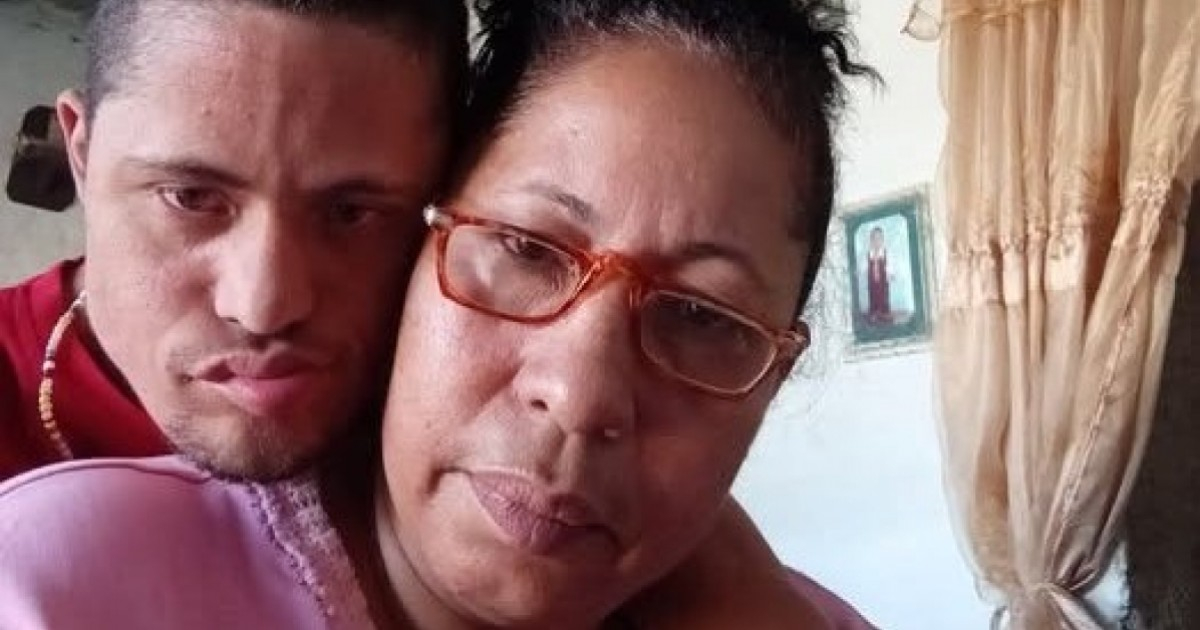
Arisleydis Hernández, a 55-year-old resident of Placetas in Villa Clara, made a heart-wrenching appeal on Facebook to the International Red Cross, human rights organizations, and the "World," spotlighting the Cuban government's complete neglect of her and her 32-year-old son, who has Down syndrome and multiple serious health conditions.
"Here in Cuba, those who are supposed to listen turn a deaf ear when it's convenient," Arisleydis expressed. Her situation has become emblematic of the crumbling social safety net in Cuba.
The young man's medical condition is dire: he suffers from heart disease with a "hollow heart," asthma, has only one functioning lung and kidney, epilepsy, and a bleeding ulcer that can cause him to vomit blood at any moment.
Insufficient Government Aid
The regime provides her with a monthly social assistance of 2,900 pesos, which is even lower than the official minimum pension, increased to 3,056 pesos in September 2025. Experts argue that this amount should be at least 10,000 pesos just to cover basic food needs.
"To this government, I'm just a social welfare recipient who must survive on a pitiful 2,900 pesos to support myself and my son. Please... without electricity, with skyrocketing prices," she lamented.
A Cry for Help
Arisleydis herself suffers from epilepsy, among other illnesses, confining her to her home. Despite her family's "vulnerable" status, her social worker has never visited. Calls to the social workers' office, the local government, and the Party in Placetas go unanswered.
"Please, world! Hear the muffled cry of a mother and don't turn away," Arisleydis pleaded. Her closing words resonate beyond her personal story: "It's not just my cry; it's the cry of a nation in agony."
Endless Struggles
This isn't the first time Arisleydis has raised her voice. In June, her complaint about enduring more than 63 consecutive hours without electricity struck a chord with many Cubans: without power, her son can't blend his food or sleep.
She also rejected the official narrative blaming the embargo for these issues: "And then 'resist,' because everything is the 'blockade's' fault. Please, no more nonsense."
Her latest post comes during Cuba's worst energy crisis. The island experienced its fourth nationwide blackout of the year on July 10, with a record shortfall of 2,341 MW on July 8, against a demand of 3,100 MW.
In March, the regime admitted the budget is "not extensive" and unable to support all vulnerable individuals. In response to the collapse, the government announced in June that both private and state enterprises would be required to fund the social assistance system, acknowledging the state's inability to maintain it.
A Broader Crisis
Arisleydis's case is not unique. In April, families of six children in Pinar del Río, reliant on electricity for nourishment or breathing, pleaded for portable power stations.
In January, a campaign sought generators for three severely ill girls, including a two-year-old with spinal muscular atrophy who depended on a permanent mechanical respirator.
Understanding Cuba's Social Crisis
What is the main issue Arisleydis Hernández is facing?
Arisleydis Hernández is struggling with the Cuban government's neglect, receiving insufficient social aid to support herself and her seriously ill son.
How has the government responded to the social assistance crisis?
The Cuban government acknowledged its budget limitations and announced that private and state enterprises would need to help finance the social assistance system.
What are the living conditions like for Arisleydis and her son?
They endure severe living conditions with frequent power outages and an inadequate monthly aid of 2,900 pesos, which does not cover basic needs.
Why is Arisleydis's case significant?
Her case highlights the broader failure of Cuba's social protection system and the government's inability to support vulnerable populations effectively.