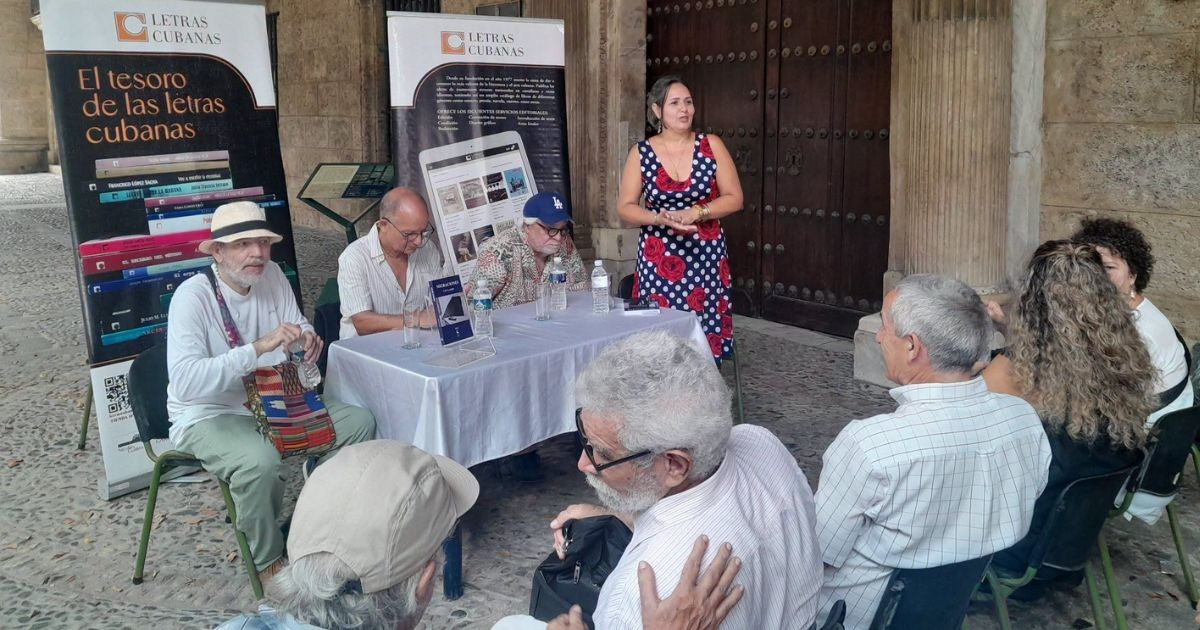
On the fifth anniversary of the July 11, 2021 protests, the Cuban Book Institute chose to unveil the poetry collection titled "Migrations" by poet Luis Lorente at the Plaza de Armas in Old Havana. The timing and title of the book seem to hold a significant, albeit perhaps unintended, symbolism.
This event was part of the "Saturday Book" series, a cultural gathering regularly held by the ICL on the Calle de Madera in the historic center of Havana. The event itself did not explicitly carry any political undertones.
The panel featured writers Arturo Arango and Israel Domínguez, and was led by Yanelis González, director of the Letras Cubanas publishing house, alongside the poet himself. Attendees included ICL President Juan Rodríguez Cabrera, renowned editors Norberto Codina and Alex Pausides, as well as authors Charo Guerra and Leyla Leiva.
The ICL described the event as "a cloudy morning in the humid Plaza de Armas of Havana's historic center where poetry brought the clarity of the absent sun." Luis Lorente, a pivotal figure in contemporary Cuban poetry, hails from Cárdenas and has been awarded the David Prize for Poetry and the Casa de las Américas Prize in 2004 and 2021.
Comprising nearly 100 poems over almost 300 pages, the book was published by Letras Cubanas, a publishing house established in 1977, set to celebrate its 50th anniversary on January 1, 2027. In March, the state-run Granma reported that the director of Letras Cubanas portrayed the collection as "the novel of Luis's life through poetry."
The timing of the book's release sparked discussions online due to its symbolic date: July 11, 2021, marked the largest anti-government protests in Cuba since 1959, with thousands demanding freedom and shouting "Patria y Vida!" and "Down with the dictatorship!" across more than 80 locations.
The regime's retaliation was harsh: a protester named Diubis Laurencio Tejeda was fatally shot in La Güinera, and many others were injured by government forces. Over 1,400 people were arrested, and hundreds were sentenced to prison.
Five years later, 338 individuals remain incarcerated due to 11J-related charges, and Cuba reports over 1,260 political prisoners, according to the organization Prisoners Defenders.
The title "Migrations" resonates powerfully amid this backdrop: since 2021, more than a million Cubans have fled the island in the largest exodus in its history, reducing the population from 11.3 million to an estimated 8.6 to 8.8 million, according to independent research.
By 2025, Cubans surpassed Venezuelans in asylum requests in Brazil for the first time, with nearly 42,000 applications, highlighting the extent of the human displacement partly triggered by 11J.
It is ironic that a state-run Cuban institution presented a book titled "Migrations" on the anniversary of protests that largely accelerated this unprecedented exodus. Whether this was a deliberate choice or merely a coincidence of the "Saturday Book" calendar remains uncertain.
While the ICL held its literary event in Old Havana, the Cuban Freedom March organization called for a demonstration in Miami under the banner "Actions, not words," to commemorate the 11J anniversary and envision a future Cuba free from the pressures of forced "migrations."
Understanding the Symbolism of "Migrations" on 11J
Why is the release of "Migrations" on July 11 significant?
The release of "Migrations" on July 11 is symbolically significant because it coincides with the fifth anniversary of the 11J protests, the largest anti-government demonstrations in Cuba since 1959. The title reflects the mass exodus of Cubans that followed these events.
What was the impact of the 11J protests?
The 11J protests led to widespread crackdowns by the Cuban government, resulting in arrests, injuries, and ongoing political imprisonment. They also sparked a significant migration wave, with over a million Cubans leaving the island since 2021.
How has the Cuban population changed since the 11J protests?
Since the 11J protests, Cuba has experienced a massive exodus, reducing its population from 11.3 million to an estimated 8.6 to 8.8 million as over a million Cubans have fled the country.