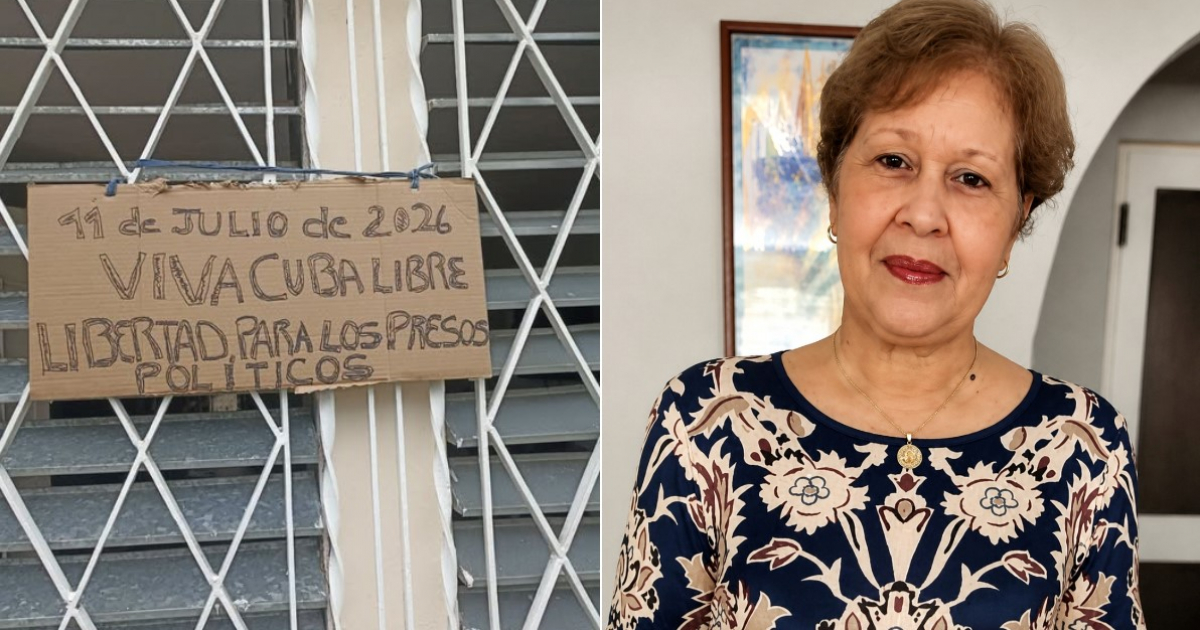
Philosopher and historian Alina Bárbara López Hernández marked the fifth anniversary of July 11, 2021, by posting a message on Facebook from her house arrest in Matanzas. In her statement, she labeled Miguel Díaz-Canel's regime as a "terrorist state against its own people" and called for the release of Cuban political prisoners.
Accompanying her message, the activist posted an image of a handmade sign hanging on her window grille, proclaiming, "July 11, 2026 / Viva Cuba Libre / Freedom for political prisoners."
The Impact of the 11J Protests
López Hernández described the social uprising of 11J as a turning point in Cuba's recent history, affecting individuals and families deeply. Despite being under house arrest for over a year, she has not yet faced trial.
In her post, she drew a direct line between the power transition from Fidel Castro to Raúl Castro, which she characterized as "markedly anti-popular," and the oppressive crackdown in the summer of 2021, when the regime "shed its last disguise."
Escalating Repression and Public Dissent
Five years after the protests, López Hernández was blunt: "Repression has only intensified, responding to the ongoing protests of a citizenry that feels exploited and abandoned. The demands now extend beyond basic needs like food, medicine, electricity, or water, to freedom and rights."
She mocked the regime's annual security measures surrounding July 11: "It's absurd how the Cuban government tries to prevent another 11J uprising while failing to stop its own continuous decline towards disaster..."
Additionally, she pointed out that Cuba's wars of independence began in different months—October and February—highlighting the futility of the government's obsession with monitoring a single date: "When people decide to claim their freedom and dignity, any date will do..."
Calls for Justice and Liberation
The professor emphasized that over these five years, Cuban prisons have filled with unjustly punished citizens, demanding their immediate release. "Their cause for freedom should guide our social struggles. Today it's them; tomorrow it could be any of us or our children," she stressed.
Alina Bárbara has been under house arrest since June 18, 2024, accused of "assault" alongside sociologist Jenny Pantoja Torres. The prosecution seeks a four-year prison sentence. Her trial, initially scheduled for January 30, was indefinitely postponed by Judge Ysenia Rodríguez Vázquez without a new date.
Despite restrictions, she was detained for almost ten hours in April and again in June while attempting her peaceful monthly protests at Matanzas' Liberty Park.
Worsening Political Climate
Her message comes amid an unprecedented crackdown. According to Prisoners Defenders, Cuba reached a historic high of 1,306 political prisoners by the end of June, including 40 minors, with 16 held in adult prisons. Of these, 338 individuals remain imprisoned for their involvement in the 11J 2021 protests.
The anniversary also coincides with the forced disappearance of artist Luis Manuel Otero Alcántara, who was removed from Guanajay prison on July 7 without notifying his family. This prompted the UN Committee on Enforced Disappearances to initiate an Urgent Action, giving Cuba until July 25 to provide answers.
Understanding 11J Protests and Cuban Repression
What was the significance of the 11J protests in Cuba?
The 11J protests marked a pivotal moment in Cuba's recent history, signaling widespread public dissent against the government and demanding freedom and rights beyond basic necessities.
How has the Cuban government responded to the protests?
The Cuban government has escalated repression, with increased detentions and crackdowns on dissent, filling prisons with political prisoners and intensifying security measures to prevent further uprisings.
What actions have international organizations taken regarding Cuba's political prisoners?
International organizations, like the UN Committee on Enforced Disappearances, have initiated urgent actions and demanded explanations from Cuba concerning the treatment and whereabouts of political prisoners.